
Why I hate meritocracy.
How the "Marketplace of Ideas" Destroys Civilization.

Politics are downstream from personality. The political compass is an astrological chart. You can make, with a high degree of success, predictions about personality traits from someone’s political opinions.
If someone supports a moratorium on immigration, you can reasonably assume that person is low in openness. If someone supports lowering the age of consent to 14, you can assume that person is higher in openness, but probably is also low in agreeableness, because that is a fairly controversial position.
My personality bleeds into my writing. People say, “you write like a right-winger.” Not a conservative — I’m too wacky for that. But the emotional structure of my writing, the personality framework in which I operate, is harsh, unforgiving, cutting, cynical, and brutal. I lack the sacralization of Christianity and Trump of the conservatives; I lack the sacralization of the poor people of color of the liberals.
I am “dispositionally nihilistic,” in being skeptical of the two poles, MAGA and Mamdani. The “deep” in “deep left” refers to the deep state, the unelected academic professorial bureaucracy. The “left” in “deep left” refers to the scientific revolution as the foundation of western civilization, originating in the Platonic dialogue. You can call this elitist classical liberalism, but it would be a mistake to call it “libertarianism.”
While the term “classical liberal” is appropriate for my purposes, the term “libertarian” associates me with atheists and cultural relativists who believe that engineers are more important than artists. Unlike the EHC libertarians, I do not believe in meritocracy, or the “marketplace of ideas.” Instead, I believe in a deep state, and a “liberal theocracy,” modeled on the Platonic Republic.
the problem of “POLITICAL NIHILISM”
It is common for Christians (and increasingly, certain liberals) to complain about our “uniquely nihilistic and hedonistic pornogrified society, which believes in nothing.” While this seems true on the surface, the truth is exactly inverted. Our society, in historical terms, is uniquely ideologically obsessed, fanatical, sexless, castrated, and puritanical. The fish fail to feel the water on their scales, because they have no knowledge of history.
Between FDR and Trump, no other presidents have had such loyal bases of support from within their own party. Reagan and Nixon had popular support, but they were “movement conservatives” who conformed to the party and united its factions with moderation and appeasement. They did not launch a “scorched Earth” campaign of “Trump or bust,” threatening to go third party if they lost their primary.
Similarly, JFK is remembered as a popular president now, but he was actually vociferiously opposed by a large contigent of Southern Democrats who viewed his racial policies as treasonous. In order to find a president with a cult-like following with the size and intensity of Trump’s, we need to go back over 80 years to FDR.
Before Pearl Harbor, FDR had difficulty convincing Americans to defend Britain. Trump, by contrast, can flip 90% of his base into supporting a potentially economically disastrous war with Iran without any justification at all. That is the power of belief at work, not self-interested nihilistic, hedonistic pragmatism.
The power of belief that the average Republican puts in Trump is unparalleled in the last four generations of politics. To call this “nihilism” requires some playful semantic games, where belief itself is redefined as “nihilistic.” You can make fun of MAGA, call them dumb, point out the splits in the coalition, and I do all of that and more. But I will not deny the fact that they demonstrate their power of sincere belief, even if it is only brief, and will die with Trump.
Turning to the left: what is wokism, if not “true belief” run wild? In a traditional society, like the Catholicism of 16th century Italy, belief exists only as a superficial veneer, a polite fiction. Popes are fucking prostitutes, backstabbing and poisoning their opposition, and everyone is well aware, and only pretends to look the other way. The term “Machiavellian” comes out of this era, although it is unfair to our friend Niccolo, since he protested against this faithless behavior and praised the Germans for demonstrating “true piety.”
A sufficiently conservative, traditional, or authoritarian society is one in which infidelity runs rampant, abortions are administered by priests,1 and the rate of violence makes Detroit look like a Montessori kindergarten. Once an authority structure is sufficiently entrenched, it runs on the fumes of formalized inertia, and has no more need for “true belief.”
Wokeness is the exact opposite. Rather than appealing to the stars and stripes, or the church, or the military, it fights, subverts, and undermines all institutions, even cannibalizing itself in the process. You would expect a self-interested, pragmatic wokeness to attack everything except the universities. But instead, it is the liberal college professor who is placed under the greatest microscope of scrutiny.
Wokeness is not, as Rob Henderson claims, a set of empty virtue signals meant to demonstrate wealth and privilege. Wokeness has more in common with a revolutionary religious movement which seeks to deconstruct society and usher in a new utopia.
Taken together, MAGA and wokeness represent an excess of belief, a poverty of cynicism, too much faith, and not enough pragmatism. But why?
This is where the argument becomes more complicated, and folds onto itself. If MAGA and wokeness represent a “Second Religiousness,” a brief flash, a resurgence of true belief in a perverted form, then why now? What are they reacting too, if not a deeper form of nihilism, lurking underneath?
That nihilism is none other than atheistic “meritocratic” libertarianism, with its hollow conception of the “marketplace of ideas.”
Sympathy for the Devil
I am a dispostitional libertarian, meaning that I tend not to care about those worse off than me; I have a very low disgust reaction; and I highly value my own personal freedom. This means that I offend conservatives and have no time for their shibboleths, but I also find the outrage-porn of the left to be superficial and hysterical.
My dispositional libertarianism means that I end up sharing the emotional biases of real libertarians, like Bryan Caplan. Caplan and I have similar personality traits; on an intuitive or pre-rational level, we share similar biases about human beings and the world. His instinct, when looking at the institution of education, is to investigate the inventives, discover their teleology, and propose a market solution to resolve their inefficiencies.
Although I am sympathetic to Caplan’s approach in the domain of economics, because it appeals to me personally, it is entirely wrong in the domain of politics.
While I am referencing Caplan here as a “kicking off” point for the rest of my essay, and I will indirectly address some of his points throughout, first I need to set the stage and explain some of the broad misconceptions surrounding my philosophy.
WHY I HATE MERITOCRACY
Meeting up with people in real life who read my blog has been a wonderful, disturbing, heartbreaking, and encouraging experience. On the one hand, there has been an outpouring of love and interest in what I have to say, which is always shocking to me.2 On the other hand, one the most problematic impressions I encounter, again and again, is the conflation of my philosophy with that of “elite human capital” libertarianism.
I have already written several articles Against Elite Human Capital and Against IQ Maximalism and Total Nerd Death, but that is not enough. Branding is a function of consistency. If people are consistently misinterpreting my message, that’s not their fault for not reading enough of my articles. That’s my fault for not being consistent enough.
The misinterpretation has six or so components: (1.) markets, (2.) open borders, (3.) atheism, (4.) Nietzscheanism, (5.) IQ supremacy, and (6.) transhumanism.
MARKETS: The flight of smart people from the right to the left is accelerated by Trump, but represents a larger long-term trend. Republicans will get dumber and more socialistic, while Democrats will get smarter and pro-market.
OPEN BORDERS: Even if Somalis abuse welfare, cause cultural friction, or burden social services, what truly matters for innovation is increasing the absolute number of smart people, even if the average IQ decreases.
ATHEISM: Only idiots would worship an imaginary God; socialistic “slave morality” is for the weak. With intelligence, primitive emotions can be overcome, along with superstition, conspiracy theories, sexual jealousy, sexual repression, the desire for the divine, and the need for imaginary heroes and myths. Intelligent people prefer statistics over anecdotal stories.
“NIETZCHEANISM”: Old-fashioned norms like monogamy or homophobia are of the masses. For “elite human capital,” everything is permitted. Intelligence allows you to see “behind the curtain” of sexual, moral, or religious taboos, to freely actualize your individual desires.
IQ SUPREMACY: Israelis are smarter than Palestinians, so Zionism is good. Americans are smarter than Iranians, so Iran is bad. Urbanites are smarter than ruralites, so the urbanite is superior. Nerds are smarter than jocks, so ideally, we would castrate all men and usher in an enlightened eugenic state based on cloning and IVF, with artificial wombs.
TRANSHUMANISM: There is no need in the 21st century for men with muscles; those are a useless “virtue signal” based on an evolutionary environment which no longer exists. The body mattered in the ancient past, but now, all that matters is the mind. Eventually, technology will allow us to exist as brains in a vat, or upload our brains to the computer. We can live forever, and explore space, unencumbered by ancient instincts or anarchronistic aesthetics.
Some of these points are objective and fact based; for example, it is true that pro-market ideology is correlated IQ. It is also true that immigration, on net, increases global innovation. I agree that smart people prefer data over anecdote, and that an obsession with sexual morality (Epstein panic) is a feature of the less intelligent.
But taken together, these six points form an ideology which is distinct from mine. One could call it “EHC libertarianism,” as opposed to the MAGA libertarianism of Dave Smith or the Heritage Foundation. It is preferable, but still not correct.
In contrast to the EHCL position, I would provide six elitist counter-points:
Elite Cohesion
Elite Continuity
Elite Investment
Elite Idealism
Elite Personality
#1: Elite COHESION
Imagine two archipelagos of desert islands.
In the first archipelago, a plane carrying disagreeable geniuses crashes into the water, and the survivors cling to their lifejackets. In the distance, they can see several different islands. It’s difficult to tell which island is best. One survivor swims to one island; another survivor swims to another island; until each survivor finds themselves miles apart from one another, isolated on their own island. Although the average IQ of the survivors is 140, none of them survive.
Now in the second archipelago, a plane carrying agreeable idiots crashes. Faced with an identical situation, the captain speaks up: “we will all swim to one island.” Although the average IQ of the survivors is only 80, they band together and survive.
The lesson is that, when it comes to making mutually exclusive decisions, such as we find in geopolitics and war, having an elite which is decisive and cohesive is much more advantageous than an elite which has higher test scores but is divided.
When it comes to managerial or technical tasks, such as programming, engineering, or medical research, IQ-maxing is a decent strategy. Researchers, engineers, and programmers do not require a common worldview or value system in order to coordinate. Their work is not mutually exclusive — working on one computer program or research project does not prevent any other team from working on a separate project.
But at the level of leadership, we can either support Ukraine, or abandon them. We can invade Iran, or use diplomacy. We can defend Taiwan, or abandon it to China. These choices are mutually exclusive; one can’t have it both ways.
In each of these cases, there are arguments for both sides.
Ukraine is a flawed, corrupt society, and Russia isn’t a direct threat to America. On the other hand, directionally, Ukraine is moving toward the EU and NATO, while Russia is moving toward China.
In the case of Iran, the regime is oppressive and backwards. On the other hand, a war might only strengthen those backwards elements, without resulting in regime change.
Taiwan is a richer and more progressive society than China; if China has access to Taiwan, it can project its naval power more easily. However, allowing China to absorb Taiwan might help moderate the Chinese political system, and avoids risking a larger war.
If America were to commit to either binary, that would be better than pursuing the “moderate option” in each case. Massive aid to Ukaine, on the scale of the Iraq War, would easily defeat Russia and solve the problem. On the other hand, full disengagement could help make Russia into a partner. Fully committing to regime change in Iran would have a positive influence on the Middle East; but a strong commitment to diplomacy would avoid instability. Sending a strong message to China would keep it at bay; but working with China peacefully would be good for global trade.
These are just three examples, and the problem of elite cohesion is not a purely geopolitical one. You also have the issue of religious coherence and cultural coherence. A country which is 100% English or 100% Japanese, 100% Muslim or 100% Christian will have little sectarian conflict. But mixing cultures and religions carries with it the potential for identitarian, tribalistic blocs to form, which promote the interests of their faction at the expense of the greater whole.
The amount of money spent on preventing racial segregation comes out to 21.8% of GDP, or roughly $5.1 trillion. This is due to the increased cost of housing (through zoning law and the desirability crisis), transportation, and crime. Civil Rights did not come about as a result of black riots — that’s reversing the timeline. Civil Rights came first; black riots came second. The driving force behind Civil Rights didn’t come from below, but from above. Elites forced Civil Rights on a population that did not vote for it.
This is not to say that racial or ethnic diversity is inherently bad. In ancient Sparta, a majority of society was Helotes, an untouchable worker class distinct from Spartan citizens. Similarly, Athens had slaves, many of whom were imported as conquered peoples from elsewhere, or part of the “natives” of Greece (Pelasgians). This diversity of identities did not prevent ancient Greece from achieving the philosophy of Plato or the military victories of Leonidas or Alexander. The Greeks were also prolific colonists, who established cities in Russia, France, Italy, and Africa.
However, at no point in Greek political history do we see elite diversity as an advantage. While the common worker was of diverse origins, a menagerie of “natives” and “barbarians,” the elite had a cohesive lineage, stretching back hundreds of years.
#2: Elite CONTINUITY
In America, the closest thing we have to an aristocracy is the WASP, but this was overcome by elite Catholics and Jews. If America is to survive, it needs to reconsolidate its aristocratic identity, in the same way that after the death of Alexander, Greeks in Afghanistan, Persia, and Egypt had to develop their own elite identities.
I am not calling for an expulsion of Jews and Catholics to revive WASP supremacy, but suggesting that the existing elites need to be mythologically re-cast or re-molded into a new coherent form. Specifically, elites need a common cultural, religious, and ethical framework.
MAGA is a terrible model, because it is so dependent on Trump, and has little appeal to academics. Wokism is much better, since it has no dependence on any particular figure, and is already accepted in universities.
What is needed is a reform of wokism to be simultaneously less destructive and more established. Rather than an endless tearing down of American institutions, wokeness needs to refocus its ire outward toward regressive societies abroad. If wokeness can come to accept American institutions as sacred, and refine its critique of conservatism to the third world, it can be a positive force.
I am not suggesting that this process will occur, only that it is the best option available. During the French Revolution, things were out of control, and elite cohesion was undermined by endless denunciations. It was only when Napoleon seized power that the ideology of the revolution became coherent and useful to the state. Such a figure would need to come from within the left. It could not be an outsider like Trump. In the context of democratic politics, this is difficult to imagine.
If possible, this figure would share similarities with Biden, Talarico, or Platner. They would have broad appeal among the population, but also align themselves with the principles of the left, at least superficially. They would then undertake a great purge of all dissident elements, either of the far left or far right, removing extremists from both sides. This “re-centering” would not merely result in a personality cult (as in the case of Trump), but would build up new American institutions and a new American mythos which would be global in scope. It would confidently seek to dominate the world, and spread a doctrine of scientific and social progress.
One can also see how Lenin and Stalin performed a similar function as Napoleon, and how Hitler in Germany was able to bring coherence out of a self-negating state. In America, FDR consolidated opposing factions (segregationists and Jews) to decide the outcome of the Second World War.
This coalition building is not impossible, but it is not inevitable either. It must be consciously desired and the subject of an obsessive and single-minded aspiration. The American “Deep Leftist” revival must be memed into reality. With enough intelligence, force of will, and personality, a small cadre (perhaps 1,000) can develop such a personity from within its ranks, and tip the scales decisively.
While intelligence is part of this formula, it is not the entire formula. Pedantic nerds whose interests lay only in housing regulation or affirmative action or immigration reform are distracted from the central task at hand. I will count myself as being among these pedantic nerds; but I seek to influence them in a new direction, which is less petty and more grand.
#3: Elite INVESTMENT
Imagine an American general who is invested in a series of companies in Moscow. Such a general would oppose our involvement in Ukraine. Conversely, if those investments were in Kiev, he might favor our involvement. Elite investment adds up to become a decisive factor in decision making, independent of IQ.
In the case of Indian and Chinese elites, these ethnic groups will have certain ties and interests overseas. Jewish American elites have a much different relationship with Israel than Armenian Americans. Intermarriage dilutes the strength of these ties, but that process takes time.
One way to prevent “fresh off the boat” immigrants from taking charge is to require, unofficially, that all elites have some multi-generational investment in the country. That could come about in a number of ways, but I will provide some examples to stimulate your imagination.
Let’s imagine that, across the country, there is a cabal of Freemasons who act nepotistically to control everything. They hire other Freemasons; promote other Freemasons; and they conspire to make sure that Freemasons maintain a monopoly on all the major industries, political offices, and military positions of leadership.
Now, imagine that these Freemasons have exclusive policies, in which they neglect to induct anyone into their ranks who is not considered sufficiently “American” — maybe for ideological, religious, or ethnic reasons. As a result, without any law being passed, America’s elite would be cultivated along these lines.
Historically, the picture I have painted is too stark, but secret societies, or public fraternities, did perform these functions in the past. They created an “old boy’s club” which excluded out-groups.
In the case of geopolitics, whether someone is pro-Russian or anti-Russian, pro-Iran or anti-Iran, pro-China or anti-China does not seem decided by religion, ethnicity, or race. Douglas MacGregor, JD Vance, Tucker Carlson, David Sacks, and Candace Owens do not seem to share a common ethnic or religious framework, but they all seem to have very strong opinions about our involvement in Ukraine. Is this a result of something arbitrary and spontaneous, or is it due to a lack of elite investment?
I don’t mean to suggest that these diverse figures are all being paid off by the Russians, or something sinister. Rather, it seems that they all obtained positions of power and influence without being sufficiently tied to a cohesive elite core. The “populist right” is not a result of foreign influence or bribery, but a result of detachment, apathy, and a lack of exclusion.
In a better America, we would ensure that no podcaster, talking head, or politician would ever rise up the ranks of the algorithm without being a part of “the establishment.” We need to radically strengthen the power of the deep state, to the point where it becomes impossible to defy it.
Libertarians might argue that this would subvert the will of the people, undermine democracy, and restrict our freedom of choice, reducing the “marketplace of ideas” to a tyranny of ideas. This moralism is destructive and hollow, and neglects the greatness of states, and even our very survival.
A state in which elites are not invested in the long-term health and survival of the state is called oligarchy. Aristotle and Machiavelli diagnosed these cases clearly.
I invite libertarians to maintain their love of markets when it comes to goods and services. Let’s deregulate housing and shoe production; let’s remove farm subsidies and unleash energy production. There are many areas of economic life where libertarianism and the free market can have a positive impact. But when it comes to the question of ideological investment, libertarianism is a cancer. We must either destroy it or be destroyed by it.
#4: Elite IDEALISM
Idealism, as opposed to pragmatism, is the abnegation of self-interest in favor of a grander vision. “America First,” as a combination of tariffs, isolationism, and xenophobia, contains no idealism at all, but a defensive ethnocentrism and petty-mindedness.
Libertarians are split on this question. On the one hand, libertarians recognize the reality of trade-offs. While global competition does reduce the profits of some local businesses, it also grows the economy as a whole. Libertarians understand the problem of parasitism and self-interest, and prefer to sacrifice special interests for the sake of the total economy.
In the realm of foreign policy, however, libertarians take the opposite position. When it comes to war, or foreign aid, or foreign development, or foreign alliances, libertarians develop an allergy and retreat into small-mindedness.
This does not mean that we should reflexively support any war for the sake of war. I oppose the war in Iran and hawkishness toward China. Peaceful development with Iran and China would be preferable, given the interests of NATO and the cost-benefit analysis. However, in Ukraine, libertarians have a tendency that defies a long-standing policy of NATO expansion, because they cannot think in civilizational terms.
NATO is the exoskeleton of western civilization. It possesses the nuclear bomb, the aircraft carrier, biological and chemical weapons, cybernetic and AI weaponry now in development. It contains within itself the power to end the world, several times over. Libertarians can protest against this power, impotently, but they will not accomplish global disarmament. Instead, they will unilaterally undermine American power, and favor the “multi-polar” powers, whose interests conflict with the west.
An idealistic empire is self-confident, assertive, universal, and global. It understands itself as containing the “end of history.” Even in the earliest colonies of Greece, nearly 3,000 years ago, this expansive seed of an idea was present. Farther back, with the expansion of Indo-Europeans and even Anatolian Farmers, we can feel echos of that great globalist ideal.
The world has become smaller. No longer do we think in terms of “the Great Mediterranean” as a global ocean. In the 1860s, the Altantic and Pacific were connected for the first time by an intercontinental railroad, and not long afterwards, Russia developed its Transiberian Railroad to link Paris to the Pacific.
While the Greeks themselves were not aware of the existence of America, Alexander, by force of will and with divine strength, fought to the ends of the Earth, arriving at the Indus River, conquering the Nile, and everything in between. Were Alexander alive today, how would he consider these libertarian objections to NATO expansion?
These men are intelligent cowards, slaves to be conquered, eunuchs whose lives are best dedicated to counting beans. The fact that someone like Elon Musk is allowed to own any property at all, while ranting against NATO, is evidence that our elite has lost its idealism.
This is not to say that cowards are a recent invention. Against the desires of Washington, the British always held the American colonies back from the frontier, protesting about treaties with the natives; they had to be overcome. Between the two, we can see that our whiggish Founding Fathers, with their world-conquering vision, were much more idealistic than the Tory bean-counters who thought in terms of taxes and budgetary expense.
#5: Elite PERSONALITY
The last, but maybe most significant element of my dispute with the EHC libertarian crowd, is their neglect of great personalities. This disagreement comes sharply into focus when we consider the primacy of the body.
Nerds misunderstand human biology. They see the mind as a separate system from the muscles, or perceive the relation between the two as mono-directional. This defies all available scientific evidence, which points decisively toward a bi-directional relationship between mind and body.
Without doubt, our psychology determines, almost in a Lamarckian sense, our physiological development. Controlling for height: men who win grow stronger; men who lose grow weaker. This doesn’t take years to observe: just look at the posture of those who win and those who lose. It is an undeniable, indisputable fact.
Women intuitively understand this, because their biology drives them to be selective. Men are less perceptive of the importance of the body, because their duty toward reproductive exclusion is weaker, if existant at all.
Because women understand the importance of the mind-body connection, they are drawn to musicians, artists, and athletes. Nerds regard this obsession as “dysgenic,” and claim that women are superficial. Really, it is the nerd’s narrow-minded understanding of physiology which is superficial.
The personality, aesthetically and behaviorally, in posture, tone of voice, and athleticism, is correlated with and causative of real psychic phenomena. This is not to say that intelligent people are all clumsy, uncoordinated, hunched-over weaklings; quite the opposite. But the EHC crowd seems to contain within it a pseudo-scientific resentment against jocks as inferior lunks, and a preference for a dysgenic, “narrowly intelligent” physiognomy.
I am saying this not as a subtle jab at any one person, or an entire race of people, but I will explicitly call out Vivek Ramaswamy as advocating this position: “less sleepovers, more study sessions.” This poisonous ideology of striverism, which sacrifices strength of personality in favor of Goodharting, is much more destructive than losing a few IQ points.
CONCLUSION
Increasing the IQ of Harvard graduates will not solve America’s problems. Neither would sterilizing the poor or the stupid. The problem isn’t that present-day America is too stupid, but that our elite is too divided, too fractured, and too apathetic to unite and provide us with a grand, confident, global quest.
Resolving this problem will not be easy; doomers claim that it is impossible. From my perspective, this is the only problem worth solving.
The reason that I am in favor of biotech is not because I believe that adding more IQ points to our elite will solve our problems. On the contrary, I believe that biotech has the potential to forge a new cohesive elite by forging a new race of Homo sapiens, Homo geneticus.
My own prediction is that when genetic engineering becomes viable, it will result in human diversification, rather than unity. Different people will be optimized for different things. But ultimately, one class will ascend to a position of leadership, engaging in an arm’s race of intelligence and personality.
This process of ascent will share many similarities with Napoleon’s emancipation of the Jews, which led suddenly and violently to Jewish domination in the arts, sciences, finance, and politics. The 1848 Revolution, Bolshevik Revolution, FDR’s coalition, and Civil Rights all contained an expanding element of Jewish ethnic power. Since that zenith, Jews are now in decline, having fallen into the same trap of intermarriage that has diluted so many elite castes before them.
Mark Zuckerberg is married to a Chinese woman; Larry Ellison’s children are not Jewish; neither are Steve Ballmer’s, or Larry Page, or Sergei Brin. Jews no longer care about maintaining their identity, and so they are being absorbed into a general ecumenical “liberal elite.” I do not see Zionism halting this process, but accelerating it, by polarizing American Jews into opposed camps.
Barring genetic progress, there may be a more anodyne and traditional process of “liberal ethnogenesis.” Some imagine that a Judeo-Hapa caste will come to recognize and assert itself as the elite core of America.
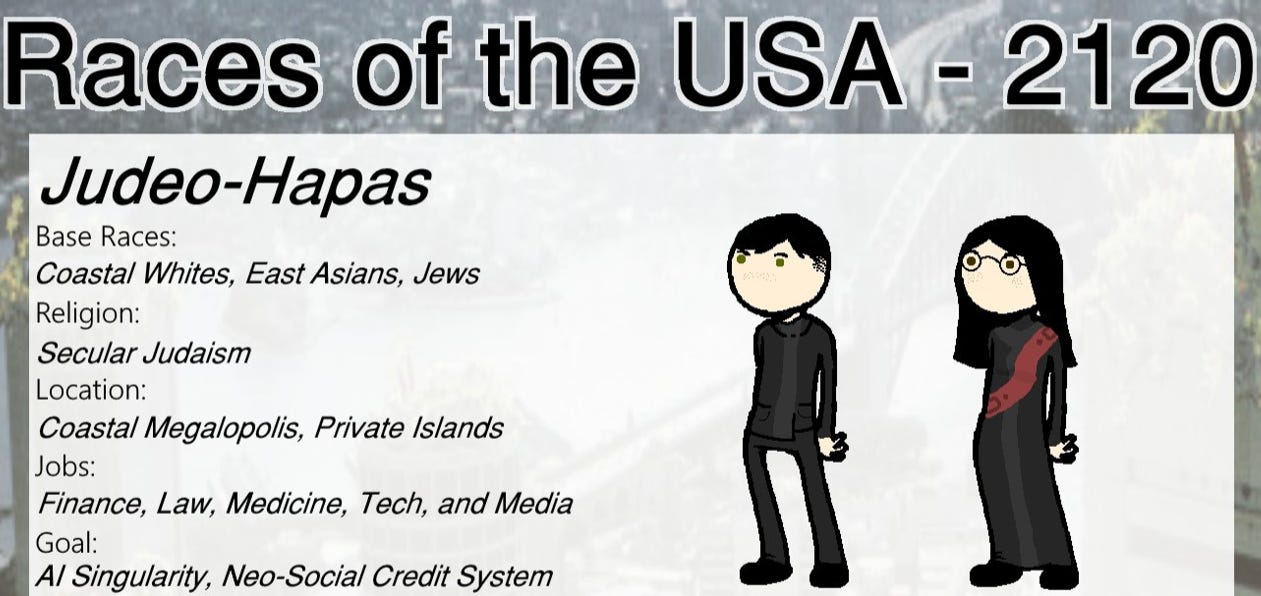
The reason why I find this prospect frightening is because, putting aside any genetic considerations, the selective process that leads to Judeo-Hapastan is biased toward striverism: social signaling, IQ-maxing, and conformism. These are not the virtues that founded America — they have more in common with the ancient Chinese bureaucracy.
My fear isn’t that China will take over the world, but that the spirit of stability, conformity, and fearfulness will reduce humanity to an era of eunuchry. One could argue that this process has already been taking place, slowly, for centuries now. Spengler certainly recognized it in the last century, and we have continued in that direction. What could possibly stop it?
First of all, individuals must, as a matter of idealism, throw off fear, and declare war on it, on all fronts. Personally, this is why I praise Worst Boyfriend Ever. Not because he is moral, or intellectual, but because he is fearless. Not in the sense of lacking fear out of apathy, but because he confronts it and overcomes it. A society led by Worst Boyfriend Ever would be more exciting and meaningful than a society led by Judeo-hapa nerds.
Second of all, institutionally, academia must throw off centuries of infiltration by the civil services, and refound itself on liberal principles. This means reintroducing the tyranny of the professor, eliminating GPA, and requiring Platonic dialogues. The “thesis defense” should be a daily practice, not a once-in-four-years goal. Anyone who is unaccomplished in the field of athletics and rhetoric should be barred from graduation in our elite institutions.
Third of all, all restrictions on genetic research must be eliminated. Whether or not this produces advances in IQ is irrelevant; the purpose is mythological and religious in nature. By forcing a confrontation with the nature of identity, ethnicity, and our human origins, the resulting genetic arm’s race will product the pressure required for the ethnogenesis of a new American elite.
These goals are lofty and not easily achievable. They will not be up for vote in 2028, at least not directly. Indirectly, we can take the following pragmatic and feasible steps:
Support highly electable “dark woke” candidates; that is, candidates like Graham Platner and James Talarico, who shift the focus of wokism from internal endless self-critique to substantive policy issues (immigration, academic funding, NATO).
Fight the “America First” position, within both the DNC and GOP, of isolationism, xenophobia, and tariffs. Promote free trade, open borders, and deregulation (in alliance with YIMBY, Abundance, and EHC libertarians). This will aid GDP growth and help accelerate genetic technology.
Culturally, resist attempts by the far right (and far left) to promote sexual conspiracies, puritanism, and hysteria, including the Epstein panic, the human trafficking hoax, and other Qanon fantasies involving mass rape. These populist superstitions undermine the stability of the deep state and grant credence to outsiders like Tucker and Candace.
Among the left, fight the tendency toward the regulation of AI. Refocus environmentalism away from “fossil fuels” and toward attacking agricultural subsidies, fighting pollution, and reducing plastic waste. Resist the tendency of leftists to characterize AI as “dehumanizing,” and emphasize its capacity to reduce poverty and level the playing field — the ability of poor filmmakers to create art without a large budget, for example.
Thanks for reading.
This is one of my longer articles. My ability to continue this project is due to the generosity of my supporters. Paid subscribers get access to:
700 paywalled articles
Fresh article requests
(100 words per $1)
(up to $10,000 for a million words, [Mr. Beast torture chamber challenge] in which I take Adderral, Zyn, nicotine, green tea, and nootropics [alpha brain] and hire an assistant to force me to write 14,000 words a day for 71 days straight)
Early access to drafts
Access to the elite editor’s group
If you are not a paid subscriber, remember that every comment and re-stack helps improve the visibility of this article in the algorithm. Hitting “like” also makes me feel good and motivates me to keep going. Thank you.
See Machiavelli’s fantastic but little-known play, The Mandrake Root.
The “Squeaky Wheel Effect” creates the impression that everyone hates me and only reads me out of sheer masochistic rage or because they want to laugh at ideas they find to be incoherent and ridiculous.
This is fascinating. Similarly to you, people have a very hard time guessing my political persuasion based upon my OCEAN Factor V results, though similar to yourself I think it’s because I’ve done some metacog and realized that I don’t like the 100 year consequences someone like me would supposedly advocate for. So I end up advocating for things that are pretty contrary to my personal interests and in favor of a hypothetical descendent’s interests. It’s caused a great deal of cognitive dissonance, which imo is likely why you get this personality-politics concordance even in high IQ people who should know better. It’s uncomfortable to advocate for the thing you know would screw you personally should it come to pass, but would help your nation. Anyway great article as per usual
I like this. Humans and AI must develop along orthagonal axes. IQ maxxers cannot compete with AI for long.