
TND: Total Nerd Death.
AI and peak energy.

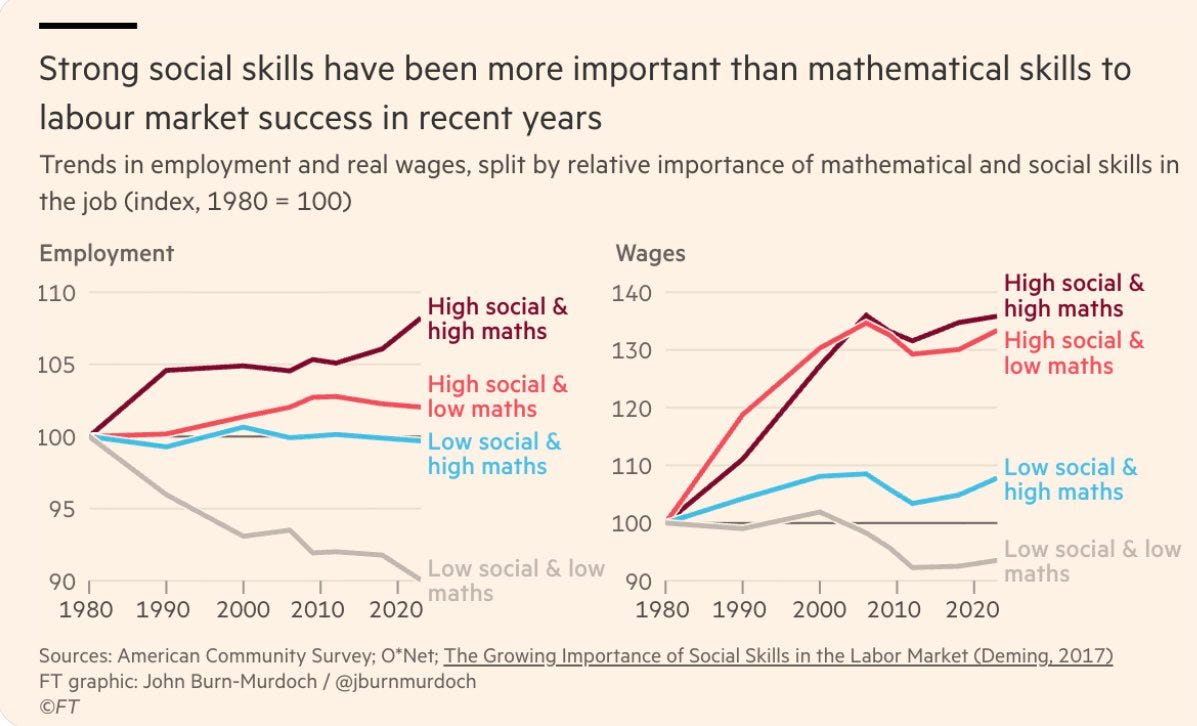
Here are two contradictory predictions for the future:
AI capabilities are accelerating.1 “Companies are starting to prefer AI over {college} graduates… AI will surpass the average STEM graduate at 3-20x cheaper cost by next year.”
2030 is the decade of peak energy. We hit peak oil in 2018, and will hit peak natural gas in 2032. Nuclear power isn’t that great. Renewables will not save us.
AI is the “solution to all problems,” but peak energy is the “collapse of civilization.”2 We cannot simultaneously solve all problems and also collapse civilization…
… UNLESS … ?
The contradiction is false. AI and peak energy are not mutually exclusive opposites. They are interdependent events, two sides of the same coin.
AI will increase energy usage; expensive energy will force companies to cut costs by firing NERDs. This vicious cycle will result in TND, Total NERD Death.3

NERDs refers to Neurotically-Educated Researchers and Developers. These are abstract, theoretical, white collar “work from home” jobs — office workers, code monkeys, and spreadsheet slaves.4
The death of the NERD will not bring about the future envisioned by traditionalists, nor the “luxury gay space communism” of free housing and global peace.
Before I explain exactly how or why this will occur, I want to skip straight to my eight conclusions. There’s no point in reading a boring article on the intricacies of AI and hydrocarbons and lithium-ion batteries if I’m just going to hide all the juicy stuff at the end.
The eight conclusions are:
TWINK SUPREMACY: The world will be thinner, more urban, and less fertile.
FATTIE GENOCIDE: RIP to childhood obesity, 1990 - 2030.
GIRL-BOSS APOCALYPSE: Women, prepare for a career switch to healthcare.
RE-URBANIZATION: Transportation costs will kill the suburbs.
THE END OF 13/50: The future will be more racist, and more diverse.
WAR IS BACK: AI hyper-centralization will generate a global security crisis.
WOKE IS DEAD, BUT SO IS GOD: Cat-ladies and conservatives will diminish.
Ethno-LIBERALISM: “Ethnic liberals” will dominate, even as “wokism” dissolves.
1. TWINK SUPREMACY:
The world will be thinner, more urban, and less fertile.
Food prices will skyrocket,5 leading to global food insecurity.
A McDonalds burger will cost $40.6
Candy bars will be locked behind glass displays.
Government-run grocery stores will burden the middle class with higher taxes.
Private grocery stores will require expensive monthly memberships.
The median consumer will spend 54% of their income on food and transportation (up from 24% today).
2. FATTIE GENOCIDE:
Obesity will be remembered as a weird 40 year period between 1990 and 2030.7
Ozempic and Adderall will help the poor cope with smaller portions.
BBW porn will increase in popularity as obesity becomes a sign of wealth.
Women are about to get very sexy. However, impregnations will decrease, because other forces will drive fertility even lower than it is today.

3. GIRL-BOSS APOCALYPSE:
If you are a woman, prepare for a career switch to healthcare.8
The “office girl-boss” as an archetype will disappear.
Nurses will be in high demand, as the elderly population increases.9
De facto gender segregation will increase, divided between healthcare and security / construction.10
“Office romance” will be replaced with “nursing home romance.”

4. RE-URBANIZATION:
Transportation costs will kill the suburbs.
Gasoline will hit $10 per gallon, pricing out the morning commute.
Road trips and plane flights will be a luxury of the rich.11
Job growth will be in security, construction, and healthcare, all of which require in-person attendance.
The rural-urban divide will widen, as jobs are sucked out of rural areas.12
Re-urbanization will accelerate the global decline in birth rates.

5. THE END OF 13/50:
The future will be more racist, but in ways that we might not presently expect.
As “white flight” is reversed, crime will no longer be tolerated.
“Inner cities” will be forcefully gentrified.
Segregation will become de facto legal again through innovative loopholes.
Liberals will revert to the “stop and frisk” politics of Clinton and Bloomberg.
In the NERD economy, racism is justified by fear of violence and “IQ charts.”
In the TND economy, racial hierarchies will emphasize “firearm proficiency.”
Global demand for security will draw whites overseas into India and Arabia.
Russia and Europe will be flooded with Indians due to labor shortages.

6. WAR IS BACK:
AI hyper-centralization will generate a global security crisis.
“Policing for profit” will become the #1 export of America and the EU.13
Security jobs will be for the 21st century what factory jobs were for the 19th century — dangerous, dirty, hellish, with long hours and inhumane conditions — but the market demands, so the people will follow.
Global spending on security will increase from 2% to 10% of GDP.
40% of able-bodied men, ages 18-45, will work in security.

7. WOKE IS DEAD, BUT SO IS GOD:
AI militarization will undermine “catlady liberalism” and “Christian conservatism.”
Harpies shrieking nagging shibboleths will be replaced with militant values.14
Security demands will liberalize cloning and animorphic engineering.
TND is a reckoning, transforming the values of liberalism to survive a new age.
The priest, in self-abnegation and humility, pursues the Will to power. This Will to power will not disappear — it will find new avenues in which to express itself.

8. Ethno-LIBERALISM
Conservatives claim that “woke ideology” is “driving people insane.”15 This is a backwards view of the world.
Liberal status anxiety is a group evolutionary strategy, which drives them to control institutions.16
Liberals are universal (open) and status-obsessed (neurotic), while conservatives are nepotistic, localist, personalist, and materialistic.17
Conservatives are being “drained” of openness and neuroticism through assortative political identification and mating.18
Ethno-liberalism will be more masculine, militant, and self-aware.19
Even as “woke” shibboleths erode, underlying personality differences remain.20

How and Why?
Now that I’ve finished my conclusions (because no one really has time to read an entire Deep Left article these days), the rest of the article will be dedicated to explaining exactly why and how these changes will take place.
I will cover:
The X-Graph: Why catastrophic energy prices are inevitable.
NOT the SINGULARITY: Why I am not a transhumanist.
Are you saying all jobs will be gone? No.
The NEXT 12 Months: Discrete and measurable predictions.
OBSOLESCENCE: How this has happened many times before.
AI doesn’t need to be “better than humans.” Disproving a common objection.
GEOPOLITICS: The future of the six “superpowers.”
ROBOTS and DRONES: Why human soldiers will be in high demand.
1. The X-Graph
Green scammers like Elon Musk have been extracting billions of dollars from the government by promising that “Green Energy” will replace fossil fuels. It will not. Nuclear power is subject to the same security concerns as AI data centers, but even more so.21
As the demand for energy increases, the availability of energy will plummet. This is the X-graph: supply goes down, but demand goes up, resulting in catastrophic increases in price.
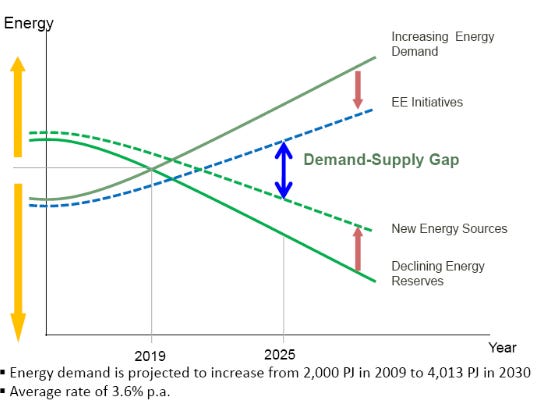
Socialists think that the solution to the X-graph is to regulate AI so that it doesn’t steal all our energy, but this is backwards thinking. Without AI, we will have even less efficient economies, a dwindling supply of labor, and a declining global IQ.
Even without AI, we were on track to reach peak energy anyway, just with less intelligence and efficiency. Peak energy is coming no matter what — no policy intervention is feasible within democracy. Rather than trying to avoid the inevitable, it is best to maximize AI innovation before the big crunch. There’s no way to avoid the X-graph.22
![Dexter's Laboratory] : r/explainthisscreen](https://substackcdn.com/image/fetch/$s_!vVvy!,f_auto,q_auto:good,fl_progressive:steep/https%3A%2F%2Fsubstack-post-media.s3.amazonaws.com%2Fpublic%2Fimages%2F65b8c4ae-7b33-458d-bbec-44f04b54bd35_640x479.jpeg "Dexter's Laboratory] : r/explainthisscreen")
2. NOT the SINGULARITY.
Before you dismiss what I am saying as insane or overzealous, please be advised that my claims are limited and have nothing to do with “transhumanism” or “the singularity.”
Transhumanism is a cult of unathletic, atheistic NERDs who despise the physical body and seek its elimination. It is a robot sex fetish and a solipsistic pursuit of immortality. In opposition to transhumanism, I propose the supremacy of the biological body and its purposeful form in the sacrifice of war.23
I have nothing to do with transhumanist fantasies:
AI will not “replace humans.”24
It is neither possible, profitable, or rational to solve the problem of aging. The optimal human lifespan for peak militarization is <45.25
Placing chips in brains will not result in “superior soldiers.”26
Neither drones nor cyborgs will ever fully replace biological soldiers.27

3. Are you saying all jobs will be gone?
No. The following jobs are safe:
Non-STEM (75% of workers)28
Public sector STEM (government / academia)
Blue collar or grey collar STEM; physical, manual, or technician-level jobs (oil rig worker, phlebotomist, dissecting cadavers).29
PhD-level STEM30
Human beings will increasingly specialize in war-fighting, blood-drawing, and hammering nails. The only jobs left for sub-115 IQ humans will be in healthcare, construction, and security.
As the economy shifts, the cultural dominance of the NERD archetype will finally end.31
No more Ross; no more Sheldon.
No more liberal cat-ladies nagging about harm reduction.
No more trad caths ranting about demonic possession.
Instead, a world dominated by fascistic mercenaries and piratical terrorists. The Wagner Group and Bukele are the future.32

4. The NEXT 12 Months:
In February, CNN reports “private sector STEM headcounts are down 1%.” (1%)
In March, fear of an “AI bubble” causes a spike in market volatility. (2%)
In April, an Italian radical centrist detonates a bomb outside a data center. (3%)
In May, Trump increases tariffs on “foreign AI.” (4%)
In June, Trump bans Chinese AI for “spying.” (5%)
In July, Congress increases NASA/NHS budgets to hire unemployed NERDs. (9%)
In August, the “Stop AI Act”33 introduces regulations on AI construction. (13%)
In September, Trump revokes 90% of H-1B visas. (18%)
In October, Trump begins deporting 11 million Green Card holders.34 (24%)
In November, the “Hire American Act” introduces an “AI Corporate Tax.” (31%)
In December, Trump announces an “AI dividend” of $2,000 per month. (39%)
By January 2027, private sector STEM headcounts are down 50% from 2026.35
5. OBSOLESCENCE
Throughout history, new technological inputs have made entire skillsets obsolete, even as demand for outputs increased.
Between 1500 and 1700, military spending increased. At the same time, the demand for sword-and-armor smithing plummeted as firearms were adopted.36
Between 1850 and 1920, spending on transportation increased. But old skillsets related to transportation were made obsolete, like smithing horseshoes, weaving sails, and constructing carriages.37
Over the 20th century, demand for food increased. But as tractors replaced human laborers, farmers as a percentage of workers shrank by 90%.38
Old skillsets became obsolete, even as demand increased.39

6. AI doesn’t need to be “better than humans.”
For headcounts to decline, AI does not need to be “better than humans.” It can be within a tolerable variance — say, 90% as good — but orders of magnitude cheaper.40
If AI outputs are almost as good as human outputs, at 30% of the cost, the choice is clear.41 AI can replace 50% of NERDs, even if it is never “as good as” a human.42
This is due to the division of labor. Every jobs has “hard parts” and “easy parts.” If AI eliminates the easy parts, companies will reduce headcounts to reallocate resources to the frenzy of capital investment. The top 50% of NERDs who remain will focus on tasks where AI underperforms.43
To understand how headcounts can decrease while revenue increases, think of AI as a “robotic outsourcing.” As corporate profits grow, the incentive won’t be to protect existing headcounts, but to go all-in on AI by firing the bottom 50% of workers.
Building websites in 2006 would pull a middle class salary. Now you can build your own website on Wix for $5. Maybe it’s not as good as a custom-made website, but it’s good enough. Imagine Wix, but for everything.44

7. GEOPOLITICS.
AI will disproportionately benefit countries with the following assets:
Energy
Working-age population
Stability
Using these three criteria, we can assess the fortunes of six power blocs:
1. CHINA
China lacks energy, which is why its relationship with Russia is so important. Its working-age population is projected to fall by half in this century, which might reduce stability. It also has perpetual border conflicts with India over Himalayan water rights, and an unresolved conflict with Taiwan.
2. RUSSIA
Russia has energy, but that’s all it has. Its working-age population is in terminal decline, and it has the worst stability of any “regional hegemon” in the world.45
Russia’s two options are to submit politically to the much larger EU, or to submit economically to a much larger China. If the EU begins to dissolve in 2029, this will present a new opportunity for Russia to dominate a divided Europe. However, by that time, it may be acting more on behalf of Chinese interests, not as an independent power.
3. INDIA
India lacks energy, but it has the largest projected working-age population in the world, and the best internal stability of any third-world country. After adjusting for its low level of education and PISA scores, one could say that India is the “Switzerland of the third-world.” This is despite the fact that it has 100 million Muslims.46
I expect Indian labor to flood into Europe, Russia, and even China as those countries become desperate to increase their working-age population. This will brain drain India, but it could also help the Indian economy grow through remittances in much richer countries.

4. EUROPE
Europe has no energy outside the North Sea. The EU could have imported Indian, Chinese, or Vietnamese immigrants. Instead, it chose to import the least physically healthy and most religiously deranged people on the planet. Chronically unemployed migrants do not increase the “working-age” population — they make the dependency ratio worse.
The impact of Muslim immigration in itself is small.47 The real threat of Muslim immigration is in the second order political consequences. If far right parties seize power in France and Germany in 2029, this will threaten the internal stability of the EU and NATO.
5. AMERICA-CANADA
The American-Canadian alliance has energy, a growing working-age population, and remarkable stability. America hasn’t had any border disputes since the Civil War (1865). Immigrants to America are the most peaceful and easy-to-assimilate group of immigrants anywhere in the world.48 Pakistani Americans are richer than white Americans — a far cry from Europe’s welfare-dependent rape gangs.
If America can secure stronger alliances with Mexico, Brazil, Argentina, and El Salvador, or flip enemies like Venezuela and Cuba, then the American advantage will only further increase.

6. Middle East?
“The Middle East” is unstable.
Despite having energy and a growing population, no one wants to build a data center in Saudi Arabia.49
The bombing of Iran’s nuclear facilities and perpetual riots make that country unattractive to foreign investment.
Israel is too small and has even worse border stability than Russia.50
Each of these countries will of course attempt build up AI infrastructure, but individually, they are too small to compete on the global stage.51
Let me know when the “Saudi Arabian superpower” manages to control the quasi-Subsaharan insurgency on its southern border; then we can talk. Let me know when the “jewel of the gulf” stops bombing its own Arab allies.
The Middle East is very far from anything resembling the internal unity represented by China, the EU, or America. Too much royalist squabbling, nepotism, and tribalism, with no idealistic vision of pan-Arab unity.
America remains king, followed by China, Europe, and India.52
8. ROBOTS and DRONES
AI increases demand for security, because it depends on hyper-centralized infrastructure, secure supply chains, and an extensive electrical grid.53
Transhumanists propose that security could be solved by drones or robots alone. They fail on three counts:
They fail to distinguish between offensive and defensive capacity.
They ignore cost-per-kill.
They confuse the blitzkrieg of battle with the attritional endurance of security.
Offense vs Defense
A drone is a guided missile with a webcam. Drones are offensive weapons and surveillance tools; they are not defensive weapons. Drones cannot occupy, patrol, or secure an area.
If terrorists rushed a data center, or used hit-and-run tactics on power lines, drones would be helpless to stop them. Drone work best in open fields, like those of the Ukrainian steppe, and less well in urban zones.54
Security is not a pitched battle. Drones can out-perform humans where there is a defined and immediate target to search-and-destroy (a bunker, a tank, a trench). This proficiency does not translate to performance in long-run security detail.
Drones are not meant to fly around 24/7 for 52 weeks a year — they are meant to be deployed for hours at a time, and destroyed on impact. If the goal is not to attack, but to defend, then humans out-perform drones.

Cost Per Kill
Let’s say a cheap drone only costs $1,000. How many people can you kill with a $1,000 drone? Some drones will be destroyed, others will crash, others will miss their target, resulting in a ratio of 10 drones per kill, or $10,000 per kill.
Cheap drones are single use suicide-weapons. Human soldiers, on the other hand, can be used repeatedly over a period of months. A single human soldier might cost $100k to employ, but if he kills 10 enemies over the course of his employment, that’s $10,000 per kill.
As the cost of energy increases, the cost of building drones will also increase. However, energy costs do not affect the existing supply of human cannon fodder — in fact, as food becomes more expensive, people become much more willing to risk their lives for lower salaries.
Endurance
Proponents of “robot soldiers” claim that robots are already faster, stronger, more coordinated, and more accurate than a human. Even if this were true, it doesn’t matter.
Remember what I said before about AI being “better than a human”? What matters is not output, but output as a function of cost.
A tank is stronger than a human; faster too. Why don’t we abolish the infantry, and just replace all soldiers with tanks? If you are capable of confronting that question, then you should be capable of understanding why robot soldiers can never fully replace human soldiers.
If robots are twice as fast and strong and accurate as humans, but they cost millions of dollars, and their batteries go dead after 5 hours, then they are inferior to a human who can be paid a $100k bounty and operate autonomously for weeks at a time.55 For anything lasting longer than six hours, I would rather have an army of 100 Japanese men than an army of 100 robot super-soldiers.

Ninja-robots could carry out Blitzkrieg operations, like the capture of Maduro by American Special Forces. Any high-stakes operation requiring less than five hours of autonomous movement may eventually be performed by Ninja robots as shock troops or SWAT teams.
Security demands masses of cheap cannon fodder. In that task, humans will continue to beat robots for decades to come.56 With genetic engineering, biological soldiers will only become faster, smarter, and stronger. Robots will never catch up.
Why build a million robots, when you could clone a million werewolves?

The problem here is not technological — it’s moral. Robot soldiers are desirable when human life is valuable, and cloning is banned. In a world where AI does more of the thinking for us, the calculation shifts.57
By 2030, AI will replace 100% of accountants, 50% of primary care doctors (but not nurses), 50% of post-secondary educators (teaching assistants, adjunct professors), and 50% of truck drivers.
Because the projected outcomes are opposite, these theories are thought of as mutually exclusive.
Both visions are apocalyptic, or salvific, depending on your perspective. AI could solve all our problems, or eliminate humanity. Economic collapse could lead to human extinction, or it help us “return to tradition” and a more natural way of life.
NERDs stands for Neurotically-Educated Researchers and Developers. More specifically, I am referring to Bachelor-level White Collar STEM Private-Sector jobs (BWC-STEMPS).
The debate should not be whether or not 50% of STEM graduates will be forced to find a different line of work, but whether the timescale is 12 months or 12 years. For the quantitative argument, I demand you read Uncorrelated’s article. I am here to make qualitative arguments and to draw out more speculative predictions.
The bottom half of BWC-STEMPS will need to find a different line of work.
When I refer to jobs, I am talking about the private sector: …engineers, computer programmers, chemists, biologists, mathematicians, statisticians, data analysts, physicists, and research assistants…
Academia will lag 10 years behind; I don’t expect universities to downsize their STEM faculty until 2037. What this means in practice is that many STEM graduates, struggling to find employment in the private sector, will go back to school to get their PhD and try to get a job as a professor.
When AI takes my job as a Substacker I plan to become a massage therapist for a rich Jewish man living in southern Florida.
Food prices are a function of energy. {See Bridau on fertilizer.}
Rising energy costs are a universal tariff on every form of economic activity (except for white collar services, which will drop to 1% of current costs).
Every physical good requires energy to produce and transport:
It takes energy to manufacture a car and to fill it with gas.
It takes energy to build a house and fly on a plane.
It takes energy to ship cheap goods from China to America.
AI will solve problems in biochemistry, genetics, mathematics, and physics, but the average person will be spending a greater percentage of their income on groceries and transportation. To give an example of 10x food inflation, I will use a Kansas house (KH) as the standard of measurement. A home in rural Kansas costs about $150k. A loaf of bread costs about $5. Therefore, the ratio of bread to KH is 1:30k. By 2040, I predict that the ratio will shift to 1:3k. Meaning, you could buy a house for 3,000 loaves of bread. This sounds insane, but it is in line with the increasing energetic costs of producing fertilizer.
Inflation adjusted, 2026 dollars.
There are many fancy diet-based theories for why people are fat today (I like Ray Peat), the most simple and elegant one is that people eat too many calories, because calories are abnormally cheap. If a dozen donuts or can of soda cost $40, lower class Americans would ration the food they give to their kids much more strictly.
If you listen to stories from your grandparents (or great grandparents, if they’re still alive), you might hear of the old “basket trick.” When food was scarce, parents would place the food in a basket, then hang it on the ceiling, out of reach from the children.
This section is plagiarized from Philippe Bridau.
In the 1950s, a woman’s place was the kitchen, and a man’s place was the office. The woman wore an apron, and the man wore a suit. In the 2050s, a woman’s place will be the nursing home, and a man’s place will be the construction site or the perimeter of a data center.
The reason why feminism was so red-hot between 1965 and 2008 is because society progressively replaced manual labor with NERD jobs. Data entry, secretarial work, copy-editors, and other low-level mental tasks benefitted female independence. Men had no advantage in these tasks.
Unfortunately for traditionalists, this will not signal a return of “family values” or increase the fertility rate, because the cost of raising children (feeding them, clothing them, healthcare, childcare) will only increase. But unfortunately for feminists, the future will also be much more sexist than it is today.
If you are not rich, and you plan to travel anywhere, I recommend you do so in the next 12 months.
Those “left behind” in rural areas will be reduced even further to the absolute dregs of the disabled and welfare abusers. If you think the opioid crisis is bad now, you haven’t seen anything yet.
Techno-optimists claim that further advances in technology will result in a more peaceful world. However, historically, the invention of new technologies did not bring about world peace. …the firearm (16th century) or machine gun (19th century) or tank or fighter plane (20th century)…
Tank technology was disruptive to the previous geopolitical order. In creating instability, technology made the world a less peaceful place, at least until a new geopolitical “equilibrium” was reached.
It’s fashionable to say that “Blitzkrieg was a hoax” because it’s a contrarian take, but just because the Germans didn’t use the word “Blitzkrieg” doesn’t mean that their use of tanks as a forward vanguard (rather than as a rear support) wasn’t innovative and effective in the Battle of France.
Think of a fusion of Mitt Romney and Gavin Newsom; Jim Mattis and Dan Caine.
I would also put post-liberals like Yarvin in this camp. Yarvin claims that everything would be solved if Tim Cook was king, and blames it all on the Calvinists. He fails to recognize the implications of the widening gap in sexual selection between liberals and conservatives.
The dividing line between liberals and conservatives is anxiety over the meta-shibboleth.
By meta-shibboleth, I mean that the fundamental difference between liberals and conservatives cannot be reduced simply to any particular policy. In 2006, the Democrats were anti-war, and the Republicans were pro-war. Then when it came to Ukraine in 2022, the Democrats were pro-war, and the Republicans were marginally anti-war. Now with Venezuela in 2026, the Democrats are back to anti-war, and the Republicans are pro-war again.
If we passed a law banning transgenders, immigration, and DEI, most conservatives would forget that politics existed, but liberals would not. The converse, however, is not true: even if transgenders, immigrants, and black people won infinite reparations, liberals would still find something to complain about.]
Liberals are hyper-aware of the pecking order, and desperately try to climb to the top. Conservatives enjoy fishing, off-roading, fast cars, beer, and hot chicks.
The conservative enjoyment of “going to church” has very little to do with status-seeking, and more to do with their enjoyment of regularity, familiarity, and dependability. “Going to church” is like “watching the game” or “grilling the brisket.” They do not have the neurotic anxiety that pushes liberals to mass-adopt once-niche trends like “Latinx” or “people of color.”
By materialistic, I mean “oriented toward measurable outcomes, rather than subjective social interpretations.”
Sexual selection widens the lib-con gap in depression, anxiety, and fertility.
There are historical examples of this in the opposite direction. The Mormons, who were once nomadic polygamist white supremacists, are now mild-mannered pencil pushers. But the reverse can occur, with enough pressure and intensity. / Imagine Gavin Newsom and Graham Platter with less self-effacing deference to political correctness, and a little more edge.
As society reorients itself around construction, healthcare, and security, liberals become desperate to excel in those fields as much as they are desperate to excel in law, education, and “project management” today. If you want to know what the DarkWoke SuperSoldier looks like, imagine a fusion of John Brown, Leon Trotsky, and Abraham Lincoln.
A data center could be buried inside of a mountain to protect it from harm. However, the problem with building nuclear power plants underground is that they generate a lot of heat, and if they are surrounded by rock, they tend to overheat. Data centers produce heat too, but much less than nuclear power plants.
You could theoretically build a data center in Siberia or Antarctica, so long as it had access to energy. You could not build a nuclear power plant in Siberia, because it would be too far away from popular centers.
As electricity is transported along power lines, efficiency decreases with distance. This means that nuclear power suffers from transportation costs in a way that hydrocarbons do not.
Solar power is beneficial in third-world countries because it allows rich people living in compounds to survive “off the grid” when the government fails to provide power. But solar cannot efficiently power data centers, because storing energy overnight in batteries is too expensive.
Even a communist country like North Korea will need to direct limited energy toward AI or fall behind. China certainly isn’t concerned about the environmental impact of AI.
Populists blame rising energy costs on AI, when the reverse is true: gains from AI will be the only thing holding back total economic collapse. Peak energy will occur independent of AI.
A sub-115 IQ person is incapable of understanding this argument, so expect terrorist attacks on AI data centers to come from “Mangione” types, who will be valorized by the drooling masses. Such arguments cannot be won with words, but only through security.
Ironically, the most fervent proponents of AI will be its first casualty.
When I first heard of “the singularity” as proposed by Ray Kurzweil, I considering his ideas as Frashokereti mysticism sold to atheist nerds. I still believe that.
AI is a temporary “in-between,” like the invention of the matchlock rifle. It will ultimately be made irrelevant with the advancement of genetic technology, because hydro-carbon is superior to lithium-silicon. Organic biology will eventually outcompete AI.
It would be much more efficient to fund research into shortening pregnancy and puberty. If pregnancy could be shortened to 5 months, and puberty and adult height completed at age 10 rather than age 18, that would be much more impactful than “solving aging.”
To the extent that humanity can use science to produce better soldiers, those soldiers will be biological in origin. I call this idea “animorphism,” and it is entirely separate from “transhumanism.”
Manual production (real stuff in the real world) will be safer than nerd labor. Any manual labor which cannot be locally-fixed to assembly line will remain in human (or animal) hands. The most resilient job are in healthcare, construction, and security.
I don’t believe that 3D printers have any profitable future in mass production economies. There’s no point in having a “generalized production machine” when specified production machines (assembly lines) are so much cheaper...
100s of jobs will be entirely unaffected by AI… Carpenters, roofers, masons, massage therapists, barbers, surgeons, lawn mowers, snow plowers, surfing instructors, plumbers, electricians, general contractors, HVAC repairmen, welders, mechanics, chefs… Being a low-level accountant, programmer, chemical engineer, or biochemist will no longer be an option.
If this describes you, please click here.
As nerd jobs are outsourced to AI, this will lead to a mass reallocation of labor.
Nerds will find new jobs within months of being fired, since AI will generate surplus revenue that will flow into other fields.
AI will not cause a 50% reduction in all employment — the net effect on total unemployment will only be 5%. But it will disproportionately affect Indians, Chinese, and nerdy white guys.
AI-skeptics have two common counter-arguments:
The proposition depends on unproven technology;
Perhaps AI will “augment” existing skillsets, rather than replacing them entirely.
The first is reasonable insofar as no trend can continue forever; all linear (or even exponential) gains must eventually slow down.
However, in light of the arguments put forth by Uncorrelated, this skepticism is no longer warranted, and now belongs to the domain of wishful thinking.
I’m not going to rehash Uncorrelated’s arguments here. Just go read his article.
While 12 months is a short time scale, it matches the data.
Let’s say that if we were to run a polymarket betting market on my claim (50% of BWC-STEMPS jobs eliminated by _), the median/mode/average bet would converge on 13 years. That is, as of January 2026, most people believe that AI will eliminate 50% of BWC-STEMPS jobs by 2039. We can think of this median/mode/average bet as the high point a bell curve, where the range is between 6 months (absolute minimum) and 100 years (absolute maximum).
Now let’s say, in the next 30 days, there is a significant breakthrough in AI capabilities. Perhaps Deepseek, Grok, Gemini, or Chatgpt exceeds expectations. AI from revenue grows faster than expected. New economic dating shows that companies are utilizing and profiting from AI at a much higher rate. Thus, in February 2026, the median opinion of the betting market shifts by 1 year. Now, instead of projecting the 50% benchmark by 2039, the new consensus is 2038.
But what if this process continues? Let’s say in March, another model comes out which blows every other previous model out of the water. It is cheaper, faster, and more accurate. AI-related businesses blow past all expectations. Profit is through the roof. Once again, public opinion shifts — the new median projection is 2037.
And so on for April, to 2036, and May, to 2035. By June the public starts to believe that the 50% benchmark will be achieved by 2034 — the results are to impressive to claim otherwise. Betting markets shift accordingly.
By July, 2033 is the new median opinion, and in August, 2032 becomes the new “consensus.” Now we’re in September, and Summer is over, and 2031 is the final target. Surely no new models, no new data, no new data could shorten expectations — but that’s where you’re wrong! By October, 2030 is the new target for the 50% benchmark. Now it’s 2029 in November, and 2028 in December… Finally, we get to January 2027, and it’s here. 50% of BWC-STEMPS jobs have been wiped out.
In the 1980s, Reagan decided he was done playing nice with the Soviets, and decided to win the Cold War. Hollywood, coincidentally, started producing movies starring Sylvester Stallone and Arnold Schwarzenegger. Although conservatives imagine that history was linearly more masculine the further back you go, this was actually quite unusual — the rock n’ roll action flicks of the 1980s were a stark contrast to the gay disco of the 1970s. Totally different vibe.
Sub-115 IQ. Geniuses will still be needed to prompt and oversee the AI.
Some grunt work can be done by 3rd world mercenaries, like Colombians, Mexicans, and North Koreans. However, you get what you pay for.
For the most important operations, American-trained soldiers will be in high demand, with some Europeans in the mix as well.
Regarding the role of IQ in infantry performance, we have plenty of data on this question from the United States government.
It’s possible that if things get very bad in China, you might see a wave of Chinese expats founding a Chinese version of the Wagner Group. So far, however, the Chinese have been completely allergic to allowing their citizens to hold guns on foreign soil. The Chinese have a strict doctrine of being “anti-imperialist,” so they always hire non-Chinese mercenaries to do their bidding. If this were to change, it would require a revolution in the doctrine of the CCP. Not impossible, but unlikely prior to the death of Xi.
(Suspension of Tetrabytes of Overdevelopment, because they love their puns and acronyms)
… but this has little effect, since the electrical grid has already reached its physical limit.
Keep in mind that only 24% of the American labor force works in a STEM occupation; only 48% of these workers have a Bachelor’s degree. Only 18% of all college graduates were in STEM fields, out of 40% of Americans who have a college degree. When I say “STEM unemployment,” I’m referring to the 9% of the population who have a degree in a STEM field. Therefore a 50% increase in BWC-STEMPS unemployment will result in a 4% increase in overall unemployment.
When I say “eliminate,” the specific measure I am using is “company employment numbers.” For example, when Elon Musk took over Twitter, he fired 50% of workers, and the company survived. I am predicting that STEM companies (biotech, software, hardware, engineering, pharma) will reduce their total non-AI headcount of STEM college graduates, on average, by 50% over the next 12 months.
This will probably be an overcorrection, and in 2027, some BWC-STEMPS workers will be rehired. But the next 12 months will see some of the highest industry-specific unemployment numbers since the Great Depression. For the rest of us, who have degrees in the humanities, the economy will be pretty good.
Along the way, I can see Elon Musk pushing social issues like white genocide and transgender surgeries to try to distract populists from the economy.
…Between the Battle of Cerignola (1503) and the Battle of Shiroyama (1877)…
Breeders, trainers, and horseshoe makers were in high demand in 1914; now those jobs only persist as a niche, recreational anachronism for horse girls.
The lumber trade was enormous, and revolved largely around shipbuilding. But when ships switched from wood to steel, the techniques and skillsets of wooden ship building were made obsolete.
Each of these skillsets reached its peak at some point in the last 500 years, and then quickly declined over the course of a century. Here are my estimates for the peak, and the point of 90% decline (collapse):
Peak wooden ship: 1859; collapse by 1890 (31 years)
Peak horseshoe: 1920; collapse by 1955 (35 years)
Peak farmer: 1935; collapse by 1980 (55 years)
Peak sword/armor: 1500; collapse by 1590 (90 years)
And now:
Peak (low-level) STEM: 2023; collapse by 2026 (3 years).
We reached “peak programmer” in 2023, in a global sense. However, if we’re focusing specifically on the American market, “peak programmer” was probably around 2008. This is because, as far as employment numbers are concerned, it doesn’t matter whether it’s Indian outsourcing or AI augmentation. The net effect is the same: it is harder and harder for low-level programmers to achieve high wages.
With the adoption of AI at scale, there will be a much smaller demand for STEM graduates, even as demand for STEM-related problem-solving increases.
Demands for output in a particular field (STEM) do not necessarily translate into increased demand for existing skillsets (STEM graduates). With the introduction of new technologies, labor demand can plummet, even as output demand increases.
PQ
The examples I cited (horseshoes, shipbuilding, smithing, farming) were all manual labor, blue-collar jobs. They required specialized knowledge, but they were all built upon a foundation of a strong physique and the endurance to do back-breaking labor for long hours. When those skills became obsolete, it was relatively easy for a smith, or farmer, or ship builder to move horizontally into a new field — perhaps as a logger, coal miner, or factory work.
The problem with this argument applying to white collar jobs, however, is that we are not talking about a qualitative shift in materials, techniques, or supply chains. Rather, we are talking about the simultaneous destruction of 50% of white collar jobs, everywhere, forever.
Just as there is an Intelligent Quotient, we could measure a Physique Quotient. The PQ is your ability to lift heavy objects repeatedly, with some level of coordination, for long periods of time. A person with a high PQ would make for a good manual laborer, whether working with wood, or steel, in a blacksmith shop, or in a factory, or on a farm. As technology advanced between 1565 and 1965, PQ was applied in various ways, but it never lost its value.
Between 1965 and 2023, PQ was gradually undermined as automation decimated the number of farm workers and factory workers around the world, especially within the First World. As PQ fell in value, IQ rose in value.
Just like PQ, IQ is horizontally transferrable across skillsets. If you’re a smart doctor, you could probably also be a decent paralegal; if you’re decent at data entry, you’d also probably make for a good secretary. In most of these professions, we’re talking about an IQ range between 100 and 115. Above average, but not genius level.
If 50% of white collar jobs were eliminated, where would these people go? That question will be answered soon, but first, a let me provide few examples to help you emotionally process the magnitude of my assertions.
Each quarter, STEM companies evaluate revenue allocation. Should they hire more researchers? Build more factories? Spend more on advertising?
Each firm has limited revenue, and with that limited revenue, it must account for opportunity cost when making investments.
The question is not “is AI smarter than a human?” The question is, “for every dollar I spend on AI, am I getting an output that is almost as good, but also orders of magnitude cheaper?”
In the traditional model of pharmaceuticals, the company spends a certain amount of money on physical materials needed to produce the drugs, and a certain amount on research and development. Currently, drug researchers might use AI to augment their own abilities — the AI can do the grunt work for them, but you still need human researchers to “bring everything together.”
But if AI advances beyond the level of grunt work, and becomes capable of doing more holistic, long-term tasks (requiring days or even months or years of human cognition), then the only question is this: which is cheaper? Spending $9 million on a team of human researchers, or spending $8 million on an AI model?
The AI doesn’t need to be significantly better than the human researchers; it just needs to be slightly cheaper.
Human workers will still be needed to prompt the AI and to verify results. But these workers will be the top 50%; the bottom 50% can be fired.
You can say, “oh, that’s fine, the bottom 50% will just get other jobs.” This is sort of like telling coal miners to learn to code. Pharmaceutical researchers have spent years of their life (and perhaps $100,000 in tuition) to learn very specific vertical knowledge about biochemistry. If you fire 50% of biochemists, they can’t just switch to another industry, since their skills are not horizontally transferrable.
The problem becomes even worse when you realize that AI won’t just affect one sector of the STEM economy — it will affect all sectors simultaneously. Chemical engineers, pharmacists, medical doctors, computer programmers… They will all be on the chopping block.
{insert affiliate link for Wix — just kidding, websites are Boomer coded}
The top 50% will find a way to transfer or augment their skills — even with AGI, we will still need genius-level programmers, chemists, and engineers to test and direct various “prompting-trees.” AI will be constantly producing code, chemical formulas, and engineering blueprints, which the remaining human talent will then be in charge of testing, verifying, and implementing in the real world.
Since the Soviet Union dissolved, Russia fought five wars in 28 years; that’s a new war every five years.
See: The First Chechen War (1994), Second Chechen War (1999), Georgian War (2008), Donbass Conflict (2014), and now the Ukraine War (2022).
Russia has the worst track record of any non-African country on the planet for border security. Not a place where I would want to build a lot of AI data centers. (worse than China, India, Brazil, or Iran).
I credit this to Hinduism being the best social system for minimizing political conflict. It’s also possible that high levels of conscientiousness make India relatively peaceful, independent of whatever religious system they adopt. Compare Indian Muslims to Afghani Muslims — it’s like night and day. Mamdani, for example, is an Indian Muslim.
Rape and murder in Europe are still lower than the American average.
You should have heard all of this before if you listen to Peter Zeihan; I’ve just cut out the more fanciful parts about “imminent Chinese collapse” and “Polish/Turkish superpower 2030.” Obviously saying “America #1” all the time is boring, and Zeihan is an entertainer before he’s a realist, so he has to spice things up by playing up the small countries, to appeal to the autistic wishful thinking of Civ5 addicts.
The Saudis are too incompetent to win the war in Yemen. Last I checked, they were bombing UAE-backed forces in Yemen, fighting a three-way war.
In the 3rd edit I realized that I falsely claimed that Israeli foreign investment was down, but then I fact checked this and I was wrong. This error is included in the audio version. My apologies.
Third-worldists Duginists who promote a “Middle Eastern future” are extremely aggressive, ideologically motivated, and ethnocentric. Anti-Anglo haters project their hopes and dreams onto the Middle East as the new “center of the world.” It’s very difficult to have an objective conversation about geopolitics without the conversation being hijacked by archaeo-futurist wishful thinking.
Get it? Hijacked? Like, you know, Muslims, hijackings… Ok, that was bad, I’m sorry.
I could add to this list Indonesia, which has a rapidly growing population, decent internal stability (not as good as India, but still good), but not a lot of energy.
Europe is a wildcard: if it can overcome the travesty of Muslim immigration, switch to an East Asian immigration model, and rebuild the Nordstream pipeline, it has the potential to rival America. However, it is both in the interests of China and America to prevent this from happening, so I expect Europe to fall further behind China. The median case is that it remains #3 behind China; the worst case is that Europe devolves into civil war and India replaces it as #3.
Security is a perpetual problem. Even Iceland has cops, and its lack of military is enabled by a NATO blanket.
As the global economy reorients around data centers, there will be a huge demand for men with guns to protect data centers in energy-rich areas.
Oil-based economies are resistant to terrorism. You can set an oil field on fire, and the fire will burn itself out and you can just start drilling again after a few months. If you set an AI data center on fire, you’ve gone from 1 to 0. Nothing can be salvaged: you have to demolish the rubble and start from nothing.
Oil is transported in trucks and tankers, which are autonomous, individual units. If you blow up one tanker or one truck, it doesn’t stop hundreds of others of tankers and trucks from moving along independently. But if you shut down chokepoints in the electrical grid, data centers would fail. {Backup generators cannot meet the high power demands.} The problem of security becomes more important as we centralize the economy around AI.
Let’s imagine you’re consulting the King of Saudi Arabia. He wants to build an AI data center, but he is concerned about terrorist attacks and geopolitical instability. He wants to prove to investors that Saudi Arabia is a safe place. How would you advise him?
Compare the cost of “building drones” to “hire Blackrock to genocide the Yemenis.”
It doesn’t matter that robots can run, jump, or dance. It doesn’t matter that they have lightning-fast reflexes or deadly accuracy. What matters is that a soldier with 10lbs of food can fight for 10 days, while a robot with a 10lbs battery can only fight for five hours. Silicon-lithium systems are inefficient when compared with hydro-carbon systems. This is not a problem we can overcome by “building more data centers,” because the problem is the physical limitation of batteries to store energy.
When you ask AI a question, your phone isn’t running the model. Your phone is relaying the question to a data center, the size of a football field, and that data center relays the answer back to your phone. Remote control is not the same thing as remote power: for soldiers in the field, the energetic input and energetic point of output must be localized.
A light-weight battery is 10lbs. Now imagine 10lbs of really densely packed freeze-dried food — that’s about 20,000 calories. Since a person can indefinitely walk 10 miles per day on 2,000 calories, that means 10lbs of food = 10 days or 100 miles of walking. By contrast, a 10lbs lithium ion battery can barely achieve 5 hours of walking.
Humans need water, but water filtration solves this problem where lakes, rivers, and streams are available. I suppose this is a problem if you’re fighting in Yemen, but I’m imagining that most of the teams doing the fighting are doing tours of a few weeks at a time. Drop in, raze a few villages over the course of fourteen days, return to base.
Theoretically, we could build a suitcase-sized mini-nuclear reactor. But this would cost millions of dollars (using technology which does not exist), and humans cost less than $100k to produce. “Oh, but we could make it cheaper.” Well, we could clone humans for cheaper. Lithium-silicon will never catch up to biology.
When we measure advances in AI, we’re talking about months. When we measure advances in lithium batteries, we’re talking about decades.
Robot-fetishists do not understand how inefficient and heavy lithium-ion batteries are.
The idea of “robot butlers” or “robot soldiers” is a revenge-of-the-NERDs fantasy, and a luxury belief.
If you want someone to cook you a pasta, tie your shoes, fight in wars, or provide sex on command, the Ottomans figured that one out hundreds of years ago. It’s called slavery, harems, and Janissaries. There’s no logistical reason to reinvent the wheel, outside of moral disgust and human rights.
Mercenaries and prostitutes will voluntarily expose themselves to semen and bullets for much less than the price of a robot super-soldier. This is a brute fact that the robot-fetishists refuse to acknowledge. As the brutality of the world increases with peak energy, the nerd fantasy of “robot soldiers” will pass away.
The reason why robots appeal to nerds is because they resent men who are physically stronger and sexually superior. They fantasize about robots crushing Chad into a fine powder. It’s the same mentality underlying the “Saudi Arabian superpower” fantasy. These fantasies are motivated by emotionally pre-determined conclusions, not an objective analysis of the state of lithium-ion batteries.
EROI is king
Do you think the Orangeman’s sabre-rattling over Greenland will endanger or enhance American power?