
More "Liberal Nietzcheanism"

More journalist questions:
I want to know if you think something like “liberal Nietzscheanism” might actually be the next ideology that catches on among these low-in-empathy, low-in-agreeableness individuals who, in a previous era, might have been libertarians and, more recently, went alt-right.
In the last article, I address the prospect of “viability,” and how we can define that term. I said: “if the measurement of viability is in its popularity, then no, liberal Nietzscheanism is not viable.” Now we are asking a similar question, whether such an ideology could “catch on.” Is this the same question?
Not entirely. Viability is a steady state; whereas “catching on” represents the rate of change in velocity. For example, a meme is not “viable” (it lives and dies quickly), but it does “catch on” quite quickly.
Liberal Nietzscheanism does have the potential to “catch on,” even if it is not viable over the long term.
To recap my previous article, there are a two directions that “blackpilled” white nationalists can go in:
They can double-down on religion (tradcath, orthodox, paganism)
They can double-down on conspiracy theories (Candace Owens, Ian Carroll)
Both of these represent “dogmatic retreats” from the reality of the situation. Rather than acknowledge how and why white nationalism fails, the “double-down” blames failure on insufficient purity or extremism. White nationalism fails because it isn’t radical enough, it doesn’t hate elites enough. It was too moderate; too compromising; too superficial, secular, liberal, or trusting in the “official narrative.”
Nietzschean liberalism runs in the opposite direction. Instead of “doubling-down,” Nietzschean liberalism genuinely inquires as to why white nationalims fails: a lack of human quality.
Nietzchean liberalism contains within it a core doctrine of “quality realism.” You could reduce this to IQ realism in some cases, but I would prefer not to, because IQ is a narrow and limited dimension of human quality. But this broader “quality realism” is not limited to IQ; it could include a variety of traits, including charisma, aesthetic taste, physical health, mental health, emotional fortitude, and so on.
From the view of hereditarians, the stronger group always wins — usually that means the higher IQ group. This is true in struggles between nations, but also within nations. If white nationalism is failing, that is because it is not attracting sufficient “elite human capital.”
Richard Hanania’s soon-to-be-published book Kakistocracy helps explain why religion and conspiracy theories are more successful than white nationalism — they double down on deep instincts that white nationalism fails to tap into. Contrary to the mantra of white nationalism, there is no gene that says “all white skinned people must be hyper-altruistic toward other white skinned people, and hyper-hostile toward brown skinned people.” There are genes which may influence ethnocentrism, but ethnocentrism has multiple dimensions, including a physical dimension, but also an ideological or “symbolic” dimension, the dimension of the shibboleth.
Within whites, there are vast phenotypic differences. Even if humans possess a genetic predilection for “physical racism,” we cannot equate all whites into one phenotypic bucket.

Just as whites are not an undifferentiated mass of “natural brothers,” the same can be said for non-whites. Equating the blacks of Detroit with the blacks of DC, or the blacks of Nigeria, with Brahmin on H-1b visas, or Chinese students from Beijing, with Mexicans and Bolivians makes no sense from an “HBD perspective.”
Appeals to “mere biology” are quite weak on an intuitive level, outside of a racial binary. In the 1960s, when race was divided into black and white, it was easier to reduce everything to physical traits like skin color. But if an Indian, mulatto, and a Vietnamese person have the same skin color, such oversimplifications no longer suffice.
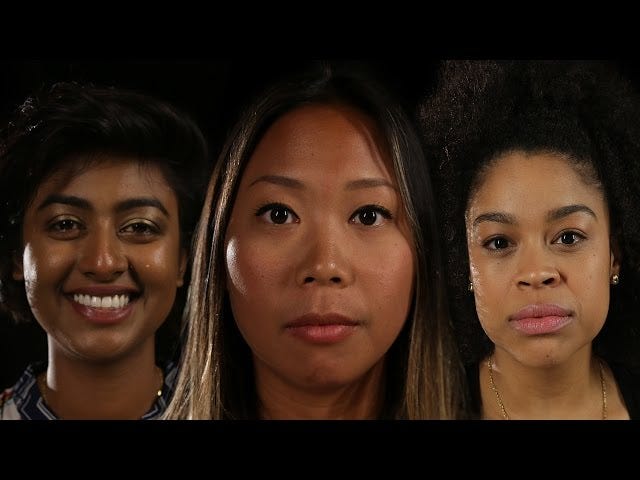
In summary, the introduction of Asians and Hispanics into America reduces the salience of the black-white divide, and forces right-wing radicals to seek alternative “shibboleths” on which to ground their identity, like religion or conspiracy theories. For Nietzscheans who reject religion and conspiracy on elitist grounds, this then leads to a new hierarchical divide, between the peasant masses on the one hand, and the multi-racial elite on the other hand.
Interestingly, there is an argument to be made that this is not happening for the first time, but for the second time. In fact, the concept of whiteness itself can be derived to the first slave ships, which, without becoming polemic, were indeed financed and captained by a mix of Christian and Jewish merchants.
Aboard a slave ship, how do Christian and Jewish merchants cooperate? They did not have a common religious framework, and there was no concept of “Judeo-Christian” or even “western” civilization in 1619. But Christian and Jewish merchants could recognize each other as “white” as opposed to “black.” In the same way, liberal Nietzscheans might recognize that Chinese, Indian, and white elites have more in common with one another than they do with the peasantry of any nation.
I’m wondering if this liberal Nietzschean ideology might catch on among the small minority of ideological entrepreneurs and early adopters who are in a position to have an outsized effect on the intellectual trends of the future.
Almost certainly, the answer is yes, although I personally try to be pessimistic in my outlook to avoid the bias of self-promotion. But let’s say that Richard Hanania has 53k followers on Substack, and I have 4k; I would not be surprised if these numbers double over the next two years. Specifically, the 2028 election will involve a number of potential re-alignments, where some Democratic elites defect to the right, while some Republicans defect to the left. Liberal Nietzscheanism has special salience because of its proximity to the most intelligent and agentic faction of the far right.
One practical example would be Clavicular’s endorsement of Gavin Newsom.
The Future of White Nationalism
Do you think these internal contradictions of the movement will hold or will there come a point when they can’t anymore?
I view white nationalism as something which will grow at least marginally with some degree of stability over the next 10 years. This is because of data showing that as white people get exposed to the reality of demographic decline, they become more conservative. I assume that trend will hold. As non-whites continue to become more visible in prominent positions, I expect there will be a continual inflow of conservatives into white nationalism.
The white nationalist movement has always experienced splits due to internal contradictions. Usually these are based on disagreements between various personalities and a crisis of succession. That occurred in 2018; the alt-right broke down on lines of class and religion.
The wignats represented by TWP broke down due to personal problems;
Richard Spencer retreated from his university tour;
Identity Europa imploded and became AIM, which then imploded again;
BAP and Nick Fuentes began to rise precipitously;
The Daily Shoah began to take refugees from TWP (Erik Striker, Tony Hovater) which moved them away from American Nationalism toward wignattery
All of this will probably happen again. At some point, Fuentes will have his own “hailgate” moment which causes his movement to fracture. You could argue that this has already been happening, to the extent that he has had to go to war with his audience over Epstein.
When these fractures emerge, they don’t immediately collapse a faction. Often the collapse happens in slow motion. Richard Spencer is still alive and kicking, just with much less market-share than he had in 2017. Patrick Casey is alive, but with a shadow of his former influence. JF Gariepy is still around — I could mention more examples. But the rise and fall of particular e-celebs between 2018 and 2024 did not result in an overall reduction in white nationalist ideology as a whole.
Hence, when I see Fuentes complaining, I see that as evidence of a fracture emerging within his movement. However, I do not take that as evidence that white nationalism will not longer grow.
Poaching
a) You mention “poaching” intelligent, high-agency teens who are likely to go on to be among the next generation of ideological entrepreneurs and political activists. Would “poaching,” so to speak, really be necessary? Are new ideological entrepreneurs emerging already? Are these kids still satisfied with the same stale alt-right talking points as they were in 2017?
Nothing is necessary; I am simply expressing a desire. I believe that targeting message toward white nationalists, or crafting messages with them in mind, is effective at changing their minds — or at least, it is marginally more effective than dismissing them, ignoring them, and not thinking about them at all.
White nationalists are often dissatisifed with the state of the movement, but this does not mean that they will positively identify with something else. They will merely be “blackpilled,” but they can then be reactivated at a later time. Trump activated many “blackpilled” white nationalists in 2015 who were previously uninvolved with politics. I don’t think David Duke endorsed Mitt Romney, for example.
I believe it is good to provide blackpilled white nationalists with a new positive vision for the world.
Democracy
1) This question of whether white nationalists are anti-democratic or hyper-democratic is very interesting to me. I certainly see what you are saying about the anti-elitism that pervades the movement and how a lot of alt-right ideology comes down to blaming the elites for mass migration, the great replacement, sexual degeneracy, etc. But since it is, after all, a right-wing ideology, isn’t there an underlying understanding that there must be some kind of social/political hierarchy and so there must be an elite? Their answer just seems to be that there needs to be a better elite (presumably, one that is made up of white gentiles). Here, I think of Yarvin’s citations of the Italian elitists and their theories of the circulation of elites.
Yes, white nationalists consider themselves to be a new elite which will someday displace the current elite. But since that never happens, they remain eternally in the position of the democratic underdog.
A definition of populism as “advocacy for displaced or downwardly mobile marginal groups” helps explain why white nationalism is tied to populism, and why the two feed off each other. One cannot have white nationalism without populism.
a) Another way to approach this question may be to ask whether there might actually be two subsets of white nationalists worth considering here. One subset might be hyper-democratic and direct their anger at the elites and the supposed unjustness of the fact that they have a disproportionate amount of cultural and political power. But another subset may direct their anger primarily at the resentful ideology of “race communism” that, indeed, constitutes a form of moralism and is reviled because it impedes white excellence.
I understand why you perceive a logical contradiction between the two, but in practice, the two are usually bound up in the same incoherent ideology.
Let’s imagine a Nietzschean who hates race communism. The target of his attacks is not Obama, but various “apparachiks” of the regime. Everything he says is directed at the existing elite, who he views at the ultimate threat. These are “fake elites,” in that they have power, but it is exercised within the confines of slave morality, a kind of “fake power.” Slave morality operates like a borgian hive mind, so that no individual has any agency, but conforms to the ruling ideology. This apersonal “zombie civilization” is maintained from the top down, against the “will of the people,” which is ideally pointed toward a charismatic king-figure. “The people” are not the enemy — midwesterners who go to state schools are the natural elite who have been displaced by race communism.
This view seems to be disproportionately common among young white guys who struggle to find jobs after graduating from college. Is it an “elitist” view? It presents itself as such, but it seems to me more a resentful ideology of the middle class than anything truly approaching “elitism.” They LARP as elitists to hide their resentment, but their emotional sentiments are something else.
Usually these guys are smart but they have deep personality defects that prevent their personal development and career success. Low empathy or low conscientiousness seem to be common. Via Helen Andrews they claim that these traits are feminine “slave morality,” and the ideal elite should be more sociopathic, cold, logical, and less “striverish.”
The problem with this story, from my perspective, is that it’s equating middle-management positions with elite positions. Risk-taking is still rewarded in Silicon Valley — are the resentful NEETs willing to do what it takes? In general, they are not, because it is easier to complain and fantasize about how life “could have been” without immigrants and feminists than to do the hard work and make the sacrifices necessary to achieve the position they desire.
Perhaps it’s not accurate to call this complex “democratic” in the sense that it ultimately rejects egalitarianism, but that speaks more to the incoherence of democratic thinking. For example, you can talk to black nationalists who believe “we were kings in Egypt; then the white man took away our civilization.” Is that democratic thinking, or elitist thinking? One could investigate, at a deeper level, the way in which Rabbinic Judaism developed out of military defeats at the hands of the Greeks and Romans — this is where Nietzsche would be useful.
Any group which believes itself to be “a temporarily agrieved elite” is naturally allied with democratic thinking. This was true of ancient Jews and Christians, of black nationalists and white nationalists. There may be logical contradictions, but this is because democracy is inherently incoherent and empty as a concept.
Take, for example, the idea of “free speech absolutism.” The left promoted it in the 1960s; then the alt-right promoted it in the 2010s. Democracy serves a similar function: it is the mechanism by which certain elites gain and advantage over other elites.
Of course, “woke” elites use democracy in a more explicit way than white nationalists, but in an even more convoluted and contradictory way as well. They claim to be defending black and brown people as a “democratic principle,” even in white majority countries. In essense: “woke” elites use the semantics of democracy, but actually oppose majorities; white nationalists oppose the semantics of democracy, but always justify themselves by “rule of majority.” Both sides contradict themselves.
Groyper to Democrat Pipeline?
1) Broader question, but how would you distinguish what you call multi-racial antisemites from Groypers-turned-Democrats? Are they largely the same in that what distinguishes them is that they are far-right people who think it’s best to unite with nonwhites against the Jews? Or would someone like Ana Kasparian be considered part of the multi-racial antisemite coalition, even though she’s clearly not a Groyper-turned-Democrat?
I reject the idea of a Groyper-to-Democrat pipeline. They are not Democrats — they are Nick Fuentes fans who are protesting the GOP. They don’t have a positive ideological affinity with Democrats; they don’t even view them as “the lesser of two evils.” They are engaged in a cynical political ploy. They have not “turned away from Groyperism.”
To the extent that a Groyper can become a true Democrat (in the sense of having a positive affinity toward Democrats as a tribal coalition), they need to go through an intermediary stage. So for example: Groyper to Nietzschean, Nietzschean to Democrat.
1) Also a broader question, but is the only place for someone who is “post-right” on the left? Or might post-rightists reform the right, as dark woke is sort of doing on the left? There might have been a time when left-wingers who were critical of wokeism could only find a political home on the right and oftentimes pretty much just became de facto right-wingers, like the Red Scare girls. But if dark woke is any indication, that moment might be over.
The term post-right doesn’t appeal to me, because it defines itself negatively rather than positively.
Dark woke is a coalition of left-wingers who want to eliminate counter-productive rhetoric on the left and simultaneously embrace edgier and more mainstream aesthetics. So Gavin Newsom saying “Republicans are retarded” is both edgy but also moves away from leftist norms of anti-ableism toward the center.
Nick Fuentes is attempting to reform the right wing as we speak, and there are many other attempts. Will any of these succeed? I expect the right-wing to become more conspiratorial. So in terms of overall market-share, no, I expect Candace and Kasparian to dominate the future, while Fuentes will decline, in relative terms.
Fishback is the future. This doesn’t mean that Fuentes won’t receive absolute growth (2 million followers by 2028, perhaps) but that he will eventually be overshadowed by new right-wing personalities. I could see a younger version of Ian Carroll or Andrew Tate rising to prominence before 2028, who talks about a shadowy “Matrix” and “elites,” implying conspiracies through subtlety but never “naming them.” This is quite different from what Fuentes is trying to do, but I view that kind of rhetoric as extremely popular on the right. It’s what Tucker says; it’s what Rogan says. Ultimately, Fuentes has only 1/30th the size of these larger audiences. He is a small chunk of the pie.
Conclusion
In absolute terms, Fuentes will succeed. His audience will grow over time. In relative terms, Fuentes will fail. The right-wing will become more conspiratorial, more anti-elite, and more democratic in its thinking. This is true of white nationalism, as well as the wider right-wing.
BAP criticizes the right-wing for having a “peasant mindset,” but his critique is not representative of the larger direction of the right-wing movement. There are much larger forces at work than either of them can control.
It would not be accurate to say that Tucker’s audience is majority white nationalist. I would estimate that between 10-30% of Tucker’s audience would say things like “America should be a majority white country.” 90% of them might feel that way, but only a minority would admit it to a pollster.
However, over the next two years, I expect that number to increase, maybe to 15-40%. At the same time, I expect Tucker’s audience to grow. Or, at the very least, I expect the total audience of the “far right” (Candace, Tucker, Carroll, etc) to grow. Even if Tucker declines, someone else will rise to replace him or compensate for his loss.
You can see this with Alex Jones. As Jones has aged, others have risen to replace him.
Qualitatively, I would not overestimate just how “rational” or “elitist” Fuentes is. In 2018, he was promoting the idea that dinosaur bones were a hoax. I don’t know if he’s changed his position on that, but it’s indicative of his personality. He forbade his listeners from taking the COVID vaccine; now he’s more neutral on it. But he still promotes the idea that Israel killed JFK, that the USS Liberty was deliberately attacked, that Peter Thiel is part of a transhumanist, and so on. Whether or not those things are true (Thiel might indeed promote transhumanism), they are all in line with the general worldview of conspiracy theorists. So long as Fuentes promotes these things, he remains well within the orbit of the people he criticizes.
Fuentes is highly combative; this goes back to his origins in the optics war. He realizes that the best way to generate content and interest is by attacking those who are similar to him, but outside his orbit. This is part of his strategy. But it does not indicate that the right-wing is falling apart, or that the “white nationalist moment” is over. It’s just getting started.