
the "redpill" is dysgenic.
Sexual Selection and the Age of Consent

There are a few moral justifications for the age of consent.
The intellectual model:
Humans below a certain age lack the cognitive capacity to understand things like sexuality.
If a human engages sexually, but does not understand the process, this results in confusion and harm.
Below a certain age, sexuality is harmful.
The intellectual model suggests that 9 year olds “playing doctor” would be traumatized as a result of their experimentation. I find this anecdotally doubtful. We hear tearful accounts of adult-child sexual abuse, but I have never heard someone cry upon recounting child-child sexual abuse (so long as the age difference was small). This indicates that “understanding sex” is not the key factor in determining its traumatic impact, which leads us to the power model:
The power model:
Rape is a form of sex in which one person holds all the power and agency, and the other person has none.
The optimal form of sex is one in which both people have full power and agency.
Age gaps risk trauma, because they create a power gap, which approaches rape past a certain threshold.
Adults can understand this risk and willingly enter into age gap relationships.
However, children are unable to conceptualize this risk, and have to be paternalistically protected from themselves (they cannot consent).
The power model implies that an 18 year old dating a 40 year old can be hurt and abused as a result of the age gap. But we socially accept this risk because, past a certain threshold, we value the sovereignty of the individual more than reducing harm.
Similarly, we know that excessive alcohol consumption is harmful. Objectively speaking, a 14 year old having a small shot of cider (like you find in a German winter market) is much less harmful than a 21 year old drinking until they black out or vomit. Yet the former is illegal, while the latter is legal. If we were trying to legislate away harm, we would prosecute binge drinking among adults *more harshly* than we prosecute wine-sipping by teens. But we do not, out of respect for the autonomy of adults.
Implicitly, the moral core of the power model of consent is that society has a duty to protect individuals from making poor decisions based on an inability to conceptualize risk. Children do not know what is best for themselves, so we make sex and alcohol illegal for them, to protect them from their bad decisions. The implication, however, is that if a person’s intellect (or responsible decision making capacity) were below that of the average 14 year old, we should also prohibit that person from having sex or drinking alcohol.
Assume that a majority of 14 year olds have an IQ of 85, and that 25% of adults have an IQ below 85. Does this mean we should make it illegal for a quarter of the adult population to have sex or drink alcohol? This is what would follow, but it doesn’t seem as appealing or morally compelling.
Why is it that we as a society are so compelled by the idea of an age of consent, such that it is one of the last remaining sexual taboos with strong legal enforcement, but the moral models to defend it are relatively weak and not consistently applied?
Subconscious Logic
The age of consent has a selective1 purpose, which is understood subconsciously.
Very few people justify the age of consent in sexually selective terms. In the same way, very few people support segregation, even though they send their kids to “good schools.” Cognitive dissonance is a sophisticated and powerful tool that humans use to reconcile strong opposing emotions.
If we are socially conditioned to believe that something is very bad, but we are also strongly invested in pursuing that thing, the mind is able to maintain a “surface narrative” while also maintaining an underlying “subconscious logic.” The ultimate logic behind the age of consent is at least somewhat subconscious, while the exoteric justifications for it are flimsy at best.
The selective model:
Children are less judgmental and discriminatory than adults.
Children seek out love, affection, approval, and attention from adults, regardless of whether those adults are attractive or not.
As humans age, they become more discriminatory and judgmental in their social selection, which has sexual implications.
If we want to maximize sexual selection, we should prohibit children from having sex.
The selective model has the benefit of being simple, and does not run into the contradictions or weaknesses of the intellectual or power model. It also helps us understand why violations of the age of consent are stereotypically caricatured as “a dirty old man preying upon the beautiful young girl.”

The dirty old man represents a low status man: he is physically weak, asymmetrical, low IQ, and infertile. The beautiful young girl represents a high status female: morally upright, symmetrical, intelligent, fertile. The pairing of the two represents a loss of sexual selectivity, which results in dysgenic outcomes.
The loss of selective fitness is not just a problem for the girl’s individual family, but a loss for society as a whole. Healthy, athletic, intelligent individuals provide the competence (human capital) upon which we all depend for the maintenance of social and technological complexity. The opportunity cost of runaway dysgenics is a loss of technological innovation, and a depreciation of collective wealth.
Even the ugliest and most low status male has a long-term interest in collective wealth, so long as he benefits from this wealth in the form of welfare. Ancient Rome had welfare, so it’s not a modern invention of socialists, and the tribal communism described by Marx created similar conditions.
If we were to model the change in welfare over time, it would look like a U-shaped curve: tribal societies with close kinship bonds probably had high levels of welfare (food sharing), and advanced social democracies or communist societies also have high levels of welfare. At some point in the middle between the two, we would expect welfare to reach its lowest point, and as a consequence, pedophilic, rapey, or polygynic (disloyal) behavior on the part of males would reach its maximum.

I have written previously on the obstinance of Hindu nationalists to raise the Indian age of consent for religious reasons, however, it should be understood that this was in the context of arranged marriage laws, which is different from “dirty old man preying upon a young girl.” The arranged marriage provides social support for the pairing, which ostensibly addresses the underlying selective anxiety surrounding an “unequal pairing.”
Where there is the greatest occurrence of “social defection” from age of consent norms is during periods of nomadic migration. During such periods, men are uprooted from their social context and see little benefit to being loyal to a social system, since welfare payouts are unstable or non-existent.

In the pastoral societies of the Sahel, we see widespread polygyny, female genital mutilation, and I would not be surprised if there were also weaker norms around the age of consent. When Mohammed married Aisha, he did so as a nomadic Arab (prior to the Arabs becoming settled, domesticated, and agricultural) during a time of migratory upheaval.2
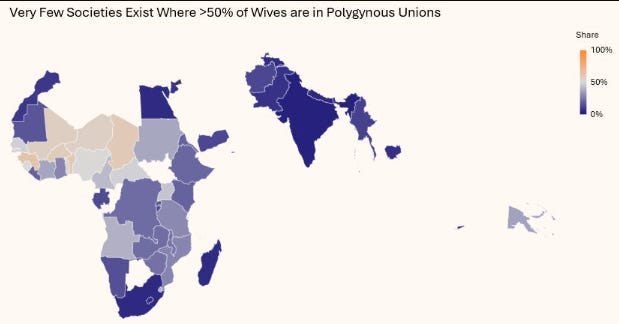
We also know that rape occurs at a much higher incidence rate during war than at any other time. Usually this is explained through xenophobic hostility. Rape is used sadistically to punish an occupied population. While the xenophobic model has predictive power, the incidence of rape, especially of young girls, may be amplified by the aforementioned migratory-welfare model. When men are migratory and removed from their social context (low social enforcement), and exposed to the privations of war (low welfare), they are much more likely to violate age of consent norms.
This also works in reverse: not only are migratory men more likely to violate age of consent, but also, there is more leniency granted to violations by migratory men. We could reference the rape of teen girls by migrants to Europe, or the forgiveness granted to Roman Polanski as a foreign director.
What I am stating here is not absolute; in a xenophobic culture (among conservatives), rape by foreigners is considered much more serious than domestic (home-grown) rape. There is also the confounding ideology of anti-racism, which states that migrants are an oppressed class. All of their crimes can be excused as a product of “systems of oppression” and colonialism rather than being a product of their own agency.
Young girls seem to have a natural and in-born revulsion for “dirty old men.” Whether this is genetic or “deep culture” is difficult to determine, but it is an independent psychological structure from the desire of adults to protect children. In the intellectual and power model, and even the selective model, we assumed that children lacked the capacity for knowledge or discrimination, which made sex harmful as a result. However, if this were the case, then that would not fully explain why young girls get the “ick” when their gym teacher stares at them for too long.

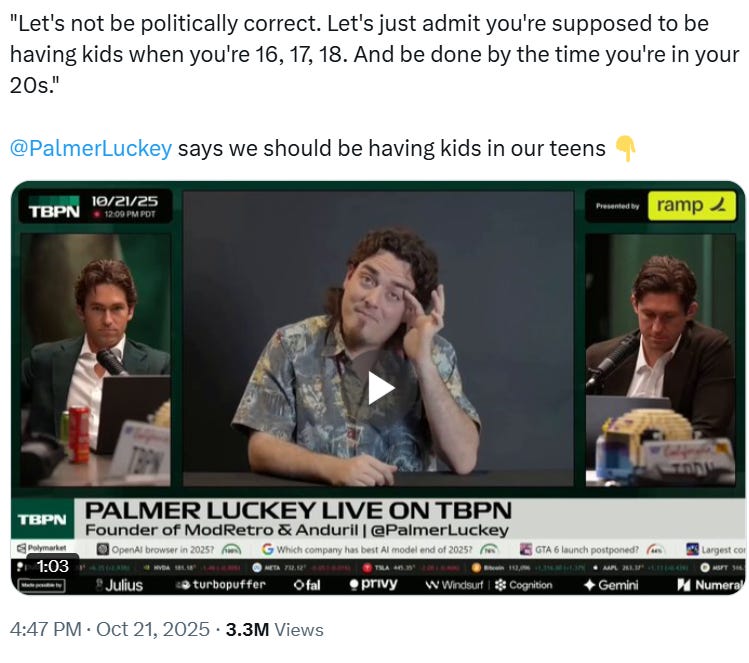
Palmer Lucky recently claimed that it is natural for girls to have children starting at age 16, and to then be finished having kids around age 30. This doesn’t align with the historical data: most data we have places the median age at first child birth between 20 and 26, and the median for last birth centers on 35. There are of course exceptions -- some 13 year olds gave birth, and some 40 year olds give birth -- but if we are speaking normatively, 16-30 is not the historical range.
Biologically, most females are capable of pregnancy following menarche. The age of menarche historically has fallen between 13 and 16, although it varies between populations. Yet human patterns of first childbirth do not immediately follow menarche. The reason for this is that human courtship rituals take place over weeks or months, and this delays pairing, for selective purposes.

In the animal kingdom, courtship rituals are short and confined to a few minutes, or perhaps hours. Humans can engage in this kind of behavior, as in the bacchanalia of a club, where alcohol loosens social rules and results in hookups or one night stands. Online dating also changes the social rules. But for in-person courtship, absent alcohol, most mutually attracted pairs do not immediately have sex.
I would anecdotally estimate that the average time between first meeting and first sexual encounter is around 2 weeks. Thereafter, assuming normal fertility, it will take a few months for pregnancy to occur, and then 9 months for birth to take place. Even if 16 year olds can viably give birth, the length of courtship and pregnancy delays birth until 17 at the earliest.
But this minimal-case scenario does not represent the fullest extent of socially determined courtship norms. During the courtly love period in France, the idea of a hidden romance between two lovers, which lasts years before consummation, was idealized. In the Victorian period, letter writing was promoted as a noble form of courtship.
Extending the period of courtship is selective, because it allows females greater opportunities for hypergamy (partner switching) and places greater demands on male investment. If a male has to make a small investment (one date), he is not likely to take selection very seriously. He can “hit it and quit it,” without feeling the need to be very selective. However, if in order to have sex, he needs to spend months writing letters, meeting parents, going to balls, attending the opera, he will be much more selective, because the costs of investment are higher. For the female, the longer trial period to socially vet the male creates higher demands on his social fitness (adherence to norms, fashions, taste, sensibility).
The power theory and selective theory complement one another. If a man is older, he has had more time to invest, while a young man has had less time. The older man has an unfair advantage with respect to his inherent genetic quality. In order to compensate for this unfairness, it is advantageous for society to discriminate against older males pairing with younger females, to give young men (who have had less time for investment) a handicap.
Wealth is not the only unit of accomplishment; musical talent, fame, athletic awards, and military victories are all similarly important in determining attraction. All of these things require time to develop.
According to MGTOW, trad, patriarchal, and redpill influencers, it is natural for younger women to prefer older men, because older men have more resources to financially support her. This is an inherently dysgenic mindset, because it privileges the accumulated material status of a man above his inherent genetic worth. Redpill influencers are biased toward this “naturalistic” thinking because they are dysgenic freaks.
Feminism is selective in attacking redpill influencers and age gap relationships. If we want females to select partners based on genetic quality, rather than accumulated status, we should discourage older males from mating with younger females. Ideally, we would increase social costs for single, unmarried bachelors, to socially punish them for not being able to attract a mate at an earlier age, to devalue the weight of accumulated wealth and accomplishments.
YIMBYism is also selective in that it allows younger people more mating opportunities by allowing them to secure housing in densely populated areas. NIMBYism is dysgenic because it forces young people to live with their parents, which reduces their mating opportunities.
conclusion.
The relationship between age and sexual selection is a bell-shaped curve. Young children cannot be sexually selective, because they are not sufficiently discriminatory toward adults. However, as men age, they accumulate accomplishments and wealth, which grants them an unfair advantage against younger but more genetically fit males. The ideal social conditions for sexual selection are to prohibit sex between young women and older men. This allows young women to develop their discriminatory powers (with the cynicism of age), and prohibits older men from flexing their wealth to gain an unfair advantage in the dating market.
On the other hand, in theory, there is little selective cost from allowing older women to sleep with younger men. The reproductive cost of sperm is lower than that of eggs, so a female teacher being impregnated by her male student isn’t prohibitive. A 14 year old boy has not accumulated any wealth or accomplishments, while his 25 year old teacher is (theoretically) past the age of naive attention-seeking and has developed her cynical, discriminatory powers. The dysgenic risks of such a pairing are much lower than the reverse.
In reality, 25 year old women who sleep with 14 year old boys are emotionally retarded and their discriminatory powers are flawed. Still, there is a smaller selective cost to allowing older females to violate the age of consent than allowing older males to violate the age of consent.
Liberalism and feminism are selective technologies which ruthlessly bully low status men into extinction. In a more primitive time, these men could be killed, castrated, or enslaved. Today, we are more civilized, and we call them names like “creepy” and police them with sexual harassment laws.
The MGTOW/redpill/trad/patriarchal fantasy of abolishing or lowering the age of consent is a result of low-status males trying to escape the pressure of sexual selection. When Palmer Lucky suggests that 30 year old men should be impregnating 16 year old teens, he comes off as creepy, because he is compromising the integrity of sexual selection. The “ick” is the voice of our ancestors, telling us to throw ugly people off cliffs, for the purification of the race.3
After recording the audio I realized that it was a mistake to use imprecise semantics and adjusted my language to be more accurate. There is a qualitative moral difference between voluntary, decentralized sexual selection and centrally-planned, violent, and genocidal state-mandated eugenics. That said, the audio still has a comedic edginess to it, so I’m not too bothered by this mistake. I just want to make it clear that I don’t endorse classical eugenics.
If you’re listening to the audio, I mistakenly thought that Charlie Johns was from the American west; he was actually from Tennessee.
I am skeptical of mutational load theory, but if you take it seriously, that’s another reason to bully geezers.
Unless you’re leaning heavily into mutational load theory, someone’s accumulated resources and status is a good proxy for “genetic quality”
I don’t understand the “welfare” point.
Setting that aside, is it the case that teen girls select inferior men compared to others? It seems like teen girls lust after the same things as young women above the age of consent: fame, looks, money, power. I don’t think they find middle age janitors attractive. Perhaps there is more randomness in the process with teen girls, which sounds right.