
Rob Henderson, Please Respond.
"sufficiently harsh moral outrage"

Rob Henderson1 implies things, but he never comes out and says anything definitive.2
He implies that old people are better than young people because old people make harsher moral judgments.3 If that’s not Rob’s argument, I am asking him to do one simple thing:
Deny the implication, explicitly.4
Rob believes that “older generations [should]5 reclaim their authority and leadership” by saying that:
“[old people] are more responsible, reflective, and stable than the young”6
Young people have higher rates of “narcissism,” “callousness,” and “psychopathy.”7
“Older adults consistently rate moral violations more harshly than younger adults”
“Moral outrage is associated with harsher condemnation of transgressors”8
“Older age coincides with the Light Triad personality traits”
“Younger adults deemed actions like tax evasion or theft as more permissible”

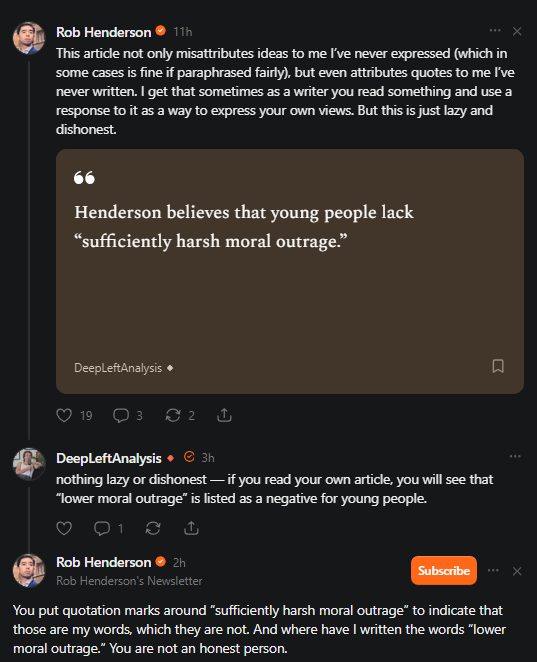
“sufficiently harsh moral outrage”
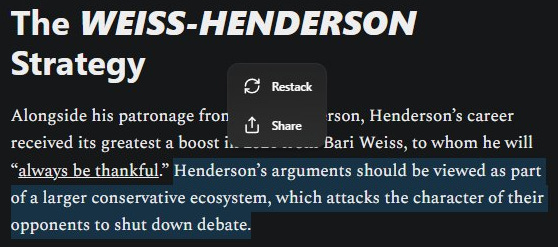
I put quotation marks around the words “sufficiently harsh moral outrage.” In my mind, it is acceptable to use quotation marks when you are paraphrasing someone. In Rob’s mind, this is evidence that I am a dishonest person who is not worth engaging with.
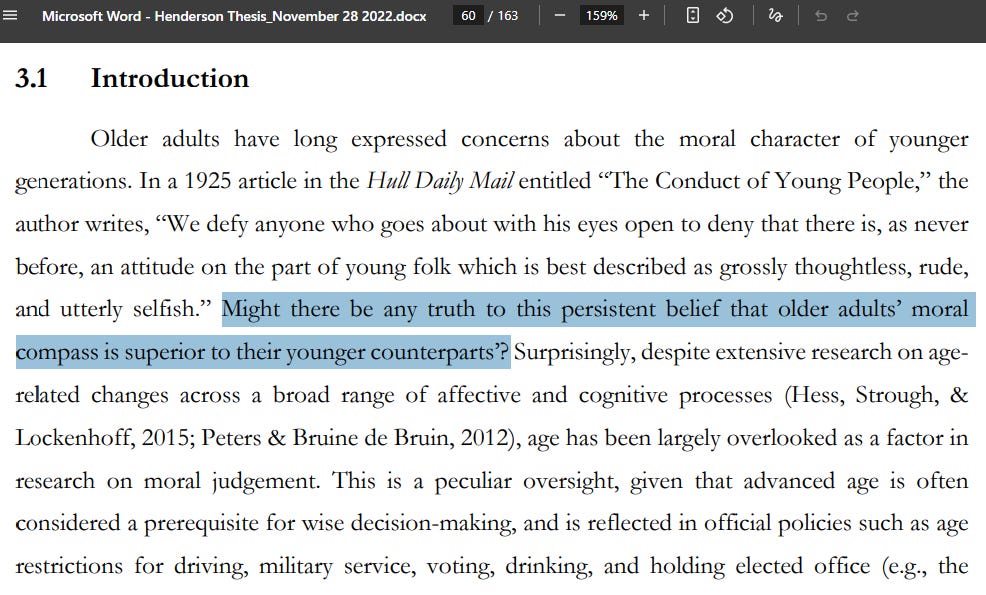
Here’s the screenshot from which I derive my claim:

“Older adults… rate9 moral violations more harshly”
“Overly morally permissible” is equivalent to “insufficiently morally outraged.”10 My “quote” of Rob’s position was substantively accurate, if not word-for-word.
In Rob’s thesis, he uses the term outrage to mean (this is not an exact quote) “an emotion proceeding from (or motivating) a harshly-rated moral violation.”11
Rob is careful to point out that while moral outrage can be positive in some circumstances, it can be negative in other circumstances:
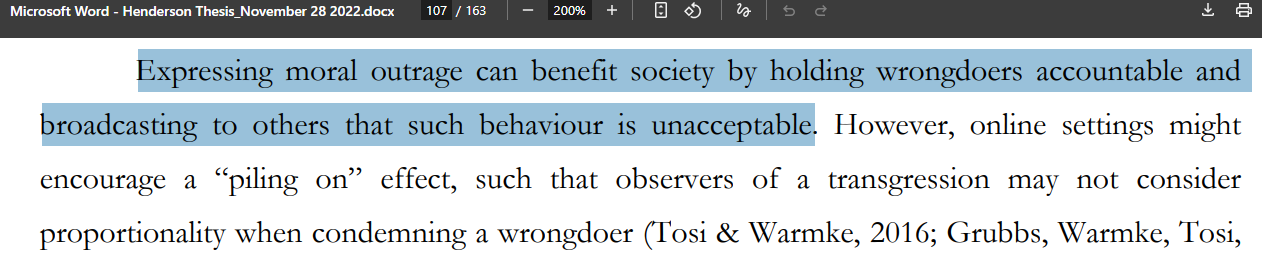
You might come away from this thinking that Rob is describing “moral outrage” in an entirely neutral way. That’s an entirely fair interpretation if we are to take this one quote in isolation. But in the context of his wider article, that’s not the only possible interpretation.
Rob, please clarify, rather than name-calling.
Tell me, specifically, what part of this is wrong:
Rob says that older adults “rate moral violations more harshly”
Rob says that older adults “might” have a superior moral compass12
Rob connects harsher rating of moral violations to “moral outrage”
Therefore, I infer that he is suggesting that young people are insufficiently morally outraged by acts of callous, psychopathic, or narcissistic behavior.
If that is not what he means to imply, he should simply say so.
Rob Henderson, please respond.
Conclusion
I can speculate as to why Rob might be accusing me of dishonesty:
Rob did not recall using the word “moral outrage” in his thesis (from four years ago), and he was surprised to see me paraphrasing him in this way.
Rob believes that there is a substantive difference between the way that I am using the term “outrage” in my characterization of his argument, and the way that he uses the term “outrage” in his thesis.
Rob hates it when people use quotation marks around exact phrases that he never used, even if it distracts from substantive argument and gets us nowhere.
Rob prefers calling people “dishonest” rather than engaging with arguments.
Rob isn’t mad at me for “misquoting” him. If I wrote a glowing review of his idea of luxury beliefs, wherein I accidentally paraphrased him incorrectly and slapped some quotation marks around the paraphrase, he would not be referring to me as “dishonest.” He would ignore the syntactical faux-paus and focus on my love, praise, and adoration for his charming good looks and brilliant ideas.
Instead, I wrote an essay which was thoroughly and completely antithetical to everything that Rob Henderson believes. This was annoying for him to read, and he took issue with… pretty much everything I said.
Good! That’s how debates are supposed to work! Now, he has the opportunity to make substantive arguments about why I am wrong.13
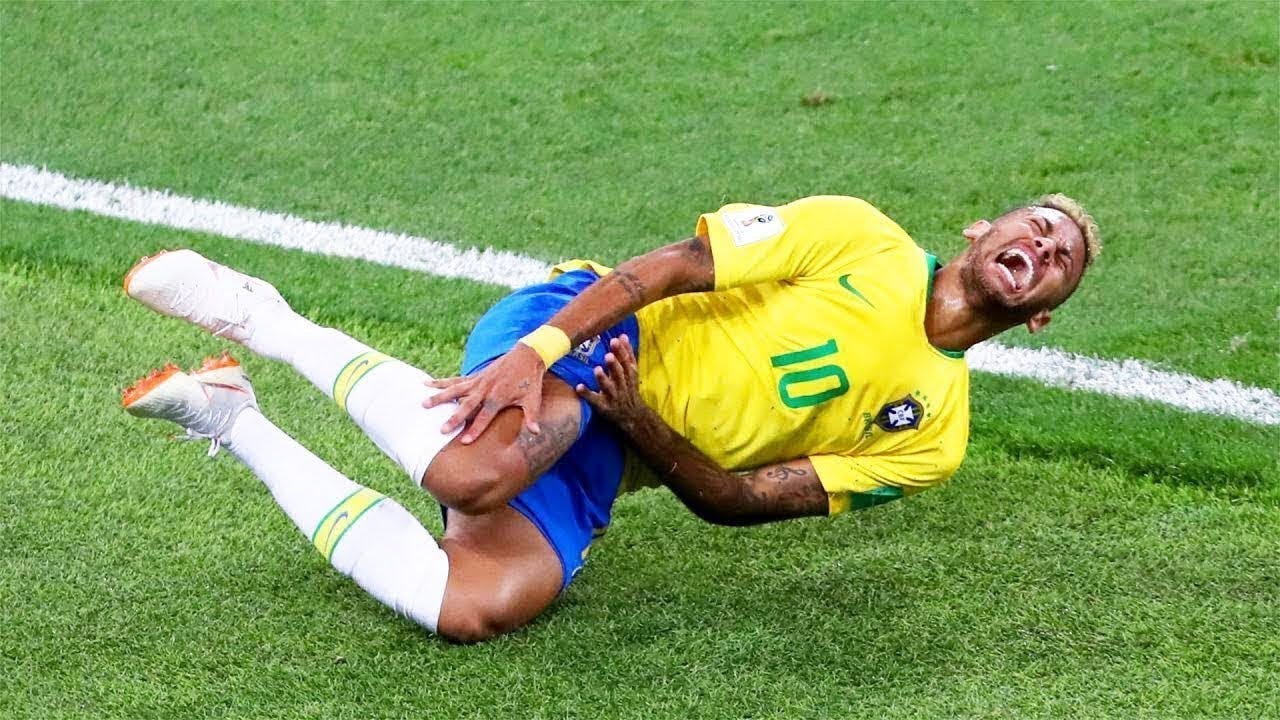
Refusing to engage with any of my arguments because I am “dishonest” on technical semantic grounds is the equivalent of faking an injury in soccer to score a penalty kick. Go ahead, take your penalty kick! Pick my worst argument, and make a counter-argument.
Rob, I was wrong. I am sorry. I did not meant to misquote you. It was bad form of me to use quotation marks without copy-pasting word-for-word transcriptions of your writing. I played fast and loose with the rules. I have learned my lesson and I will strive to do better — getting bogged down in technical fouls is not in my self interest.
However, my intention was to genuinely, authentically, honestly trying to summarize your arguments, so that I could expose inconsistency, logical contradictions, and anti-youth hatred.
Dispute substantively.
Sincerely yours,
-DLA
I’m not quoting anyone here when I say “quotation marks.” I just like using quotation marks because it reflects how I inflect my tone of voice while I’m speaking, and I write as I speak. I call these “scare quotes.” That’s also not a quote. See — quotation marks can be used in many ways, outside of literal quotes. , I am using quotation marks as a verbal cue, so that when you read this using your inner monologue voice in your head, you remember to make invisible quotation marks with your imaginary fingers, Dr. Evil style. This is especially common among deeply closeted homosexuals.
I just like using quotes. This is a bad habit of mine! I just love quotation marks! I am sincerely not trying to mischaracterize my opponent’s argument, especially when I have linked to his essay where you can ctrl-F and read for yourself!
But if I say, “Rob says old people are better than young people,” that’s technically not an exact quote. He did not literally say that. But he did heavily imply it.
Tell me that you think young people are sufficiently harsh in their moral judgments (“outrage”). If Rob can do that, we can get somewhere, rather than descending into “mischaracterizations” (not a quote) and “ad hominem” (that’s me quoting myself).
Here’s a screenshot from his essay:

I took the word “should” and changed the word order of the sentence.
In Rob’s original essay, he asks it as a question, rather than putting it as a statement. Rob does this a lot, and it makes it hard for me to tell whether Rob believes in things, or whether he is, in the words of Tucker Carlson and Dave Smith, just asking questions.
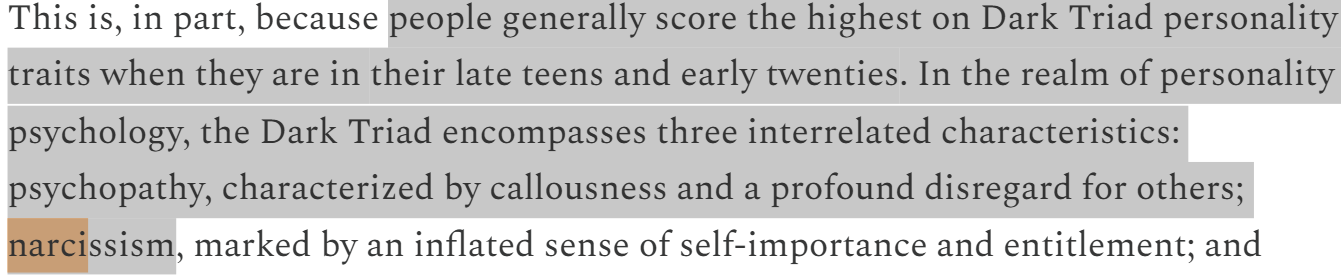
This is from his thesis.
What does it mean to “rate” something, morally speaking, in a harsher way? If I were to say,
“You are rating my behavior very harshly, Mr. Henderson,”
that means that Rob is being overly harsh when he equates my liberal use of quotation marks with evidence that I am a dishonest person. Deliberately mischaracterizing one’s opponents… is outrageous.
What are some antonyms for permissible?

Intolerable… unacceptable… unbearable…
Now if you’ll forgive me, I am going to turn this essay into AI slop. Yes, I am going to appeal to the authority of AI. Sue me!
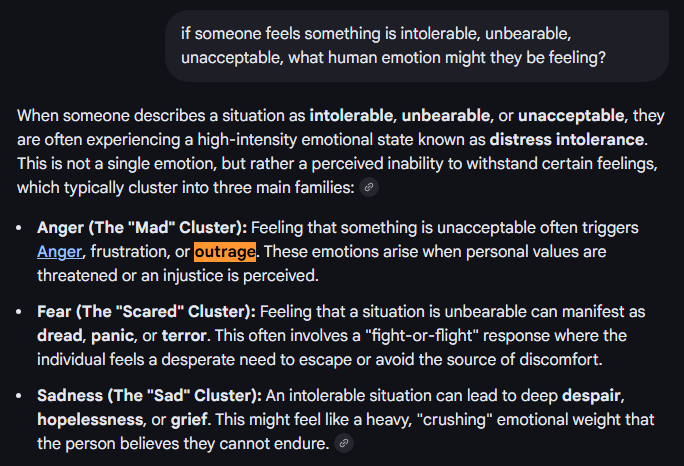
As you can see from the AI Gods, if someone feels that something is intolerable, unbearable, or unacceptable, then they are feeling one of three emotions:
Anger… such as outrage
Fear… such as dread, panic, or terror
Sadness… such as despair, hopelessness, or grief
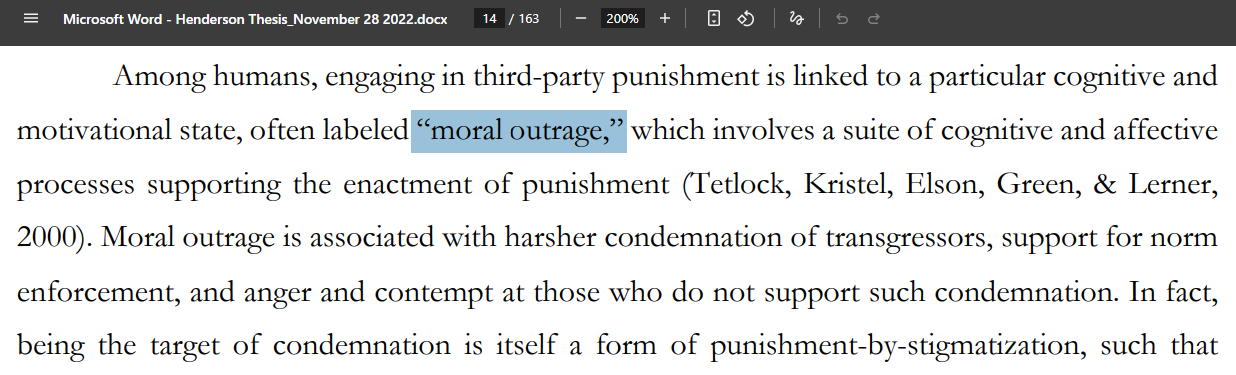
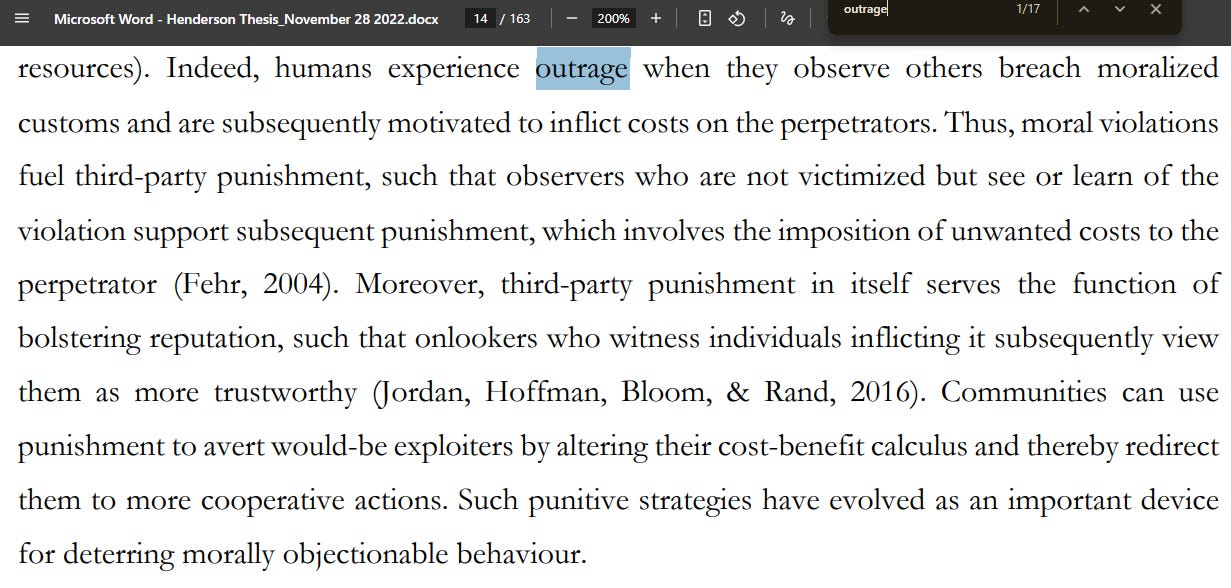
The best debate is one in which two opponents can agree on facts, but disagree on values. That’s a difficult achievement, because it requires both opponents to see external reality in the same way. But if we can pull that off, then we can really focus the debate on ethics, at which point it becomes a matter of philosophical divergence rather than empirical disagreement.
I would like to get to that point with Rob, but right now, we haven’t even disagreed on anything. All Rob has said is that I am dishonest, because I incorrectly quoted him.
It is fully accepted to use quotation marks for non-verbatim purposes, i.e., to encapsulate, paraphrase, or coin a phrase; but they are also used for verbatim quotation and it's up to context to disambiguate between these uses. The most unambiguous contextual device would be a formal page citation, or if you use square brackets within the quotation that makes it clear that it's meant to be verbatim (with modifications in brackets). Perhaps you could have been clearer in context that it wasn't intended as a verbatim quotation, but I also think Rob is being unnecessarily and counterproductively uncharitable. Persnickety, even.
You know someone's a serious thinker when their footnotes are longer than the work itself.