
Globalism with Xenophobic Characteristics
Popular Elitism.

Today is a beautiful day for Deep Leftists. Peter Magyar’s party has achieved a supermajority, which will allow them to rewrite Hungary’s constitution. This is a monumental occasion. George Soros won. Putin lost. Globalists are in control.
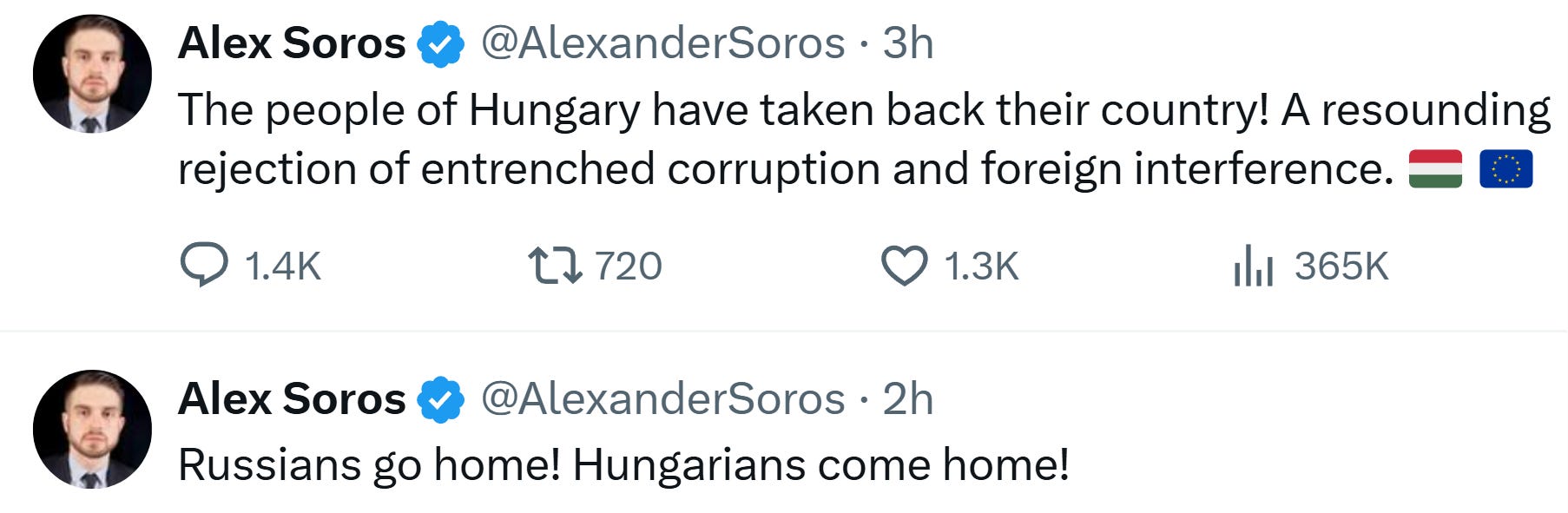
All the usual suspects are whining. All of the “official” identitarian groups are claiming that Hungary will now embrace gay sex and open borders. And while I have no problem with that, I think they misunderstand what is going on.
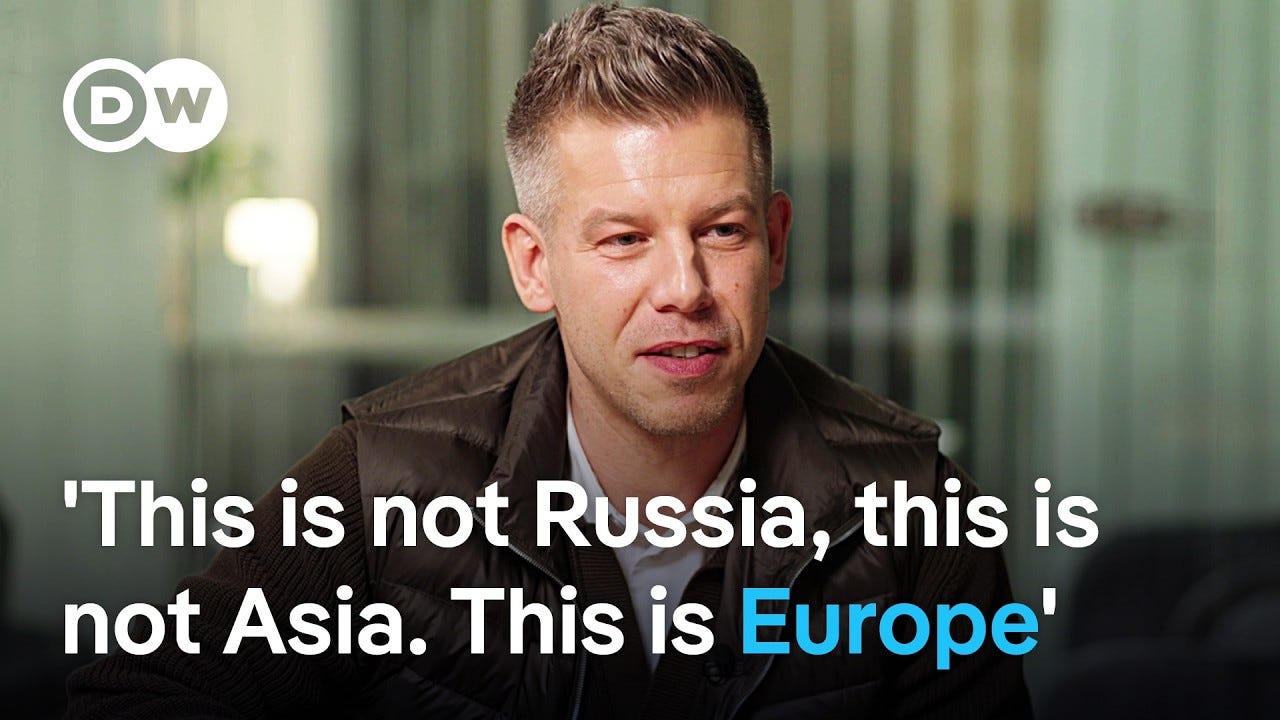
Peter Magyar did not run on gay sex or open borders. He ran as a far-right candidate.
He claimed that Filipinos in Hungary were eating ducks and goldfish out of Budapest zoo. These comments directly mirror Trump’s claim that Haitians eat “cats and dogs.”
Magyar attacked Orban for allowing these guest workers into the country. He promised a total and complete shutdown on guest workers, indefinitely, from outside the EU. He argued that Hungarian workers should come first, and not face competition from non-Europeans.
Magyar follows the rhetorical line of Georgia Meloni, who simultaneously promised to cut immigration while taking a harder stance against Russia and Israel. Meloni’s promises on immigration have fallen through, but her rise to power required an appeal to nationalism.
Globalists can learn from Meloni and Magyar. Rather than fighting the right on every single issue, simultaneously, we can steal their talking points where appropriate, achieve electoral victory, and implement our policies.
One might call this “tricking the goyim,” or one could call it “globalism with xenophobic characteristics.”
I advocated for this in my essay Globalists Should Join the Far Right.
HOW CAN GLOBALISTS WIN?
Globalism means maximizing three things:
The freedom of movement of things
The freedom of movement of people
The freedom of movement of ideas
It could be argued that, to the extent that the right-wing used to represent the party of free speech and free trade, that the pre-2015 GOP was better for globalists. At the very least, the situation was more ambiguous than it is today.
The triumph of Trump was the result of a long and slow process of political realignment that began with Barry Goldwater, Ronald Reagan, and George Bush. When the GOP began its “culture war” in the 1960s, kicking out the “Rockefeller Republicans” in the 1980s, embracing Evangelicals, and making abortion a foundational issue, they lost many educated voters, and gained many uneducated ones.
Uneducated people do not like globalism. Globalism, like all forms of progress, is destructive toward those who cannot adapt. It destroys old gene pools; it destroys old languages; it destroys old customs, habits, and religions. People who are xenophobic, conservative, traditional, and close-minded are naturally opposed to globalism.
Those who are open-minded are at a disadvantage. This is because open-mindedness1 is associated with a smaller amygdala, which is the threat center of the brain. People with an overactive amygdala are more fearful, aggressive, and violent. People with a smaller amygdala are more curious, sensitive, and experimental.
Democratic politics rewards whichever side can get more people to the polls. The strongest form of motivation, unfortunately, is not a sense of curiosity and a love for experimentation, but fear, anger, and resentment. In this way, democratic populism promotes mob rule, and is thus inherently conservative.
From 1776 to the present day, there has been some confusion over the true nature of democracy. For the first two hundred years of American democracy, poor and black people were either banned from voting, or had their voting rights curtailed by literacy tests and gerrymandering. While America used democratic language to justify its form of government, it did not practice, strictly speaking, “rule by popular vote.”
Up until Teddy Roosevelt in 1912, neither the Republican nor the Democratic Party had a primary system. Instead, they had a small elite cabal of “delegates” who would select the nominee; the American people would then get to decide between these two hand-picked candidates.
If we kept this system, we can imagine that the race in 2016 would have been between Jeb Bush and Hillary Clinton, as the two party favorites. Clinton probably would have won.
Most European parties use this “delegate” system rather than the “primary” system. If they do have a primary, it is not an “open” primary, but a primary for members of the party, which narrows the pool who are eligible to participate. Theresa May and Rishi Sunak didn’t become Prime Ministers because they were popular, but because they rose through the ranks of the Tories in Britain. This selectivity explains, in part, why European countries tend to be much less populist in orientation than America.
At a certain point, it becomes difficult to rig the system in this way, because popular resentment becomes so impassioned that to deny popular sentiment would incur a total collapse in trust and legitimacy. It becomes necessary for the system to make concessions, even if those concessions are merely rhetorical in nature.
PRIORITIES, PRIORITIES, PRIORITIES!
If we accept that globalists need to make concessions to maintain and expand their power, what sort of concessions should they make?
First of all, politics is cyclical. It might even be influenced by solar cycles, if you believe in that sort of thing. As a result of the cyclical nature of politics, there are going to be years where elections are easy, and there will be other years where elections are hard. Understanding national mood is very important. If you ignore this factor, you will lose in the difficult years, allowing the other party to undo your success.
If our choice is between:
Pro-Russian, anti-abortion, anti-trade, anti-gay xenophobe
or
Anti-Russian, pro-abortion, pro-trade, pro-gay xenophobe
Then the latter is obviously preferrable to the former. Ideally, it would be possible to win elections on a platform of open borders, but that is not the system we presently have.2
Globalists need to make pragmatic decisions based on political realities.
SWALWELLIAN PRAGMATISM
I am vehement in my defense of Eric Swalwell, not because I’m in love with the idea of getting black-out drunk and cheating on your wife, but because I care about winning. Swalwell himself is totally irrelevant; what matters is what he represents: a masculine young white man. I’m not saying that we should specifically encourage reckless drunks to run for office, but if a man turns out to be a reckless drunk a week before an election, we should withhold our moral judgments and vote for the candidate with the right policies and the best appeal to voters.
In 2016, at the last minute, the Access Hollywood Tape was released, with the famous line, “grab ‘em by the pussy.” Dozens of donors and key Republican officials blew up at Trump, promising to take their money and run. Some decided to support Evan McMullin — like JD Vance. But enough Republicans had the stoicism and foresight to realize that if you don’t get hysterical, things like that blow over. Republicans held their ground, Trump won, and they got the policies they wanted.
Democrats could learn from that behavior.
The people criticizing Swalwell fall into a few different camps:
Women, whose job it is to police the behavior of men
Simps, who are Machiavellian sexual predators that use an ideological veneer to gain access to women
DINOs, Democrats in name only, who don’t care about winning, but would prefer to be “beautiful losers”
By all means, vote for Tom Steyer if that floats your boat. But if you take even 5 seconds out of your day to criticize Swalwell, I know that you don’t really care about stopping Trump. I don’t care if Swalwell is a serial killer — infighting is a poisonous cancer. We knew he was a slut for years. Bringing this up now is petty.
Similarly, I see Graham Platner as demonstrating a hope for the Democratic Party. He is young, white, rural, and masculine. Yes, he had a Nazi tattoo, and yes, he made a bunch of offensive Reddit posts, but I’ve done much worse. If you want to win young white rural men to the Democratic Party, you need to either embrace Platner, or find someone even better than him. Newsom’s national approval rating is underwater — don’t talk to me about Newsom.
In Europe, the situation is different, because they lack an entrenched two-party system. This allows for a greater variety of strategies.
CONCLUSION
The best hope for globalists today lies in the following set of policies:
Strengthening the EU and NATO
Working toward open borders between America and Canada
Decreasing hostility between America and China
Disengagement from disastrous Middle Eastern wars
At present, Trump, as the leader of the global national-populist right, is actively campaigning against the EU, suggesting we leave NATO, pushing away Canada, and threatening to blockade the Strait of Hormuz. Anyone aligned with Trump is toxic and poisonous to globalist interests. They all must go.
To defeat Trump, Putin, Orban, and all their allies, globalists need to make hard decisions. Are we going to get hysterical about a dude cheating on his wife? Are we going to endlessly litigate a skull-and-bones tattoo? Are we going to continue to blather on about “too many white men,” which alienates whites, and doesn’t win you any brownie points with non-whites either?
Locally, and at the state level, there is much to discuss regarding economic policies. Should we regulate data centers? Should we abolish property tax, or increase it? Is NIMBY housing regulation good or bad? These are conversations worth having, but they are lower on my list of priorities than the big picture of geopolitics. When discussing national elections, either for President or Prime Minister, foreign policy is the most relevant issue, and economic policy is better left to state-level or regional elections.
Although Peter Magyar presents himself as a nationalist, and scapegoats Filipinos for eating “ducks and goldfish” from Budapest zoo, he will be much better in the long run for globalism than Orban. Recognizing this fact requires maturity and the ability to see the big picture.
If globalists get caught up in petty or myopic issues, we lose. If we think globally, we win.
I accidentally sent out the email before catching an error here. I originally said “low open-mindeness” instead of just open-mindedness, my bad.
One of the beauties of democracy is that it exists downstream of media control. People can only vote for candidates they know; they can only get upset about what is told to them on the news. If our media never reported on Trump’s candidacy, no one would have voted for him.
This is not a problem of “free speech,” since media control is privatized and not regulated by the government. Theoretically, one could buy Twitter from Elon Musk and reintroduce an algorithm that would favor the left over the right. It’s simply a matter of money and willpower.
I accidentally sent out the email before catching an error here. I originally said “low open-mindedness” instead of just "open-mindedness," my bad.
Why are you pro open borders?