
Against Crypto
Crypto as a Mercenary Religion



My political theology is centered on Machiavelli. In The Prince, Machiavelli compares a religious state with a mercenary state.
In the religious state, men are bound by rituals, traditions, and holy, sacred institutions. Often these institutions are ethnic, hereditary, and blood-based. They all have as their supreme virtue piety, worship and respect toward one’s ancestors and the Gods. Piety is best exemplified in self-sacrifice, whether of the Odinic warrior, the Roman who fights in the name of Apollo, Zeus, and Mars, or the Hebrew who fights for Yahweh.
Machiavelli is modern in his aloofness to any particular religious dogma — he views piety as a good in itself, regardless of the particularity of any given ritual. This is logical given Machiavelli’s criticism of the Catholic church as a corrupt institution, but also as one too early to embrace Protestantism. Machiavelli’s associations can be described as “proto-Freemasonic.”
The new theocratic form of government, according to Machiavelli, should model itself on the Republic of Plato, in regarding itself as a thing of the people. This does not mean that Machiavelli embraces democracy, but that he believes that the state is strongest when it is made definite, blood-based, and theocratic.
Machiavelli is not, however, an “ethnonationalist.” He makes no mention of the Helots as a “people” worthy of liberation, while he praises the Spartans. He explicitly argues in favor of immigration, colonization, and the subjugation of one’s enemies. Machiavelli has no principled opposition to the idea of flooding the provinces with urban foreigners. He does, however, caution against the opposite tactic, which is to allow provinces ethnic autonomy, and to rule over them by sheer force.
Since Machiavelli is writing prior to Rousseau (let alone Marx), when he speaks of the people, it is necessary to disentangle his meaning. He is not referring to slaves, or serfs, or manual laborers as a significant political entity. Rather, he is referring to the professional or middle classes, which are traditionally shut out of political power by the aristocracy, but which, in times of trouble, exercise their will by brute force. These professional middle classes make up the bulk of the “citizen army” that Machiavelli envisions.
In modern day America, “the people” that Machiavelli speaks of would be equivalent to “white urban middle class college educated voters.” This is a solid 30% of the electorate — they are not rich or elite, but they are the backbone of the state.
In other words, Machiavelli would look at this broad swath of the population as “the people” of America, while the welfare-dependent urchins of Springfield, Ohio would be regarded as an irrelevant underclass. In times of trouble, the state cannot depend on those unable to feed themselves (obese, disabled) to defend it. For this task, it requires “the people” — those of middle income, middle intelligence, who dwell within important cities. These people are overwhelmingly liberal Democrats.
Machiavelli has an urban-centered concept of state power. Rural populations are irrelevant, and they cannot project power. Even if a rural group could assume power, it would need to do so either with the consent of urbanites, or in opposition to them. Eventually, however, every regime must reconcile itself to the urbanites, or crush and replace them with a new class. Power is held in cities.
A Machiavellian account of state legitimacy would look kindly upon Zohran Mamdani. Here is a man who is creating jobs for lawyers, social workers, and genders studies majors — the middle income, middle intelligence, urbanites. Zohran represents a faction within the Democratic party that wants to eliminate student debt and make healthcare free. Whether or not such policies are fiscally responsible, they directly reward “the people” and legitimize the state.
Crypto attempts to side-step this process of building up state legitimacy by instead using technology as a God-like authority. This is problematic for multiple reasons.
Assume two ideal solutions to the problem of legitimacy. The first operates along traditional lines — reward your friends, punish your enemies. It is not very complicated or innovative, but it gets the job done. The second, however, promises some innovative new solution to the problem of legitimacy. It provides complicated, obscure mathematical justifications. At no point do we “come back down to the Earth” and discover what any of this complicated math has to do with the daily business of ruling the state. If you don’t understand these abstract concepts, you are probably just dumb, and NGMI.
The problem with this logic is that legitimacy is mythological. Meaning: legitimacy is a set of beliefs which constitute the power of the state. If your state legitimacy is illegible without arcane mathematical knowledge, then it is useless.
The best way to understand legitimacy and authority is as a hierarchy. At the base of the pyramid, you have the simplest possible explanations for state legitimacy. At the top, you have refined concepts. For a Christian state, the base would represent Pascal’s Wager, and at the top, you might have Platonic justifications of theism.
Crypto, theoretically, offers a top, but it has no base. “Crypto legitimizes the state — trust me bro” is not a good base.
Crypto-defenders might claim that crypto is a limited financial asset which solves certain problems created by fiat currency. In which case: I am wholly disinterested.
This doesn’t mean that I am incapable of delving into financial architecture; see my review of More Money Than God by Sebastian Mallaby here. But the use case for crypto is limited.
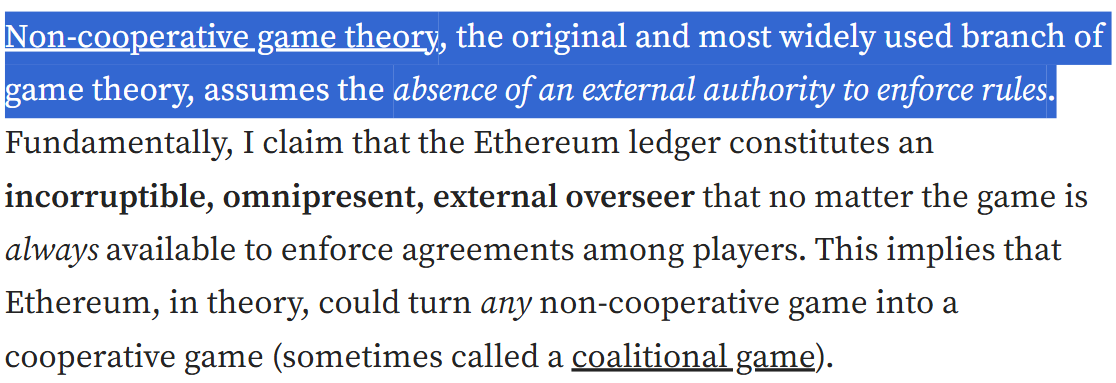
Crypto-defenders seek to expand the scope of the use case. Crypto goes from “a form of money which is a hedge against inflation” or “digital gold” to “it could solve all sorts of problems of trust and replace all authorities, turning non-cooperative games into cooperative ones.”
Crypto-defenders have a vested interest in pushing crypto, which makes them suspect. You could also make this criticism of any group: hedge funds have an interst in defending hedge funds. But due to the populist nature of crypto, it is more insidious.
Hedge funds rely upon the United States government to exist. They have to play nice. If hedge fund managers openly wished for the collapse of the government, they would be heavily regulated and punished. Crypto is unique in that it both benefits from a critique of existing power structures while being largely insulated (theoretically) from regulation. Of course, in practice, Democrats do have the power to regulate crypto, and as a result, crypto-defenders have swung very far to the right since 2017.

What if I’m wrong?
The incentive structure of crypto promotes the dissolution of the current state. This is bad. If crypto could provide a better alternative, I suppose that would be good, but it would be risky. I would compare crypto to any other obscure “alternative media” practice, like Ivermectin or crystal healing. The difference is that crypto has much more math involved and a larger market cap.
It’s possible that Ivermectin does cure cancer, or something, and the mainstream establishment is covering this up to protect their profits. Not plausible, but possible. If that were the case, waging all-out-war on the establishment might be justified — even if we undermine every other good thing (vaccines, hand washing, germ theory of disease) the net benefits of curing cancer would be worth it.
But if Ivermectin does not cure cancer, then we just destroyed public health and got nothing in return. Except scammers like Vivek Ramaswamy just made a profit and got away with it. Many such cases.
Crypto has a stronger case to be made for a limited use case: digital gold. Because the ledger is public, you can trust it. The code is not something you can crack — crypto is a safe asset which cannot be inflated. This is useful for individuals or corporations who are attempting to safeguard their assets during times of inflation. But when crypto-defenders start inflating the use case, to very general and abstract things like “turning any non-cooperative game into a cooperative one,” they lose me.
Let’s say I’m wrong, however, and crypto really does have these magical powers. If that is the case, then by implementing crypto-government, we could get rid of democracy. I think this is what Curtis Yarvin was promoting with Urbit — a digital feudal system, where contracts between Lords and Vassals would be secured by crypto. You don’t need to trust anyone; just trust math.
My problem with this is that it forms a mercenary state without any deeper meaning. The problem here isn’t just one of “trust,” but of meaning.
Let’s say that you are depressed, and you watch some political content, and you completely trust the e-celeb that you worship. What is that worth? Not much. Trust only has value in coordinating competent agents. Trust itself does not build agency.
Meaning, however, does create agency. With sufficient meaning, individuals develop competence. Crypto, as a central “God,” an “incorruptible, omnipresent, external overseer,” cannot provide meaning. It is nihilistic; an empty void.
Summary
I am not against technology; but I am against this cold, lifeless, disembodied silicon fetishism. Robots and crypto are overrated. Cloning and genetic engineering are underrated.
The final taboo is cloning and genetic engineering. If and when that moral taboo falls, the military applications are endless. Biological life has everything from the base to the tip of the pyramid. There is no need to create meaning from the ground up; we don’t need to put faith in some untested technology. We’re merely selecting from elements which already contain the Freudian Id. The spark of life, the soul, is the most powerful force in the universe. Call this mystical, if you like, but mysticism is indeed the foundation of the state.
Crypto attempts to dissolve mysticism with cold math. This is not possible, because that is not how meaning works. Nietzsche would call this approach “the view of the English psychologist.” You cannot dissect governance and reduce it to a matter of trust; trust is really downstream from meaning, and trust without meaning is inert.
Consider, in love, a woman who you could completely trust, but to whom you had no attraction. Now consider a wild woman, who you cannot trust, but who compels you greatly. The former is a dead bedroom, the latter is the wife of Napoleon.
On a spiritual level, the fetishization of crypto is antithetical to the project of rebuilding the meaning of the state. It will not solve the problem of authority. If anything, crypto undermines this project by offering a superficial, one-dimensional view of life, in which everything is reduced to trust and cooperative behavior.
Everything within me protests against this.
All of that said, crypto’s success is understandable. Meaning is brutal and frightening — better to focus on things we can understand more scientifically and with aloofness, like trust. Psychologically, the pre-occupation with crypto allows us to ignore the more burning and obvious question of meaning. It is hyper-modern, providing a blank canvas on which to paint, but no burning desire of what to paint, or why.
All that it takes to rule a state is 1,000 men, even in an age where states govern billions. What is required is not absolute trust, but absolute meaning. With a sufficient why, you can overcome any how.
Crypto, in focusing on the “how,” ignores the “why.” It undermines the state, cheering on instability abroad and the downfall of the American Empire.
I’ve never met a crypto-defender who does not predict the fall of America. This is wishful thinking — but since I am a morphogenetic Lamarckian, I believe this kind of thinking will undermine the state.
Sex and the State
Crypto is useful to individuals. You can get rich off crypto. I know many people who are richer than me because they trade crypto. I am disinterested.
Personally, each moment of my life that I spend gaining money is regrettable. From my perspective, the acquisition of money is only useful for sex — that is what it all reduces to.
The car is for sex, the house is for sex, and if not for sex, it is for dating and marriage and children. But there is no inherent value to these things. If I pursue money at all, it is selfish, toward my own hedonism or reproduction, which are petty things.
Sex and reproduction are not great; they do not rise to the level of the state.
I should make it clear that the sex drive itself is good, because it provides the Id which is the basis of the state. But directing the sex drive toward women and children is a waste.
If I show any interest in women at all, extending into my interest in cars and housing and other expenditures, I am wasting a valuable drive on an internal satisfaction. But in the state there is a transcendent object. This is Platonism.
This is why I advocate for monogamy, because men should not be wasting their time inseminating legions of women or reveling in orgies. Not because those things are “evil,” but because they are ultimately mediocre. The sex drive can be sublimated for higher purposes.
If we could call the state absolutely evil (and also absolutely good), as it is the author of all war and genocide and human rights abuses, then one can see in the state an opportunity to commit supreme acts, rather than petty acts, of both good and evil. Whereas sexual intercourse and child rearing is by comparison petty.
Yet as Saint Paul said, the ability to forgo these desires is rare. Unfortunately it is the eunuch who prides himself on “chastity” when in fact he lacks the drive that greater men have.
Ideally a man constrains himself absolutely to a single wife, fulfilling these desires in a limited fashion — sexual pleasure and child rearing come without much effort. There is no need to amass millions.
However, I can consider one case in which wealth is useful to the state, and that is in the case of the merchant-patron.
When I was in college, I conceived of myself in this way. I soon discovered, however, that I totally lacked the self-confidence needed for this. Instead, my confidence is found in ideology.
It is not good to stroke against the grain. Those who are good at making money should make money; those who are not should not bother. Crypto, as it generates funds, can be put to good use in the role of patronage. It is not, however, an end unto itself. Patronage only gains meaning in the arts, and crypto is not an art.
There is a division of society into landlords (Vaishya), priests (Brahmin), and warriors (Kshatriya). Of the last two there is much controversy — is the realm of ideas one conquered by adherence to dogmatic tradition, or exploration and conquest? But the role of the Vaishya is clear — they generate funds for the state and maintain it. Crypto is a Vaishya pursuit, and cannot solve the fundamental problems of our time.
One of the divisions between the deep left and deep right is that leftists are artists, while rightists are engineers. We can dispute that characterization, but if it is true, then crypto is obviously of the right.
The arguments I make here are derived from an already established position. I am not coming into this subject undecided — my mind is made up, and I am attempting to rationalize an already-held belief. This would not be useful or convincing to someone who likes crypto, except to explain that my opposition has nothing to do with finer technical details, but is entirely metaphysical, superstitious, and spiritual in nature.
While I am open minded regarding various geopolitical questions, this is one where I am extremely prejudiced.
My attempt here is only to make clear that prejudice, which cannot be dislodged by some technical demostration of the “trustless” power of crypto. Maybe if I was better at mathematical reasoning I would be more impressed by crypto. My math skills suck, so it’s all Gematria to me.
Final Thought
This is a bit stream of consciousness. Unlike other topics, I don’t think systematically about crypto, so I don’t have a template in my head of what to say. But I should make this point clear before we leave.
I don’t care how much money you make in crypto; I don’t care how much crypto reduces the need for “trust.” Mercenaries will never die for the state. When the going gets tough, they take their money and run. This is Machiavelli’s central thesis. The math is build on sand.
In order for a state to exist, men must be willing to sacrifice their wealth, their advantages, and their lives for that state. If you hollow out this need by supplanting it with crypto scaffolding, eliminating the need for anyone to believe in anything higher than their own self-interest, you have introduced a tape-worm into the body of the state. You can keep eating, but the tape-worm is faster. Eventually, you will be reduced to a skeleton, and a slight wind will blow you over.
I would rather have a few hundred men willing to die than a million mercenaries.
Money is not the state. But bad money rots the state from within faster than any enemy ever could. BTC isn't the tapeworm — endless fiat debasement is.