
The Solution is not "Building Housing"
It's not a housing bubble -- it's a tumor.

Imagine you’re sitting on a plane, and 18% of the passengers take up 54% of the plane seats. They are morbidly obese. This drives up the price of plane tickets, because there’s less available supply.
In the short term, yes, you can build more planes and fly more flights to bring down ticket costs. But this requires you to waste a lot of money on building expensive, unnecessary planes.
If obesity was a “fact of nature,” I suppose we would just have to accept that some people are fat and build more planes. But now imagine that the reason that these 18% of passengers are morbidly obese is because the government subsidizes their eating habits. In fact, the government pays them $1,000 per pound of fat on their body. That’s a horrifying incentive structure, but it is an accurate metaphor for how entitlements work.
Now, imagine that instead of building more planes, we simply removed the “obesity welfare benefit,” and started taxing people for being fat. Once the incentive structure changes, that 18% would become thin very quickly, allowing for the other 46% of passengers to have much more room on the plane. Almost instantly (within a few months), we would see immediate returns. More supply, lower prices. No need to build more planes.
What does this have to do with housing?
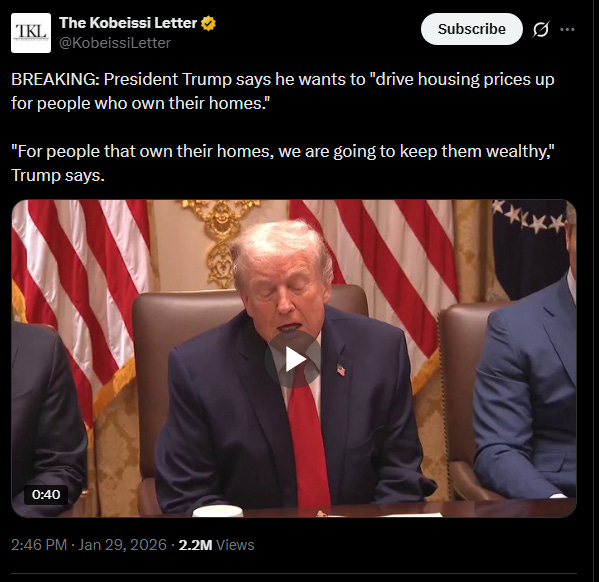
At Davos, Trump made a shocking admission: you can’t lower housing prices without decreasing the wealth of home owners. This is of course true, but it’s somewhat controversial to say out loud, because he’s admitting that there is a financial interest to *keep housing expensive*.
It’s one thing if expensive housing is due to bureaucracy, regulation, or “market forces.” These are all abstract, impersonal, unintended consequences. But once you provide the housing crisis with a human face -- the face of a greedy Boomer -- it’s easier to demagogue against the elderly.
Which, to be clear, I endorse.
When populist politicians like James Fishback rant against “BlackRock buying up our homes,” he’s scapegoating corporate greed, to cover up for Boomer greed. BlackRock owns less than 1% of total equity; greedy Boomers [65+] own a whopping [54%] of all housing supply.
18% of the population owns 54% of the housing. No wonder there’s a housing shortage!
The solutions here are pretty simple:
Higher property taxes on non-primary residences
Higher property taxes on McMansions ($500k+ value)
Apply an equity test to Social Security and Medicare (incentivizing seniors to downsize)
I said “simple,” but not “easy.” AARP is the largest lobby in the country, and it is overwhelmingly in favor of inflating the equity trap, not deflating it.
I hesitate to call this a housing “bubble,” since the underlying causes (Social Security, Medicare, and low property taxes) are politically sticky in a way that FreddieMac and FannieMae were not. When poor people defaulted on loans, it was considered politically acceptable to kick them out on the street -- they were poor and marginal, so who cares? Less than one million homeowners completed foreclosure by October 2008; compare that to the 74 million people who receive a Social Security check, which is growing every day.
Instead of calling it a housing “bubble,” I’ll call it a housing tumor. With a bubble, you can just take any sharp object and accidentally “pop” it, leading to recession and asset deflation. With an economic tumor, you can poke it, stab it, bash it with hammers -- doesn’t matter. That tumor is going to continue to grow unless you subject it to careful extraction with a scalpel, and generalized chemotherapy. Chemo sucks, by the way, and many people (especially in their old age) would rather just die than attempt chemo.
I can scream about property taxes and equity tests until I’m blue in the face, but it’s not happening. AARP is too strong. 74 million voters don’t want to go through chemo -- they want the tumor to keep growing. And there’s nothing we can do about that, for now.
While democracy seems completely incapable of solving the housing tumor, there’s always the hope that a neo-liberal authoritarian takes power. FDR lowered tariffs; Deng pushed market reform against party orthodoxy; Lenin did the NEP; Lee Kwan Yew crushed socialist interest in Singapore. Although neo-liberal authoritarianism is much less likely than the alternative (socialist authoritarianism), it is much more likely than the idea that 74 million voters will, out of a sense of effective altruist charity, suddenly and collectively decide to harm their own petty, greedy interests. Human nature means that, so long as we have a democracy, this problem can only be solved from the top down.
If Trump were to declare himself a dictator for the purpose of lowering housing costs, I would support that. Unfortunately, he’s doing the exact opposite: he’s defending high asset prices on the grounds that he wants old people to be rich. When I hear other Republicans like Fishback and Desantis moaning about property taxes, I see that the Republican Party has made its bed on this issue -- they are the party of Boomer welfare.
For the record, I’d much rather we give a trillion dollars to immigrants and black people than giving it to senior citizens living in McMansions. [Obviously we should make sure that no senior ever starves or go homeless, but if that’s what you’re claiming I’m advocating for, you don’t understand the meaning of “equity testing.”]
If I had to bet on it, I’d say that Democrats have a much higher chance of increasing property taxes than Republicans; conversely, Republicans have a much higher chance of lowering property taxes, because “lowering taxes” is part of their brand.
Republicans tend to be better on zoning law and regulations, which can be thought of as effective taxes on building new housing. I’d argue, however, that building new housing is a terrible misallocation of resources: we already have enough housing, it’s just “locked” in the hands of seniors who refuse to downsize.
If we deported [all seniors and criminals from America’s cities], we wouldn’t need to build any new housing at all.
So far, I’ve argued that the housing tumor is a net transfer of wealth from the young to the old. Since young people are the future, we are killing the future in this way. But I’d also like to raise the larger issue of an equity trap.
Let’s say you’re rich retired person, and you have a million dollars to play around with. Your housing needs are quite small -- you really only *need* a two-bedroom house. However, since housing is a safely appreciating asset (tumors are safer than bubbles), buying a much larger house (say, five-bedroom) seems like an attractive investment. You don’t need all those extra spare bedrooms, but it seems like a smart way to invest your money in something safe.
By contrast, investing outside of housing is scary. What’s going on with the bond market, or stock market, or private investment? No one really knows. Will the market crash, as it did in 1929? Or could we have another COVID, like we did in 2020?
Adjusted for inflation, the SNP500 did not grow at all between 1971 and 1984. [Reagan’s ability to bring the market back was one reason for his immense popularity.] Even if housing prices don’t exceed the returns of the SNP500, this isn’t factoring in potential rental income, which stacks the equation far in favor of housing over stocks as a safe and reliable asset.
Even if our goal was to support the old and crush the young, there are still problems with this picture.
Past a certain point, housing is a luxury. If we invest a trillion dollars in building homes for seniors, we’re not going to get much innovation out of that investment. By contrast, if we were to invest one trillion in biotech, pharmaceuticals, AI, robotics, automation, public infrastructure, airports, roads, high speed rail, policing, education, or medical care, the potential return on investment is much higher. Therefore, for every dollar spent on “luxury housing,” there’s a huge opportunity cost, both for individual investors and the economy as a whole.
Unfortunately, it’s rational for each individual investor to prefer “safe housing” over “risky investment.” Hence, we have the following:
- Retirees buy expensive housing they don’t need in cities where they don’t work
- By “locking” a significant percentage of the urban housing market, young people and the employed are forced to pay much higher prices, or commute from farther distances
- This creates massive costs: higher mortgages, higher transportation costs, and the opportunity cost to human capital development
- If young people can’t afford to live in cities, they cannot gain skills -- which means that we have smart young people who are systematically “underemployed,” and we are delaying the rate at which they develop their productive capacity
At the risk of sounding like a broken record, the optimal solution here is not “build more housing.” Yes, technically, if you increase the housing supply, you will lower prices, which is good for young people. However, there’s a massive opportunity cost.
Think of it like this:
Let’s say that, in a particular city, 18% of the population owns 54% of the housing. Obviously, this 18% does not need that much housing -- they own excess housing as an investment, not as a consumer good. Just as there are only so many sports cars that you can enjoy, there are also only so many spare bedrooms that you can enjoy, and there are diminishing returns.
This means that housing is needlessly expensive. You could build more housing, which would drive down prices and allow young people opportunities. However, let’s say this involves increasing housing supply by 10%. In a city with one million properties valued at an average of $100k per property, increasing the housing supply by 10%, the total cost comes out to $10 billion dollars.
By contrast, imagine that we started equity testing and property taxing this 18%. Naturally, they are going to either downsize or sell off their investment properties. This will have the same effect: prices go down, young people move in. But the added benefit here is this: we lower government spending via the equity test, and we increase government revenue via property taxes.
Since the 18% own 54% of the million properties, averaged at $100k each, raising the property tax on these 540,000 homes by 1% would result in $540 million in revenue; a 10% increase would result in $5.4 billion in revenue.
[When I say 1% or 10% increase, I mean as a percentage of the home value, not as a percentage of the previous property tax.]
Now if we assume that the average annual Social Security benefit is $24,852, and an equity test would force 50% of this 18% off Social Security, in a city of one million people, the total savings from the equity test would be $2.2 billion. Thus, the total net benefit of my “no new housing” plan would be $7.6 billion in government revenue (increased taxes, lowered spending).
Conclusion
We don’t need to build more houses. In the absence of Social Security and Medicare, supply would increase as a function of downsizing. Building more houses is wasteful -- we already have all the housing we need, we just need to “unlock it” by cutting off the welfare to McMansions.
Not only would this benefit young people, but it would also benefit the economy at large. With higher property taxes on non-primary residences and properties over $500k, we could shift investment away from housing and toward real productive and innovative sectors of the economy.
None of this is going to happen, not because people are “stupid,” but because the senior lobby is simply too large. In a democracy, you cannot undermine 74 million voters and expect to win an election.
The populist right claims that it would be cool to have a king, but so far, their candidates (Trump, Fishback, Desantis) are all in favor of protecting Social Security and lowered property taxes. That’s the exact opposite of what we need.
This isn’t an article about how the left could establish a dictatorship, but imagine that, in 2028, Trump tries another coup. This time, the military has to intervene, leading to a constitutional crisis. In the ensuing power struggle, the FBI and CIA coordinate and place one of their Deep State agents in the throne of power.
Ideally, this anti-Christ figure would then equity test entitlements and raise federal property taxes on high-value and secondary residences. Mass [deporting criminals to Nevada] would be a good measure as well. The outcome is that the housing market would collapse overnight, destroying the wealth of Boomers, but giving Zoomers the opportunity to live in cities and gain meaningful work experience.
With these measures in place, investors would turn away from real estate, and start investing in the *real economy.* Housing isn’t a bubble, because it’s not easy to pop -- it’s a tumor, which needs to be carefully cut out and subjected to economic chemotherapy.
When I say *real economy,* there’s some risk that I am privileging my subjective preferences over those of the market. You hear this a lot from populists who talk about “bringing back factories” and “re-industrializing the country.” That’s not what I’m talking about.
When I say the *real economy,* I’m talking real innovations. Building apartment buildings only boosts innovation via network effects if we have maxed out our urban density -- we have not. Housing is “locked” by speculative investment.
If we can “unlock” existing housing by addressing crime, entitlements, and raising property taxes, we’ll see much more innovation.
@DeepLeftAnalysis🔸 Great article about the Boomer Gerontracy topic, as always.
On an unrelated note, I’m finally a paid subscriber of yours, so I request an article about your stand regarding violence (gun laws, the warrior class, the slave motality-pacifist society criticized by Nietzsche, America vs East Asia and Europe regarding gun ownership laws, etc.). I feel that you’re a libertarian and sort of nietzschean regarding this topic, altough I admit when I first started reading you it was hard for me to pinpoint your specific posture on this issue (war is dysgenic, but you’re against the nanny-safeist state, which one is it, DLA?!), and still feel a little bit confused about it now.
One specific issue I have with the US gun issue is that most, if not all, of firearms and rifles (~70-95%) in latin american countries (Mexico, Colombia, Brazil, Haiti, Jamaica, etc.) used by drug cartel members, hitmen and regular street thugs are smuggled from America down the border, so if domestic production and selling of weapons in the US was banned or heavily downsized by regulation, it would have a downstream effect on murder rates down here. President Sheinbaum of Mexico (who is both jewish and the first female president of that coubtry, by the way) actually sued last year US gun manufacturers with all of this issue in mind.
Last, but not least, what is your personal opinion about the warrior class? Do you support it, to what extent, and do you seek to eliminate it in the Deep Leftist future, just like the working class?
Looking up to watching this article request from you. 👀👀👌🏻👌🏻👍🏻👍🏻