
Refuting Natalism
+ Reincarnation

Today I read seven articles, and provided some commentary. (in bold)
Warning leftists not to interfere with police is not helpful.
Two things can be true at once.
Thou Shalt Not Lie: You Must Admit to Being Pronatalist
Money spent on natalism is better spent on immigration.
Watch as I struggle to understand economics.
Explaining why I make crazy predictions.
Critique and praise for Norse paganism.
Reconciling reincarnation with an eternal afterlife.
And now for the articles:
Victim Blaming Is A Misplaced Concern
by David Dennison
David compares and contrasts three situations:
You’re a woman, wearing a short skirt, and you are sexually assaulted
You’re a woman, drunk, and you are sexually assaulted
You are an ICE protestor, impeding the police and disobeying orders, and you are shot
In all three cases, David says that the end result is wrong: no one deserves to be sexually assaulted, no matter what they wear or what they drink. No one deserves to die for disobeying the police.
However…
If you visit an Islamic country as a white woman, and you walk around in a bikini, your chances of being sexually assaulted dramatically increase as a result of two choices:
You decided to visit a Muslim country alone
You decided to wear a bikini in public
The question of foreknowledge is relevant. Could you have reasonably been expected to know such a thing? Most conservatives would say “yes.” Most liberals would say hesitate uncomfortably, and then say, “… I suppose so.” Then you have the most principled wokesters who would call you Islamophobic or something.
Ok, what about in the case of ICE? Should you expect that, if you obstruct police, you will be shot? In this case, the responses are more ambiguous. Some conservatives might say “hell yeah!” but will then tell you that Ashli Babbitt was murdered. Other conservatives will be a bit more uncomfortable, and say that you shouldn’t expect to be shot, but … maybe? Liberals will say, absolutely not.
Personally, I have seen too many cops go crazy on camera, and if I was in a situation where a police officer tried to open my car door, I hope that I would slam on my car brakes, turn the car off, and unlock the door for them. If I said anything, I hope that I would say “I’M COMPLYING.”
Now, do I know that’s what would happen? Let’s say that the police were engaged in a campaign of terror against immigrants, and I happened to have some immigrant friends, and I felt that the country was becoming a fascist hellhole. This causes me to view the police as the enemy, and I call myself “the resistance.” Then the cops try to open my door. In that situation, even if it would be a retarded idea to do so, I might back my car up, and try to swerve on out of the situation.
I hope that I wouldn’t, but I might. I try to put myself in the shoes of the people in these situations.
Therefore I don’t think David’s advice is very good, nor do I think it would convince any leftists, nor do I think it will prevent violence. On the contrary, I think it will only serve as a soft justification for violence. “Well, I told you not to resist the cops, and you didn’t listen, so I guess another liberal got shot this week…”
Policy is relevant. If the cops are fighting crime, and you obstruct them, you are pro-crime. For example, let’s say that a cult leader has been raping kids, and the police come to his compound to serve an arrest warrant, and a mob outside the compound begins obstructing police. If they get shot, my sympathy for that mob is pretty minimal.
If, on the other hand, a vigilante kills the cult leader, and the police are coming to arrest the vigilante, and a mob resists the police, my sympathy for the mob is greater.
In the case of the Nick Shirley Somali scandal, as far as I know, 100% of the Somalis accused of fraud (the ones running the centers) are American citizens. They are, at the very least, permanent residents. Most Somali immigrants to America came here in the 1990s and the early 2000s, and they’ve had 20 years to either become citizens or have kids who are citizens.
The “crackdown” by ICE actually doesn’t affect Somalis at all.
Do I need to show you a map of where Somalia is? Somalis are some of the poorest people on the planet — there’s no a lot of them flying in and overstaying their visas. Most of them were imported through legal refugee programs. That is, an NGO or the government itself paid for the plane tickets and gave these people a pathway to citizenship.
You might not like that, but that’s what happened. Nothing “illegal.”
As a result, I don’t see Trump’s actions as having anything to do with fraud at all. Instead, I see his deployment of ICE as an intimidation and bullying tactic — not a legitimate police action.
The people opposing this action have much more of my sympathy than the ICE agents carrying it out.
The Limits of Hereditarianism: Why Human Biodiversity Explains Far Less About Gaps Between Societies Than Disparities Within Them
The Mont Pelerin Review
This is a good defense of neo-liberal globalism. MPR argues that while there are some IQ differences between groups, they don’t determine country-level outcomes in a deterministic way. Economic policies affect large deviations in outcomes.
If we could influence countries in Europe, Asia, and Africa to adopt stronger pro-market reforms, we can expect global wealth to increase. However, I did present some counter arguments here. Allow me to rephrase those arguments for your reading pleasure:
The IQ advantage of Europeans over non-Europeans didn’t matter as much when 90% of the population was forced into manual labor due to high food prices and labor-intensive agricultural requirements. Once these workers were freed up for other tasks with more efficient farming practices, the mean IQ of the masses generated a stronger net economic impact.
When social mobility is low, average IQ matters less, because non-elites are shut out of the economy (they are just doing manual labor). When land became commoditized by Henry VIII and the serfs received emancipation, social mobility increased, which “unlocked” the untapped IQs of former manual laborers.
Chinese IQ is probably lower than reported. This is because China has a heterogenous population. “Chinese people” in rural China are not the same as “Chinese people” in Singapore. One is a selected population; the other is not. Much of the increase in measured Chinese urban populations is due to brain drain into cities, not improvements in nutrition/education.
American Ashkenazi Jews are over 40% European. Since a significant proportion of Jewish families are now mixed — over 70% — I would not be surprised if American Ashkenazi Jews are closer to 60% European. Meanwhile, Israel is, at most, 40% Ashkenazi (and declining), meaning that the net European admixture of Israel is less than 20%. 60% vs 25% is a big difference.
Black Americans are 25% European and are a selected population, and not necessarily representative of Africans in Africa.
White Americans are a selected population due to the Smart Mover effect. White Americans have higher PISA scores than any other European population.
Thou Shalt Not Lie: You Must Admit to Being Pronatalist
by Lyman Stone
Lyman says:
It would cost about 10% of total GDP to get fertility to replacement rate in America only via fiscal supports of this kind. This is about what we spend on Social Security, Medicare, and Medicaid combined, so yeah it’s a ton of money, but it’s not out of scale of stuff we already spend on old people or poor people.
I trust Lyman on this that it would cost about $3 trillion to bring births in America to replacement. But I don’t think this would be a good use of this money.
What I think would be a good use of money would be to take that $3 trillion and pay people to immigrate to America. Specifically, people with an IQ tested above 115. I call this the “Wit Visa”:
$1 million could be offered to anyone under the age of 30 with an IQ over 120 to live in America. The $1 million would be paid out in monthly installments of $4,167 per month over 20 years, or roughly $50,000 per year.
With a budget of $3 trillion per year, this would allow us to offer 3 million Wit Visas per year, or 30 million over 10 years.
Assuming that 16% of the world’s population has an IQ over 115, the potential pool is 940 million people, which we would exhaust after 313 years, which is quite a long time.
If Lyman wants to propose that natalism could be achieved for less than 10% of GDP, I’d be open to hearing a different number and crunching my “Wit Visa” numbers for comparison.
The best argument against the Wit Visa is on the grounds of cultural homogeneity. I reject this argument, but it is the only argument that can sustain natalism.
4. The Nguyens and the Fed
by Scott Sumner
Cash hoarding, also known as a liquidity trap, is bad. What happens is that, rather than investing capital in the market, owners hoard it, waiting till “conditions improve.” This prevents capital reallocation, which is the only way to exit a recession.
Cash hoarding isn’t just caused by fear of uncertainty — it is also caused by the income tax. Scott explains:
If tax rates are 30% and nominal interest rates are 6%, then it would be profitable to store income in the form of currency for up to roughly 5 years before you would have been better off paying the tax and earning 6%/year interest.
People hide their earnings from the government, store it in cash, to avoid paying taxes.
There’s a few solutions:
Raise interest rates. By raising interest rates, you increase demand for cash (for example, encouraging hoarders to put their cash to work in bonds, rather than hiding it)
Lower income taxes.
The question I want to ask Scott is, “why can’t the government just increase inflation to defeat the liquidity trap?” If the money supply massively increases, this devalues existing cash, which would theoretically force that cash into the market.
But if interest rates are already low, then there’s only so far you can go before you hit 0%. If you do hit 0%, then there’s always negative interest rates.
Perhaps the answer is that inflation causes problems of its own.
Nicholas Decker explains why people hate inflation:
Inflation hits people hardest who own no assets. Therefore, inflation is a regressive tax.
Wages are stickier than prices. Walmart can raise its prices within 24 hours, if need be. Employers are not so quick to raise wages. As a result, firms can perfectly match the pace of inflation with a continuous increase in prices, whereas wage and salary workers must wait for a “step-wise” increase in their income. (This isn’t as big of a problem for people who own equity)
People are stupid and when they see prices going up, and wages going up, they don’t calculate prices in terms of wages — they only see the nominal price, rather than the real price.
Now I don’t use AI to write my essays, but I did want to understand this point more clearly, and this is the explanation I got:
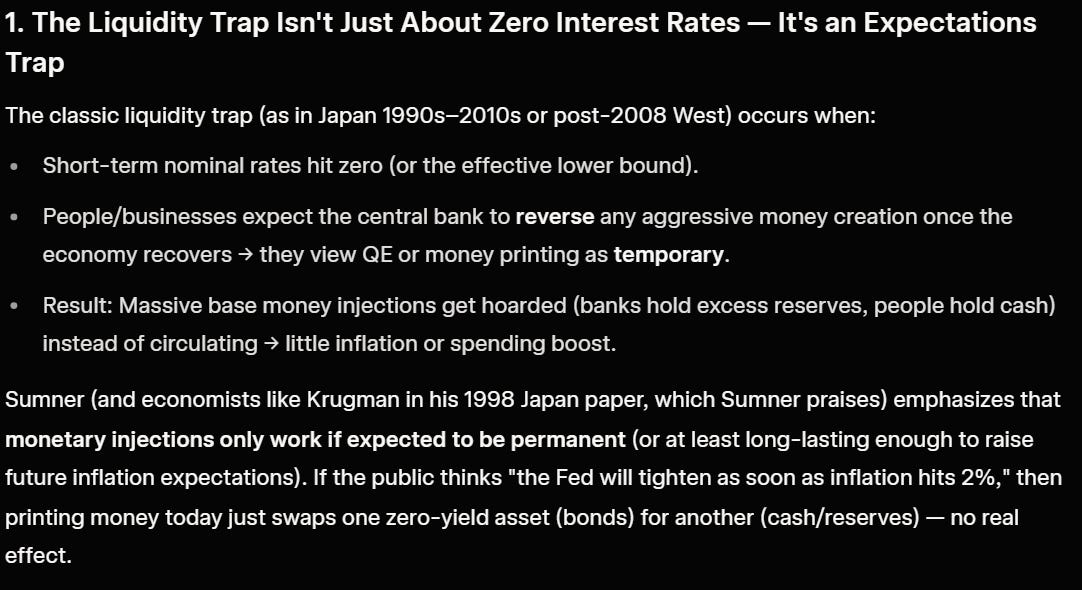
Basically, if the government hands out a lot of money to banks, the banks aren’t necessarily going to use that money in the real economy. They can simply hoard it.
This is probably why it makes more sense, during a liquidity trap, to give money directly to people who will actually spend it. For example, giving it to poor people, or using it for government projects. The problem with this, however, is that poor people will buy luxury goods (recreational drugs) which don’t actually help with capital reallocation; government projects additionally fail to accomplish permanent reallocation.
By reallocation, I mean “moving money from weak/failing businesses into strong/surging businesses.” If the capital injection is into “fake stuff” (drugs, bridges to nowhere), it doesn’t actually accomplish the feat of reallocation.
Having tried to explain all of this in my own words, this all seems a bit magical to me. Maybe that’s just because I’m jet lagged. But the idea that we can manipulate behavior using interest rates at a macroeconomic level feels like wizardry. It gives me a sense that the average person is sort of a sheep-like creature, who is easily controlled. I can understand why libertarians hate the fed — it deprives them of their myth of mass agency, that every man can be a sovereign king of his own destiny.
According to Grok:
If you were to ask Sumner directly today, he’d probably say something like: “The Fed/government could defeat the trap by targeting higher NGDP growth and making it level-targeted — but most central banks are too conservative to do so aggressively enough.”
Hopefully if I read enough Scott I won’t need to ask AI these questions anymore.
5. Good if make prior after data instead of before: because truth is many
by Dynomight
First of all, the title of this article is incomprehensible, which is kind of fun.
Dynomight explains how we might reason whether aliens exist or not. However, the question is complicated by the fact that there are many different kinds of alien: bacterial-life and human-like life, and everything in between. But we often put things into arbitrary binaries, which means that by slightly rephrasing the varieties of options, we can come to radically different conclusions:
In practice, there are an infinite number of things that can be true. It’s a lot of work to specify prior probabilities for an infinite number of things. And it’s also a lot of work to specify the likelihood of your data given an infinite number of things.
Because this is so hard, I will say things like, “the Republican party is over.”
What I actually mean is:
The chance of Republicans lowering their vote share in 2026 is C
The chance of Republicans lowering their vote share in 2026 and 2028 is C-B
The chance of Republicans lowering their vote share in 2026 and 2028 and 2032 is C-2B
Where C is the initial probability (high), and B is the chance that the Republicans recover / rebrand / make different choices / Democrats make worse choices.
But it’s really not fun to say all that, so I say, “the Republican party is over.”
While on its own, “Republicans alienate voters” is highly likely, the ultimate vote share is a composite of many factors. How popular is Nick Fuentes in 3 months? What name recognition does he get? Does the GOP move toward him or away from him? What does Meghan Kelly say? What does Tucker say?
We’re dealing with a complicated social network of influencers and trying to figure out how they will all socially coordinate with each other, what their future messaging will be, and how this will impact public opinion.
So I’ve both predicted that the GOP will lose, and also, that Fuentes will support Rubio. The chance of both of those things being correct is low…
I would even say that the chances of Fuentes supporting Rubio are under 50%, since he could still support Vance, or Newsom, or another Democrats, or another Republican, or refuse to endorse anyone. However, because I believe his chances of endorsing Rubio are higher than people would expect, I report that opinion, because I think it’s important to report underestimates.
For example, if there was a betting market that gave a Fuentes-Rubio endorsement a 1% chance, and I think it’s a 10% chance, then I would write that article to encourage people to buy low with the expectation that it will increase.
This is how a lot of my opinions are. I’m not telling you the 51% likely outcome — I’m asking you to update your model from 1% to 10%. This is because most outcomes are gradual on a gradient spectrum — not binaries. So if I say “we’ll have catgirls by 2040,” update your chance of that outcome from 1% to 10%, and then consider all the associated outcomes that you must update from 10% to 51%.
I feel this is an effective communication tactic, but it does make people think that I am insane or “conspiratorial.” Tough world.
6. Forgotten TheWarg
Reposting some essays from a long-gone iFunny Pagan
I really don’t like Norse paganism, because:
it is LARPy
it reminds me of Hindu or Jewish nationalism
In the first case, obviously, it is a contrived affection for a foreign, strange, primitive culture. It is not genuine affection — it is a fetish based on resentment: resentment of Christianity, of Jews, the modern world.
In the second case, truth is sidelined in favor of chauvinism. Just as Jews claim to be the oldest religion (not true) or Hindu nationalists claim to have invented everything and invaded Europe (not true), Norse pagans will claim that their religion is original and had no foreign influences (not true).
I also dislike Norse paganism, because if you’re going to pick a religion, pick one that did cool stuff. Norse pagans were relatively lame. They did not build the Colosseum, or the Acropolis, or the Pyramids. This is disqualifying to me.
However, I consider this to be a good defense of Norse paganism.
“We do not worship God, we instead seek to understand the Runes.”
This is a fascinating point and appeals to me greatly. While I don’t imagine myself ever fetishizing the actual Norse runes, the idea of “Runes” as a symbol for metaphysical law seems sublime. It means that Norse paganism was the first religion to place science and logic above the Gods — not denying their existence, but subordinating them to a higher law. This is in contrast to the tyrannical nominalism that you get in monotheistic systems, where God can contradict himself if he likes.
“East Asia has always been the ultimate threat to Indo-Europeans… The threat of a small tribe of sand-dwellers only exists because we allowed them to become a threat through accepting their subversive tactics... They used our own teachings, Buddhism, and our own creations, industrialization, to become a massive threat to the Indo-European man.”
First of all, Jews come from the Anatolian and Armenian plateau and are mixed with the Sea Peoples — which included Norse and Sicilian pirates. Calling them “sand dwellers” is geographically and historically illiterate. The Libyans were described in places with European features, and they could be more accurately described as “sand dwellers.”
Describing Buddhism as an Indo-European formulation also underestimates the Dravidian origins of the Upanishadic tradition.
I disagree with TheWarg regarding word power vs mechanical power. If you can control a society using religion, you have won ultimate power. This contradicts the earlier idea that “we worship the Runes” — clearly the metaphysical takes primacy over the physical.
Winterfylleth: Began the night of October 1st. This was the beginning of Winter and the year.
I like the idea of the year ending on October 1st. Halloween as a bridge between the living and the dead seems like a good time for a new year. Alternatively, I like the idea of starting the year on Easter. December 31st has never been satisfying to me, especially since it doubles with Christmas.
“Woden actually explicitly denies the idea of reincarnation as is widely thought of or found in Hinduism, for example.”
I often consider the possibility of reincarnation as a thought-exercise, but the idea of “true reincarnation” does not seem possible. I would go even deeper: a man cannot remain himself. This is why I despise the idea of life extension. Death and birth are good things; preserving life, either through reincarnation or life extension, denies the goodness of death.
SA actually discusses reincarnation here, which I found interesting, but difficult to comprehend.
“toxic masculinity… can be divided into two types: Overly and Baselessly Machismo and Feminization”
I agree with the diagnosis that what we refer to as “toxic masculinity” is a result of the decline of collective rituals. I believe it would be helpful to institute physical requirements in college degrees to move back toward a mor holistic path of maturity, rather than condensing all of life into a pure exercise of mental memorization and regurgitation.
I also like the idea of a Koryos solution, although I did not completely implement it for myself. Essentially this means a time of wandering and hardship, a quest with a definite goal toward acquiring territory. So not farming, not working a job, but a road trip with a real measurable outcome. I think something like “door to door salesman” gets close to this… WBE as “door to door sexman” comes the closest that I have seen.
“I think it’s *possible* there was some Mazdean influence on the Teutons most likely during the Migration Age.”
I believe that Iranian influence began before 500 BC, as Scythians were highly migratory and bordered Germanic lands. We know that Pythagoras met with Hyperboreans, so clearly Middle Eastern ideas were accessible to Germans during his period.
“Hagalaz is the destruction of the inner snake jealously guarding the hoard”
Maybe it’s just because I’m jet-lagged but this powerfully impacted me. Yes, within us, we have a snake-like, hoarding tendency. It is the tendency to prefer to preserve what we have rather than to seek new experiences, knowledge, relationships, opportunities. This strangles life. We have to kill that inner snake in order to progress.
7. The Nether
by Sectionalism Archive
SA’s article “The Nether” was good. I liked his romantic description of the cold of Winter, although I really wish he put a paragraph break after this sentence, because it needs space to breathe:
When the wind stops, it becomes apparent that you are not only persevering against the wind, but against death itself!
This is a very weird detail:
One strange thing that Homer mentions is that Heracles, due to his apotheosis, is not actually inhabiting his phantom which resides in Hades. Instead, he is on Olympus, with the gods.
It implies that there is some distinction between the shade and the soul.
the animus and the genius… correspond roughly to the Platonic notions of the soul (psyche) and the intellect (nous). The Romans did not identify the genius with the living self, as demonstrated by Augustus’s discomfort with the Egyptians worshipping him as a “living god” (instead of worshipping his divine genius).
I have been thinking recently that when we worship God, we are really worshipping our own inner genius, because it is only by this inner genius that we can make any contact with the divine. The “shade” or “psyche,” the ego or identity of the self, is too shallow and limited to make this direct connection, and can only attain contact indirectly through the genius (Holy Spirit), which possesses us and which we appeal to as a Guardian Angel.
It’s very clear that the biblical soul is not the same as one’s form or essence, for two reasons… The formation of Adam, i.e. establishment of his essential features into the body, occurs before the ensoulment of Adam. This is because the essence of Adam existed already in the mind of God… Both Semitic and Egyptian burial rites were very deeply concerned with some sort of preservation of the body, which stands in contrast to the transition from inhumation to cremation across the Bronze Age Indo-European world.
I never deeply considered this before, but it makes sense. This is a reversal of the Platonic position, which is that the form of the body proceeds from a part of the soul, or even the phusis.
belief in reincarnation (at least on some occasions) coexists with the belief in an ostensibly permanent afterlife in many Pagan cultures. How could that be? … I think it has to do with the aforementioned division of the soul among the Pagans.
I disagree with SA here. He claims that the soul is dualistic, having two parts, while I believe that the contradiction is a result of competing syncretism. This is actually quite clear in Kabbalah, which is Platonism infiltrating (subverting!) original Judaism.
all human souls are considered to descend from the soul of Adam… distinct souls are generated by certain qualities of a greater essence, which itself as a whole generates a meta-soul that comprises all of these different souls.
SA then quotes Praxius explaining how reincarnation has to do more with an archetypal rhyming than a reproduction:
more the recreation of a personality as opposed to an actual 1:1 recreation of a person.
Yes, I can agree with this definition of reincarnation.
Ok that’s enough!
Imagine that I wrote a tidy conclusion that wrapped all these articles together.

> $1 million could be offered to anyone under the age of 30 with an IQ over 120 to live in America. The $1 million would be paid out in monthly installments of $4,167 per month over 20 years, or roughly $50,000 per year.
This would encourage clever lazy people (think Wally in Dilbert) who're probably not the type you want to attract.