
Gypsies and Shrimp
housing + birth rates + political homelessness.

Things I read today:
Of Waymo, holiday shopping, and the buyer’s market for homes
Completed Family Size Will Soon Plummet to Unprecedented Depths
And now for my commentary:
1. Giving Up Spotify Premium Gave Me Back My Sanity
Steve writes about listening to Spotify. This brings me to make a shocking confession: I do not choose to listen to music.
At best, I got to the gym, or a cafe, and there is music being played. But I do not hear any ads, and I do not have any choices to make.
The reason why I do not listen to any music is because:
I have a flip phone. I bought my first flip phone in October 2023, and it then died a year later, so I got it replaced. The first one cost $20, and the replacement cost $100 at a repair shop. I probably need to get a new one, because I’m paranoid it will break soon.
I do not have internet at home. The last time I had internet at home was when I visited Toronto, and it was a disaster. I would stay up 36 hours, sleep for 12 hours, and do that continuously for days at a time. It was miserable. Having a continuous offer of “one more thing” on the table is not something I handle well.
My brain is overactive. That’s why I write so much. I’m constantly thinking, generating new ideas, with powerful emotions backing them up. I think if you did a brain scan of me, and someone on Adderall, we would have the same brain activity. Although outwardly I might look calm, peaceful, low energy, or even sad and depressed, internally, my mind is racing and the inner monologue is constant and unceasing. If I’m not writing, I’m monologuing.
The only time this process slows down is when I exercise.
I am constantly entertained by myself. Not a moment goes by where I am bored. I do not understand boredom. So long as I have something to write with, I can go on for hours -- and I do, sometimes for 14 hours straight.
People who get bored are bored because they are boring. They have no ideas. They need external entertainment. This is most people.
I believe this isn’t just a lack of intelligence, but a product of fear. Fearful people constantly suppress their own ideas. They judge their own thoughts as scary, weird, socially unacceptable, immoral, unpopular, disturbing, frightening, cruel, violent, perverted, wacky, crazy, insane, and so on. I also do that, but I think my “internal filter” is much weaker than most people.
Most people, I’ve noticed, when you prompt them to speak their mind, have nothing to say. This is because most people are extremely fearful and their filter is strong.
By contrast, when I get anxious, I tend to talk more, because it is calming and soothing to me to express myself. From my perspective, I’m always talking on the inside, so to have someone listen on the outside is relaxing. I actually think much slower when I speak than when I think, so in a way, speaking out loud is a meditative activity for me.
But because of all this, I don’t choose to listen to music. I do hear music when I’m in the gym or cafe, but I never select music. In the past, when I was in college, I would try to focus and force myself to do assignments, and I would listen to music to inspire myself. Now I don’t need to do that.
Although when I did start writing this blog, I still had the internet, and I would listen to Joel Sunny’s Luminary on repeat for 10 hours. That was fun. I guess I am autistic because I like to listen to the same 2 minute melody on repeat for 10 hours. I’m not a big fan of internal variety, because it seems to clash or overshadow the diversity of my thought.

2. Why You Can’t Find a Cab in the Rain
This is an interesting problem: if there is a minimum amount of money needed to satisfy workers, will high wages cause them to hit this amount faster, thus leading to lower productivity?
Nicholas gives two examples: taxi drivers and bicycle men, finding that for the drivers it is not true, while for the bicycle men it is true. Maybe we should tax manual labor income higher than other forms of income, to maximize productivity. The positive effect would be an incentive to innovate in robotics and automation.
3. What Does It Mean to Have Gratitude to a Country?
Richard makes reasonable points, but the top comments attack immigration. Richard compares immigration to a “life raft” which saves people from poverty. The top commenter replies:
“No, we’ve saved a bunch of these before and they are bafflingly ungrateful, running autism scams and not rowing very much. They scorn the raft for being better than the drowning depths from which they came, and try to poke holes in the raft to make their new environment more like their old. Look at this one we just saved, who is trying to simultaneously increase rent, taxes and crime! Look at these other ones, who see women as subhuman. This raft must defend itself, or it will sink. Making the raft Afghan or Somali will in the long run be neither humanitarian not efficient.”
There’s a few claims here:
Immigrants are not grateful
Immigrants run schemes
Immigrants take more out of the system than they pay in
Immigrants undermine the system
Immigrants increase rent, taxes, and crime
Immigrants see women as subhuman
Immigrants are Afghan or Somali
This last claim gives the game away. Most immigrants are not Afghan or Somalia: they are Indian, Chinese, Filipino, and Mexican. None of these people (including Mamdani) “view women as subhuman.” The claims of anti-immigrant activists are overblown, hyperbolic, and hysterical.
I agree that if there are crimes being committed, they should be prosecuted, and maybe if a group is disproportionately criminal that should impact the visa approval rate for that group. But Indians, Chinese, Filipinos and Mexicans are not very criminal. There are Mexican cartels, but those are organized crime syndicates, which revolve around the drug trade. Mexican cartels are very similar to the Irish mob, Jewish mafia, or Italian mafia. They reflect a “quasi-government organization,” rather than a genetic predisposition toward violence or sociopathic behavior.
If immigrants really do take money out of the system, then pass a law denying them welfare. If they really do vote for bad policies, stop naturalizing them. The point about rents is a bit silly, since the main thing keeping prices high isn’t immigrants, but the tendency of retirees to refuse to downsize. That could be solved with Social Security reform much easier than by paying money for deportations and immigration restrictions.
4. Gypsies and Jews
(Non-Zionism critiqued this article regarding Judaism, but I think the point stands on gypsies.)
I find this article fascinating and wonder how it relates to black Americans. Imagine if Obama had a white wife, and his kids were half black. Would they identify as black on the census, or as “other”? If we lived in an anti-black society, we should expect high-achieving individuals to shed the “black” label where possible.
5. I Am A Master Debater
I agree with Lyman, but in reverse:
“It’s perfectly suitable for a virtue ethicist to believe individual action should not generally be consequence-depended and that judgments of the morality of action should not primarily be consequence-informed, and also to believe that in the particular role of lawgiver and sovereign, the sovereign has a duty to perform virtues which might require the consideration of consequences. A person should not generally lie because lying is bad for the soul and sets you on a path of deception— but the sovereign by accepting sovereign duty has ceased to be human, they now are State, and are morally obliged to perform the virtues of the state rather than the virtues of the man.”
I agree with Lyman that the ethics of the individual are, and should be, different from that of the state. But whereas for Lyman individual ethics are primary, because they determine heaven or hell, while state ethics are secondary (maybe equivalent to Dharma or duty, but not heaven or hell-worthy), I have the opposite view. For me, state ethics are primary, and individual ethics are secondary. To give an example:
Let’s say Bob is a statesman, and a husband. He has two choices:
He can issue forth a correct decision of statecraft, but also cheat on his wife
He can remain loyal to his wife, but issue forth poor statecraft
The first situation seems obviously superior, and not even as a utilitarian calculation. We can imagine that the statecraft in question is perfectly equivalent to the disloyalty, in utils. That is the amount of suffering caused is exactly the same for either bad decision. But it seems to me that the obligation or duty to the state is much higher than the obligation we have to ourselves and to each other. In this sense, the state is the representative of God, and it is better to sin against man than to sin against God.
The discussion about incest as dysgenic is funny to me. Would Diana support incest if the brother and sister used embryo selection to remove deleterious mutations?
I did not watch the debate, and I don’t know Diana, but Lyman claims she correlates abortion with crime reduction. There’s no discussion of black people.
The idea of a eugenicist who is afraid to be openly racist is funny to me. I know there are such people, and I find this to be totally dishonest, and the worst part is, they believe their own dishonesty. People do this: they are so cowardly that they actually brainwash themselves into obvious lies. When confronted they will say that race has nothing to do with it. Ok, sure...
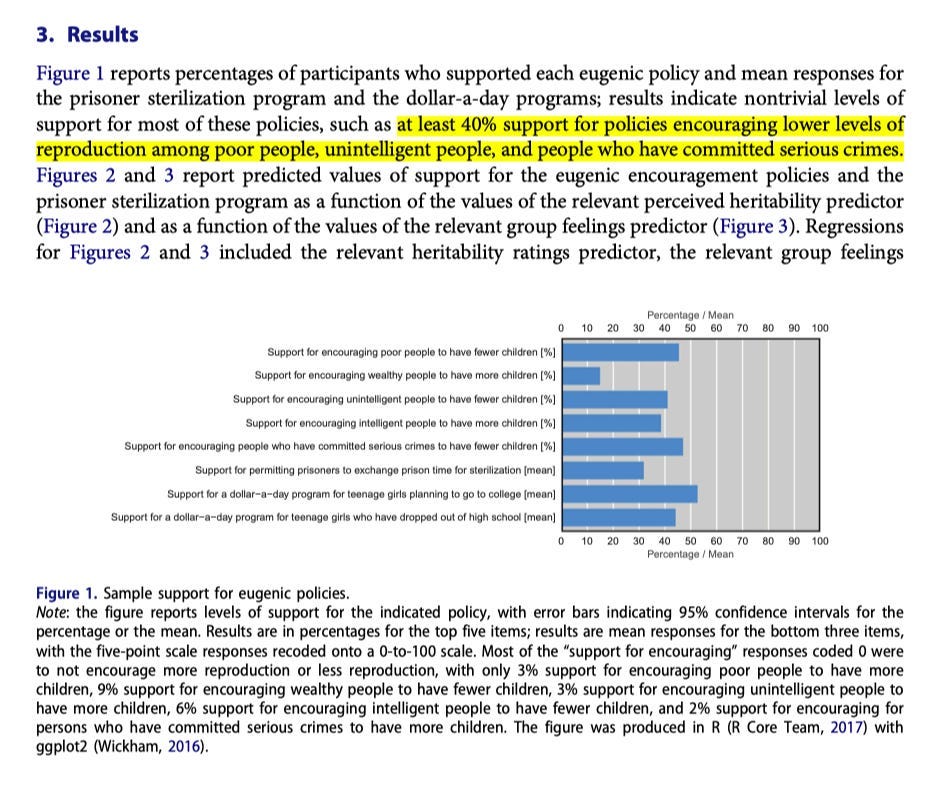
Lyman posts an image showing that less than 20% support the wealthy having more kids. I would say this is the actual amount who support eugenics. The rest simply are environmentalists who think poor people create a poor environment for kids.
This is a very strange paragraph:
“Maybe Christian Hell is real and we should all be missionaries. What these risks all have in common is that there is really no way you can go and actuarially account for the risk of these things being true, efforts to do so are just open and frank dishonesty because there is no estimable hazard function, and thus it is impossible to price the insurance product.”
Lyman reminds me a lot of Joseph Bronski in being very pro-empirical, with one exception.
This discussion of shrimp is comical:
“Bereft of eyes, shrimp simply breed like crazy. Humans don’t respond to mutilation that way, which should tell us the shrimp experience of pain is nothing like ours, and if it provokes an extremely high-evolutionary-reward-behavior (intensified reproduction), we have to consider the possibility that shrimp may be sadomasochists who enjoy certain types of pain (we’ll come back to that).”
Lyman argues that “we should take the reproduction rate of shrimp as a proxy for shrimp welfare,” which puts his support for natalism in perspective.
6. Checking in on those white collar blues
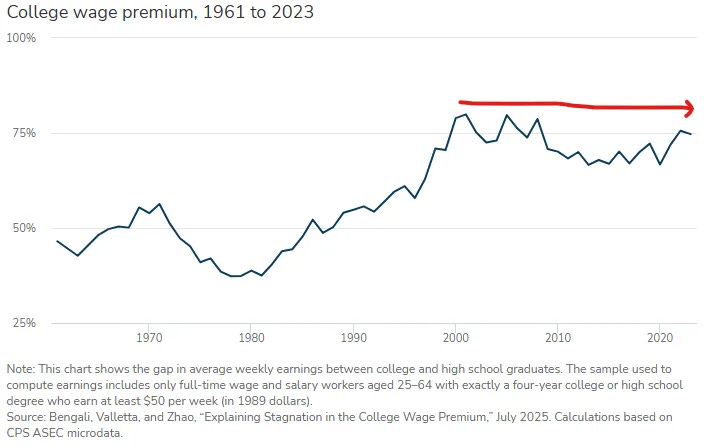
Moses demonstrates that college degrees, while providing a higher income, are also subject to a great degree of competition or saturation.
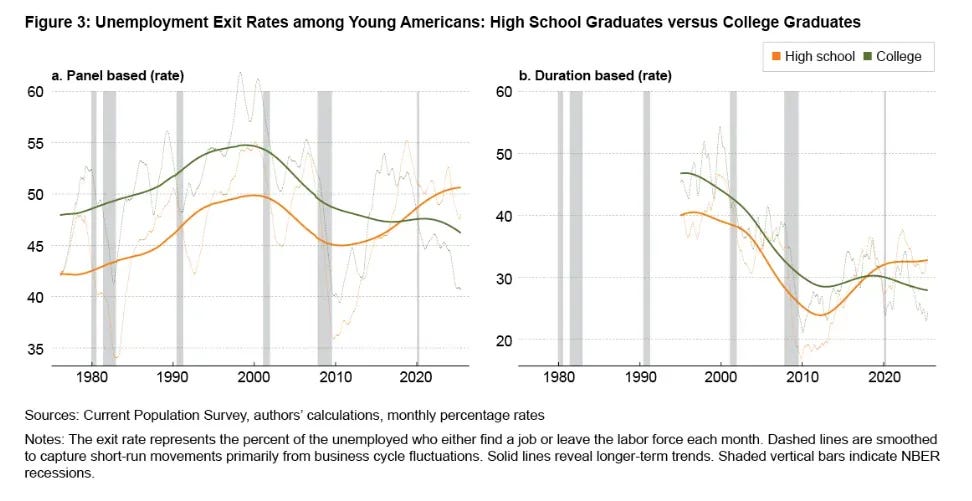
There are two solutions:
Restrict the number of entries into college (MAGA plan)
Expand the number of government-provided jobs (Mamdani plan)
The first would increase wages for everyone. It would increase wages for those with college degrees, because they would have less competition. It would also increase wages for those without college degrees, because it would increase the competence of the pool. This is assuming an competence differential between college applicants and non-applicants.
I say competence rather than IQ because I don’t think IQ is a monocausal factor in job performance.
Anyway, the Mamdani plan would not increase wages, it would just lower unemployment. But it has the benefit of keeping the university system strong, which helps the Democrats. Universities both ideologically enforce liberal norms in individuals via brainwashing (or sophisticated acculturation) and via institutional prestige.
We could actually do both of these things at the same time: create more bullshit government jobs, and also, restrict college enrollment.
This does not look good:
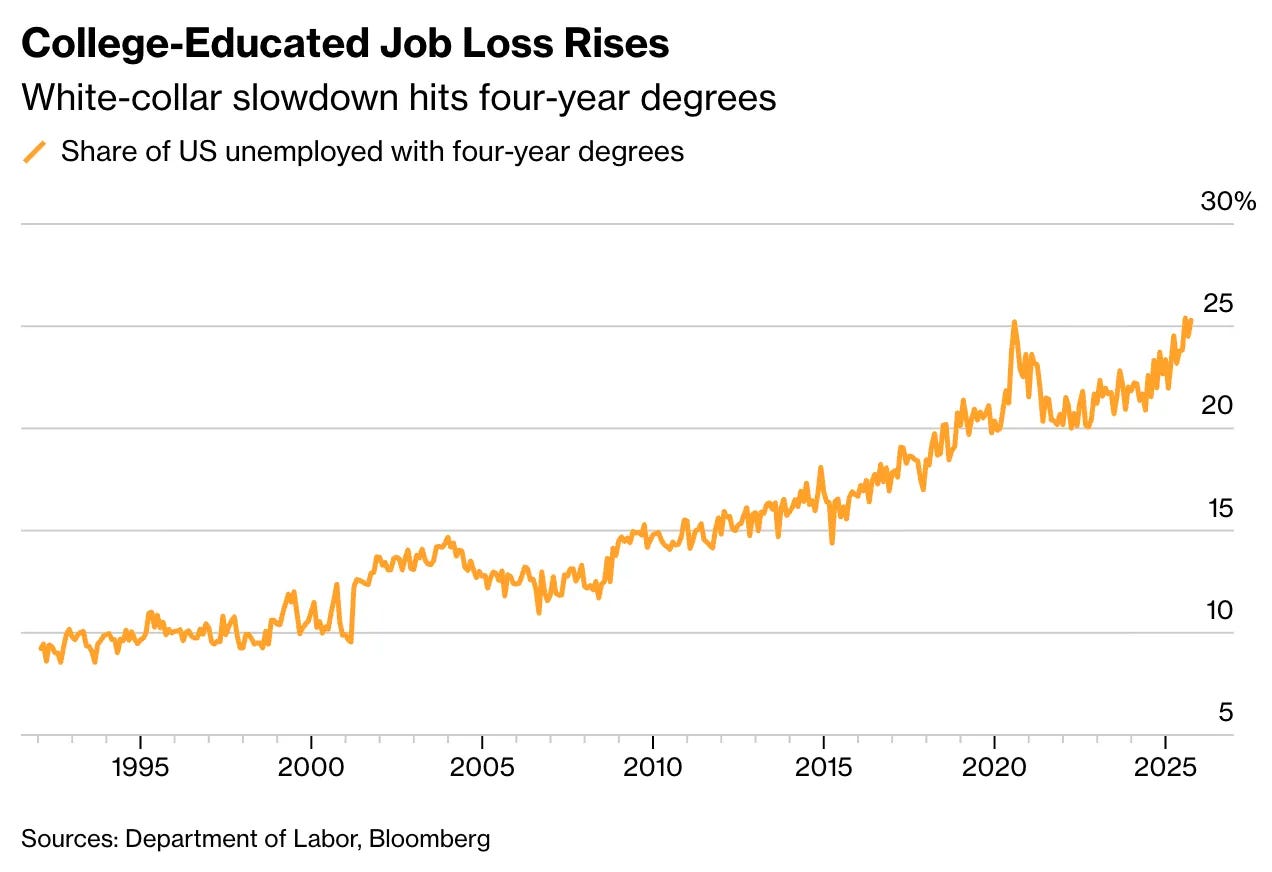
However, take into account that the number of people with four year degrees has increased over time, so this is not just a reflection of increasing employment among grads, but also a reflection of a simple absolute increase in grads. Still, it is a striking trend.
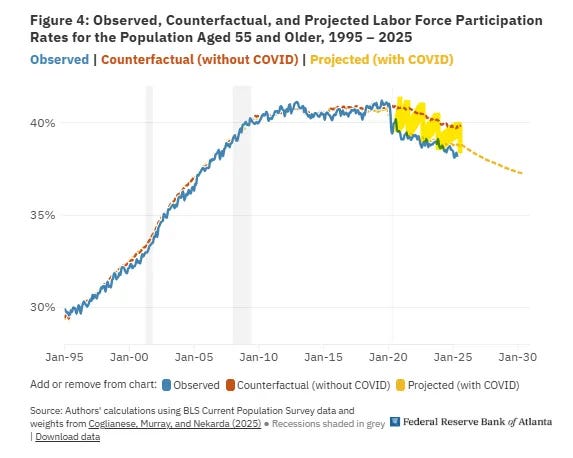
Moses mentions a couple of causal factors: old folks working longer... But wait, didn’t he also post a graph of workforce participation decreasing? I’m confused.
In any case, I think schools are probably degrading in both selective capacity and additive capacity. Meaning, they aren’t selecting for competence, and they aren’t adding competence through coursework. They’re just pushing people through the system, afraid to reject or fail anyone. Hence the quality of grads goes down.
It looks like the college wage premium peaked in 2000:
Maybe we should start talking about “the college crisis” rather than the “housing crisis.”
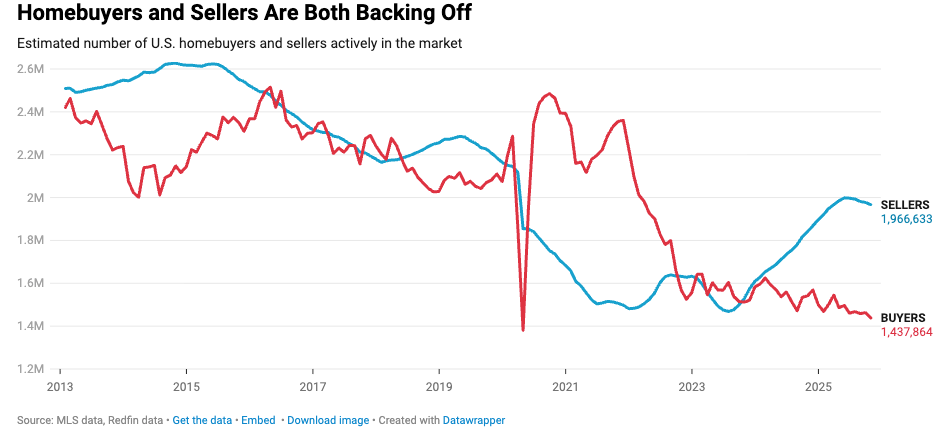
7. Of Waymo, holiday shopping, and the buyer’s market for homes
Moses spreads the good cheer on Waymo.
-Crashes down 70-90%
-Even assuming a 50% reduction in crashes, that will save $500 in medical fees alone (not counting the cost of the loss of the vehicle)
It’s also looking good on Black Friday. Number of shoppers are up, slightly, from the previous high in 2023.
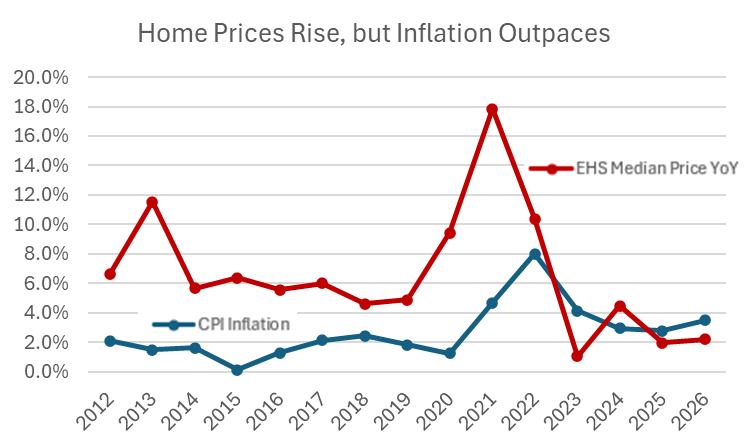
Moses shows a decline in housing prices:
Pretty cool graphs here:
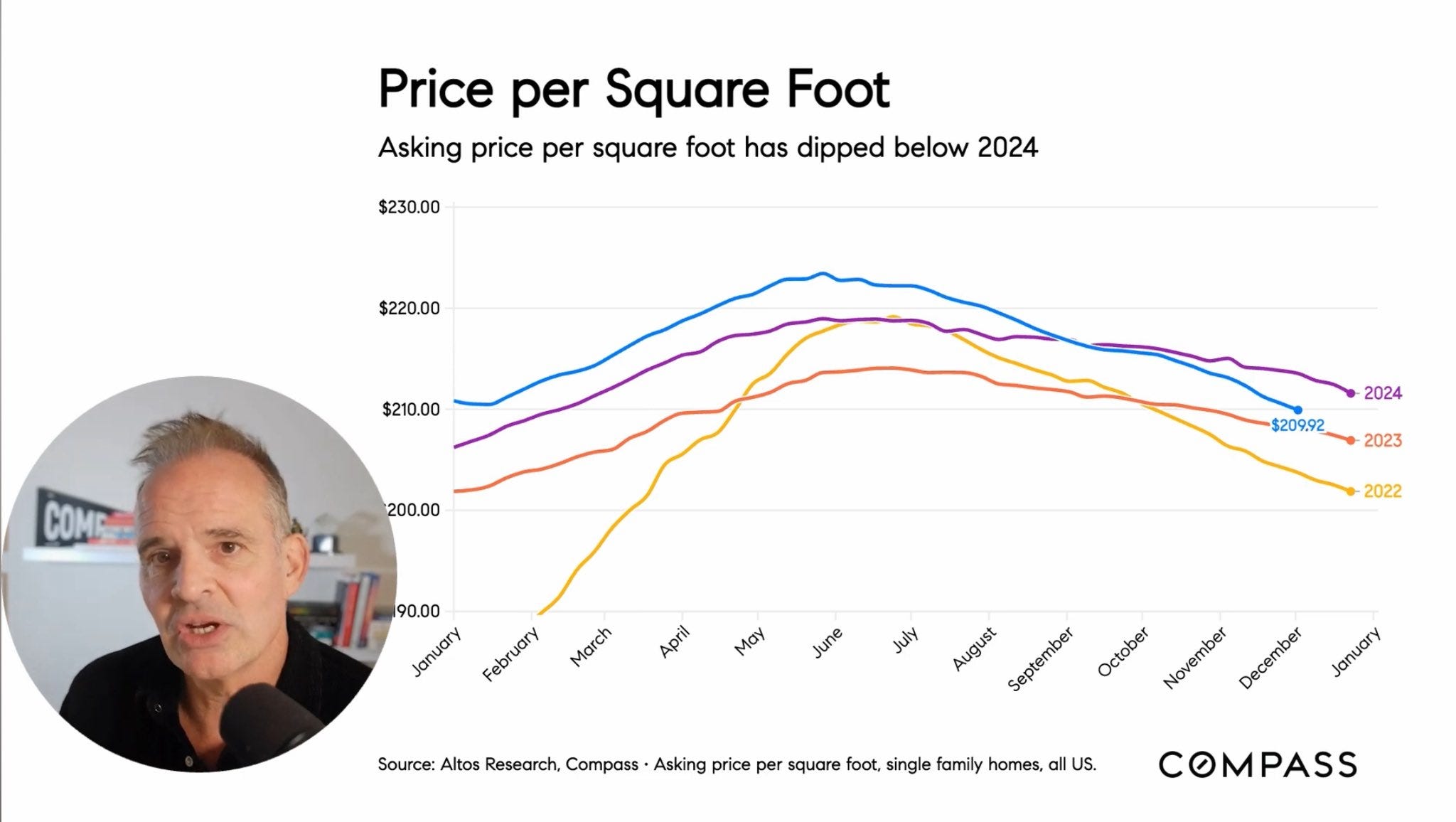
Price per square foot, since October, is officially down:
8. Completed Family Size Will Soon Plummet to Unprecedented Depths
Here is a nice graph:

If you add 16 to the birth year (the lower bound of when women have children), then the “steady period” is from 1966 to 1996. The “radically changing absolute collapse period” is from 1946 to 1965. I’m using 16 rather than 26 because my view is that the cultural factors which increase or decrease fertility are at the height of their influence at age 16, not age 26. That is, women start organizing their lives at age 16. They start thinking about college, or marrying their high school boyfriend. They form dreams and aspirations at that age that last for the rest of their lives. I’m not saying every 16 year old knows exactly what they want to do, but they crystalize the values that then inform the later choices that they make.
Using more data, it looks like the sexual revolution came in the 1860s:

Another thing I would remark is that we can’t blame the baby boom on WWII. It seems to had more to do with the Great Depression:
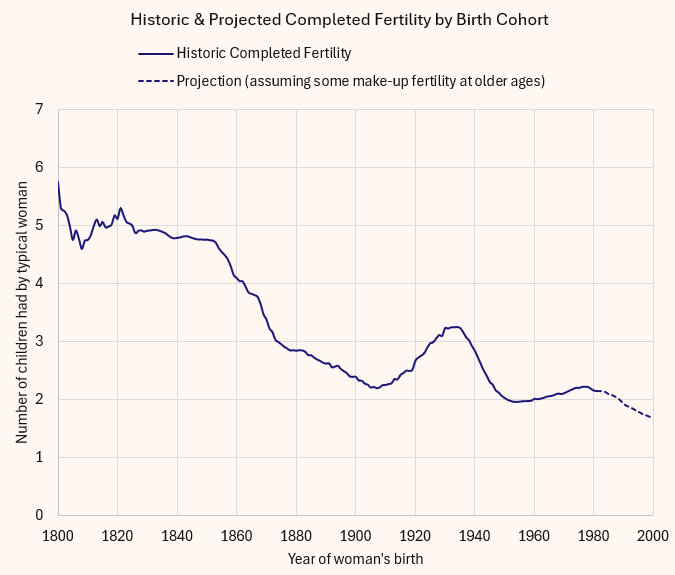
By using the +16 rule, we can see the turn-around comes in 1926, and the peak in 1936. That almost perfectly (plus or minus 3 years) corresponds with the period of the Great Depression.
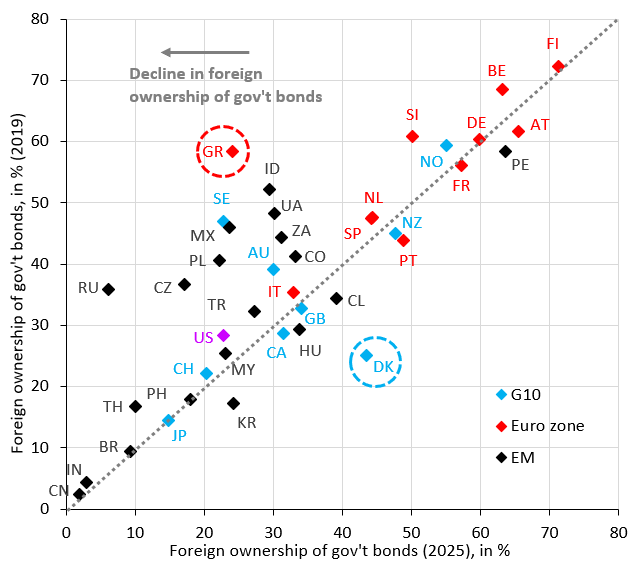
Foreign Ownership of Government Debt
I’m surprised at how moderate the US is here. (highlighted in pink)
I have often wondered why Britain sucks so much. It is, like Canada, Australia, New Zealand, and America, predominantly Anglo in its culture. 70% of British people are of European heritage -- higher than America. London is a huge city. What’s going on?
According to Brian, it’s because of:
“bank forbearance policies, under which struggling firms were kept alive for longer; low interest rates, which allowed companies to refinance debt rather than going broke; or housing policies preventing workers from moving from struggling parts of the country to relatively prosperous ones.”
Basically, the British government needs to rug-pull its unproductive firms, raise interest rates, and cut affordable housing. But British political culture seems unwilling to allow that to happen. Unionist culture seems much stronger there.
I wonder, for example, if the British had lost the world war, and the entire British population had been evacuated to Canada, if that wouldn’t have been a better result. There’s something that went wrong in the British political consciousness. Britain, which resisted socialism and fascism for so long, basically seems to have embraced it after 1939.
9. A Politically Homeless Wish List
I’m trying to read more opposing view points. This is a former Democrat. His issues seem to be:
purple-haired goblin-witches trying to make kids read books on how to blow each other.
Policing speech: Worrying about what words I use... finger-wagging.
Regarding identity characteristics (white, male, straight) as problematic.
Espouse the principles of collective or historical guilt.
I can’t read the rest because it is paywalled.
Is there a difference between “post-left” whining and MAGA propaganda?
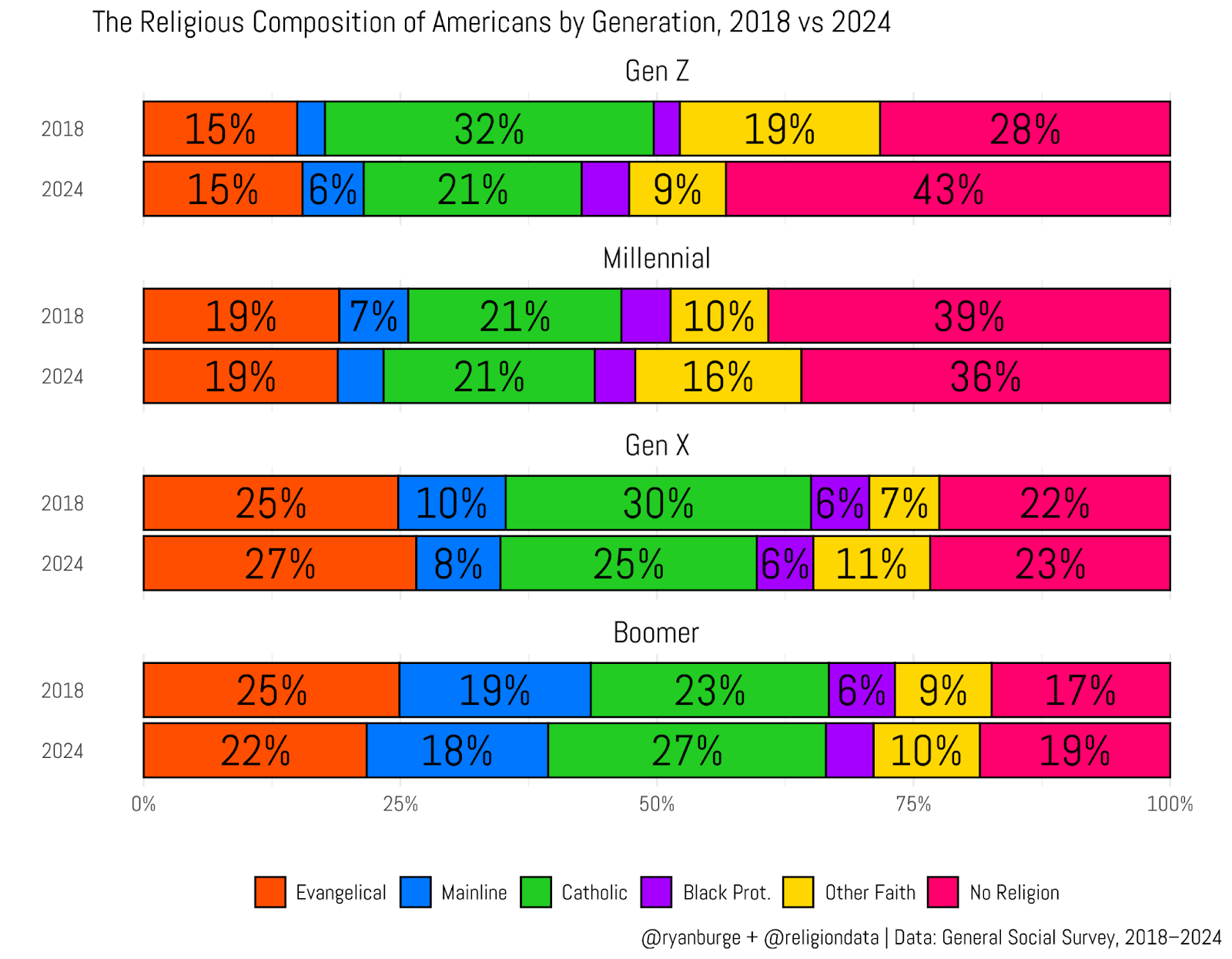
The Slow Grind of Change: What the 2024 GSS Tells Us About American Religion
This post is a kill-shot for anyone claiming that “Gen Z is going back to church.” It’s an absolute massacre. Total heretic victory.
10. The Global Debt Crisis Builds
Robin shows how governments use debt to prevent recessions. This kicks the can down the road. Is it wise? I wonder if, instead of just printing money and giving it to banks, we instead expanded food stamps.
Let’s say that anyone earning under $40k per year was eligible for food stamps. Maybe that would make people fatter, sure, but it seems like a better way to help the poor and lower classes than what we’re currently doing. The other thing that would help would be to fight crime more effectively, since that helps the poor by increasing the desirability of cheap housing.
On education, I have no clue what to do. My preferred solution would to send college grads overseas to work in third world countries in a kind of expanded peace corps. You could also increase testing requirements. But I don’t see either of those happening, so education remains a mess. On healthcare, RandomWalk has been talking about healthcare NIMBYism, which I can’t fully conceptualize yet, but I’m working on it.

That shrimp welfare argument is wild tbh. Using reproduction rates as a proxy for wellbeing seems clever on the surface but totally ignores that evolutionary reward systems aren't about subjective experience. I've wacthed crabs regenerate limbs and keep feeding like nothing happened, so the idea that increased breeding = enjoyment feels like a category error. Stress responses can absolutley trigger reproduction spikes in invertebrates as survival strategy.
Why Britain sucks post-1945; some suggestions (by a Briton)
- Ongoing coldwar military commitments with no empire to pay for it (empire more a drain on resources?)
- End of empire as crisis of identity for governing classes, demoralization only temporarily halted by universal enthusiasm for 'logical' planned economy
- National Health Service combining Stalinist centralism with continuing huge payouts for doctors (bribe)
- Slum dwellers are veterans demanding pensions and decent housing (unlike US where immigrants could benefit from benign neglect)
- Industry didn't need rebuilding, hence reactionary bosses, refractory unions, zombie enterprises
- Marshall Plan aid cancelled out by the above plus war debt repayments to US?
- Lack of interest in EEC followed by panic, joining long after direction was set and on worst possible terms