
empty, perfect love.
Why I am a conspiracy theorist; The Risk of Speculation

Casting out random speculations alienates empiricists, and attracts schizophrenics. This is what Hanania means when he calls me “conspiratorial.
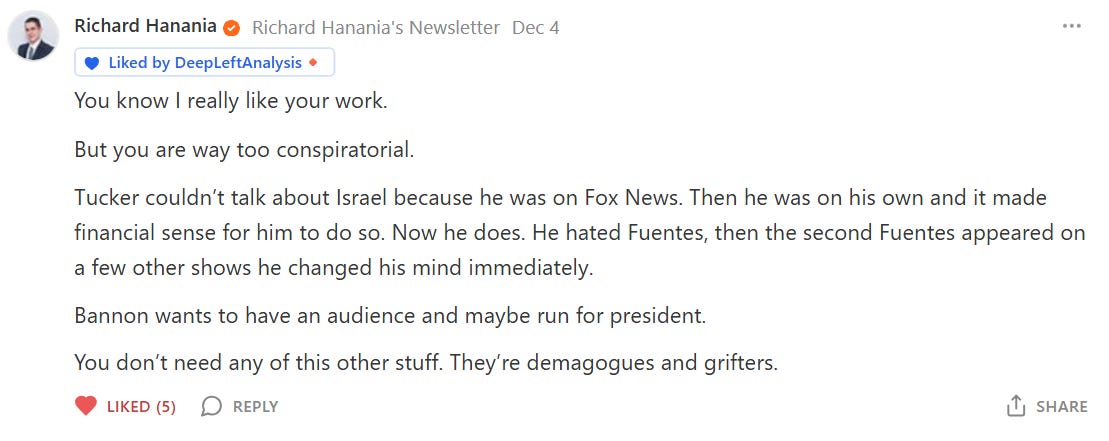
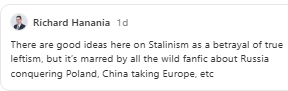
Although I am not claiming that “a shadowy cabal is conspiring against us,” he sees similarities between my assertions and the claims of Candace Owens.
I see Candace as malevolent because her conspiracy theories undermine trust in elites. My speculations have no moral content, and are merely an exercise in geopolitical war-gaming. I see these as positions in a chess game.
However, there is a risk when we turn geopolitics into a form of entertainment, because this biases us towards conclusions that are exciting rather than conclusions which are true. While I consider my speculations to be harmless in their motives, there may be an injury that I do to the pursuit of truth when I speculate.
But I am critical of the pure empiricist. In science, we must formulate a hypothesis in order to test it. The process of generating a hypothesis cannot rely upon empiricism -- it must be derived through creativity and imagination.
AI can iterate the generation of hypotheses and test them at lightning speed, but this generation must come as a result of a prompt, which one might call “the meta-generative regime.” Eventually, choices are made, at one level or another of the fractal. You cannot eliminate creativity, imagination, speculation, or even “hallucination” from the scientific process. Pure empiricism is not just impossible -- it is unscientific. It results in “historicism,” which is the worship of received dogma.
This is also true in politics. A policy which is unimaginative and uncreative, that is “technocratic,” may base itself on the most rigorous empirical data. However, it lacks a myth, and therefore has no soul.
