
Against Utilitarianism
war on the people

Warning: this is a draft. The reason I am releasing it, unfinished, unedited, it because I have cancer. Rather than leave you in a content drought, I’ve decided to release everything, even the bad stuff. Read at your own risk.
Communism is supposedly the most brutal form of government. Gigantic concrete buildings, military parades, bread lines, purges. Could a more brutal form exist?
At 3am, listening to the neon chimes of gambling machines in the Las Vegas airport, I sit and ponder the Aztecs Gods, desiring blood, terrorizing the populace. Yet even this is justified, to prevent famine, to provide rain, to prevent earthquakes. This is the most primitive, spiritual, and violent utilitarianism.
A true aristocracy would transcend this. To tell people openly, “this is not for you. You exist to serve something higher.”
Catholicism demands the abolition of wealth to aid the poor, unites all tribes under one banner, seeks the salvation of souls. But Catholicism also glorifies the church above worldly concerns. People live in huts while the church is golden. The state does not exist to serve the people, but to glorify God.
Can such a state exist today? Communism, democracy, and even fascism, all appeal to the health of the people, the wealth of the people, the happiness of the people.
The people are gullible, waiting to be led, seduced by the state; they seduce the state into seducing them. The only possible exception is in war, where man contends not with seduction, but force.
If a greater species were to dominate us to its will, in order for this alien species to form a state, it must appeal to the general will among its own kind. Small and petty states are bound to the logic of larger states. Only when a state insulates itself against foreign domination does it have the freedom to pursue beauty.
Utility serves the apparent and the obvious — petty crime, prices, stocks. Utility is definite, pragmatic, and realistic. Beauty is outside all this.
A state which bends to the aesthetic sensibility of the masses cannot ever attain visionary or transcendent beauty. Beauty is at war with the common. Beauty is an excess; an absence; a severe exclusion. The gardens of Versailles had no practical purpose.
Aesthetic state must contend, not with the people, but their seducers. The rabble rousers, activists, journalists, humanitarians, demogogues, community organizers, preachers, moralists, and priests.
The state must embrace practical nihilism, or total disregard for pragmatism. Whatever is the basis of the collective “people” must be undermined and subverted. The people is an infinite variety of individuals, each with different interests.
This “divide and conquer” strategy reduces a dangerous mass into a diffuse dust. Anything deviant can become an ally in this cause.
How does the state maintain its security? With what support does the state protect itself? As for the members of the state, under what goals are they constituted?
What does it mean to run the state well, while at the same time, not bowing to whatever traditional concerns have restrained it? In the service of the state, Plato recommends new myths, noble lies -- in other words, religions which are controlled by the state, and therefore more amenable to the freedom of the state.
All of the religious powers which oppose an aesthetic liberty are most concentrated in those elements dedicated to the poor, to the downtrodden, to the suffering, the disabled, the left behind. Against these stands the interests of the middle class, which finds itself as the first mass distinguishable from the lowest of society, yet still in large enough number to oppose this lowest strata.
The terms “middle” and “lower” are entirely relative and unstable. If the lower class is diminished, either physically or morally, then new fractures appear among the middle class. This species then divides itself into “middle” and “lower” again. The perfection of this process would leave only a higher class remaining with any physical or moral value, having discarded the rest.
Can such a process take place? The death penalty against felons is such an expression. In modern times, however, states are global in scope, and must continuously exercise their influence beyond their borders. Accordingly, the diminishment of the lower strata, when aligned with the need for external expansion, results in the policy of exile and emigration. An opposite of this policy would be “brain drain,” the flight of the higher strata.
The opposite concept, that of “brain gain,” with mass immigration in the form of skilled or credentialed labor, poses certain threats to the stability of the state. If the state is truly composed of a small dedicated core seeking the abolition of practical concerns, it can only succeed if it is unopposed and has total dominion over the state. The importation of new elite populations, however practically productive they may be, will dilute and contest this supremacy. Although it seems paradoxical, a Vivek Ramaswamy can invade America, learn the language of populism, and present himself as a defender of the “founding fathers.” The paradox of such a confidence game is lost on the masses. So it was in Rome that Christians from the Levant gradually infiltrated the halls of power and presented themselves as men of the people.
At present, it is not clear that America is governed by an aesthetic core. If the core at present is moralistic, populist, democratic and pragmatic, can that core be dislodged by foreign, hostile elements? Or will this merely replace one group of utilitarians with another?
If an aesthetic core is not present, then replacing a native more core with a foreign moral core is no remedy. The cultivation of an aesthetic core, understood to be idealistic, comes from those who are the least concerned with practical matters, and the most willing to confront force. The Christian martyrs give one example of an elite willing to die for a cause. However, the Christian aesthetic sensibility was in ever sense turned away from the aristocratic Greek ideal, and turned towards the lower strata as the “salt of the earth.”
If Christianity was a deviation from the original aesthetic core of Greek civilization, the question remains, what founded that core? If such a core could be founded in Greece, could it be founded in America? In the case of Greece, the aristocracy was concerned chiefly with the breeding of beauty as a way of life. The story of the spotted sheep in the Bible (Jacob or Isaac) indicates a pastoral preoccupation with the physical health of animals. The Greek laurel, the crown or wreath, symbolized the Greek love of flowers and gardening. Finally, the Olympic games were a chance for the Greeks to compete for the physical health of the human body.
The Greek preoccupation with flowers may have some sort of explanation in the procurement of honey. Pastoralism, on the other hand, was means of sustenance, while physical culture proceeded mostly from warfare. The crucial element here is that of a direct engagement with warfare. In the 21st century, warfare is changing. The firepower of a drone, its maneuverability, its speed, and its cost make it increasing advantageous. While some drones are autonomous, all drones require engineering and software, as well as industrial capacity.
Currently, in a drone war, the ability of China to outproduce America cannot be understated. Is China, therefore, a source of an aesthetic core? The question remains as to whether or not China’s current industrial production is sustainable, or if China is optimizing itself out of existence. China’s aging population is a result of the One Child policy, which is partially responsible for China’s wealth and middle class status. Is the Chinese economic built off genuine technical genius, or is it a result of a Molochian sacrifice of youth?
In comparison, we can ask the opposite question: had India implemented a one child policy, would it reach or exceed the Chinese standard of living? If Chinese economic success is built off low fertility, then it is a strategy which sacrifices the future for the present.
In America, and almost opposite strategy has been taken, of important large numbers of third world populations. It remains to be seen, however, if the importation of third world populations is overall beneficial or detrimental to the economy in the long-run. If immigrants regress to the American mean, this is beneficial. If they regress to the mean of their home countries, the overall effect will be negative. Russia, which is distinct from both America and China, is itself importing mass numbers of central Asian immigrants.
It may be possible that the origination of an aesthetic core has less to do with the individual fortunes of any particular state, and more to do with the international development of a core which is capable of inserting itself into existing states, or replacing those states with new ones. IF this is the case, then it is to the benefit of this aesthetic core to foment global instability of all kinds: food insecurity, war, disease, political and religious conflict, and ethnic conflict. However, the destruction of old states is not in itself sufficient to bring about an aesthetic core, as this task is entirely separate from the process of degradation.
It may be that the aesthetic core of the future is an expert class of technologists. This would correspond to the domestication of the horse and the invention of the chariot. These technologists would be dealing mostly with software, as it applies to AI and also biological research. However, as of now technologists exist as technicians within the framework of a state or corporate structure. Technologists operate in economies of scale and do not have the ability to act independently from states.
The necessity of independence also cannot be fulfilled by a re-settlement or internal colonization project, since this always exists within the framework of a larger state. To truly act outside the state, one must either be a moralist, in league with populism, or something beyond mere a technologist. It is almost inconceivable today that some sort of technology could develop outside the confines of the state.
One possibility is that of genetic engineering. The restrictions on genetic engineering are not necessarily technological, but are rather moral. It remains to be seen as to whether or not such a science can progress without the backing of the state. The development of such technologies outside the purview of the state would be capable of producing a new aesthetic core. In fact, there is no other possibility.
While it remains the case that general global instability is beneficial for an existing aesthetic core, if that core is today not yet arrived, then global instability undermines genetic progress. Another impediment to progress is the regulations of states, which is difficult to overcome. The most effective approach to a regime of regulation is speed -- the speed of progress reduces the risk of regulation.
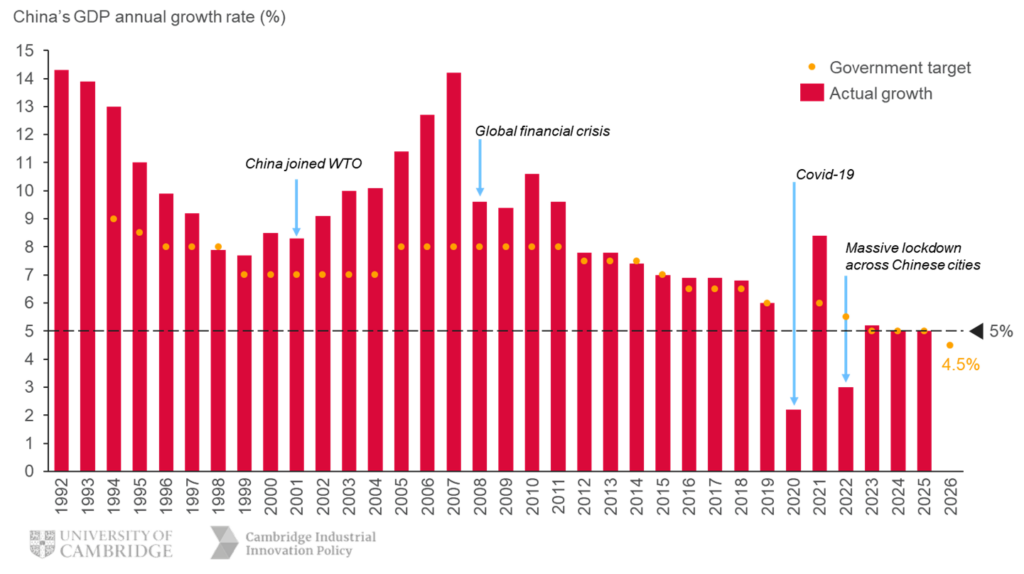
A Chinese economy in decline (since 2006) does not have the ability to be at the cutting edge of science. Furthermore, what does exist of China’s scientific industry is extremely corrupt and largely for show. Global patents continue to be of the greatest significance in America, Europe, and Japan. The success of this alliance will determine the speed of future genetic research.
A state at peace will have less pressure to explore technologies which may threaten its own existence. However, when confronted with external enemies, states may take risks which would be otherwise unthinkable. If China declines as a power, in second defeat in a broader Cold War, the impetus to take risks will also decline. Therefore, the present moment, where China appears to have peaked as a global power, can be exploited as a source of impetus for scientific exploration.